

Which One Should You Actually Reach For?
If you've ever stood over a backed-up floor drain at 11 p.m., wondering whether the cable machine in your van is going to cut it or whether this one needs the jetter, you already know the drain snake vs water jetter debate isn't academic. Pick the wrong tool, and you're either back on the same call in six weeks or explaining to a building owner why their 80-year-old cast iron now leaks at the joints.
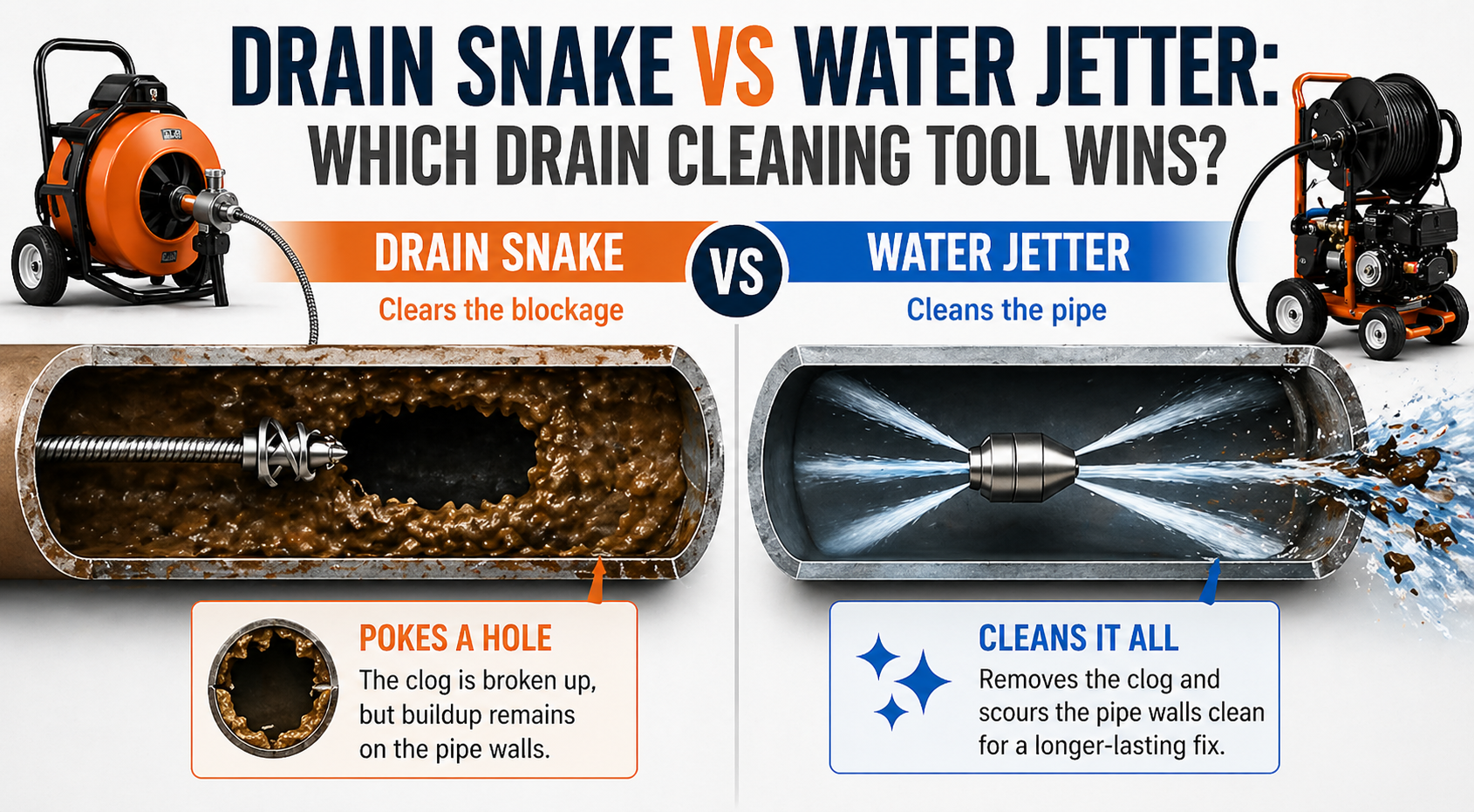
Both tools clear clogs. That's where the similarity ends. A drain snake attacks the blockage mechanically. A water jetter attacks the cause of the blockage, the grease film, scale, and sludge coating the pipe walls with pressurized water.
Understanding which one fits the job comes down to four things: what's in the line, what the line is made of, how long the line is, and how long you want the fix to last.
Here's the breakdown pros actually use when making that call.
How a Drain Snake Works
A drain snake (also called a drain auger or cable machine) is a flexible steel cable with a cutting or grabbing head on the end. You feed the cable into the pipe through a cleanout or fixture, the cable spins, and the head chews through or hooks whatever's in its way.
There are three main tiers:
- Handheld closet augers and small drum machines handle sinks, tubs, and toilets, typically 25 to 50 feet of cable at 1/4" to 3/8" diameter.
- Drum machines scale up to 75–100 feet with 1/2" to 5/8" cable. These are the workhorses for residential mainlines and lateral runs.
- Sectional cable machines and mainline units push 150+ feet through 4" and 6" sewer lines with cable up to 1-1/4".
The snake's strength is mechanical leverage. A spinning cable with a carbide cutter will chop through a wad of wipes, snag a root ball, or fish a lost ring out of a P-trap in a way no jet of water can match.
Its weakness is that it punches a hole through the clog. It doesn't clean the pipe. The grease ring that caused the blockage is still there, just with a tunnel through the middle. Which is why a drain that's been snaked often clogs again within 6–12 months.


How a Water Jetter Works
A water jetter (or hydro jetter, sewer jetter) pumps water through a flexible hose and out a specialized nozzle at pressures typically between 1,500 and 4,000 PSI, though industrial rigs go higher. The nozzle has two sets of jets:
- Forward jets punch through the blockage and pull the hose deeper.
- Rear-facing jets scour the pipe walls clean as the hose travels, and propel the hose forward through their thrust.
The result is a pipe that's not just cleared, but clean stripped back to bare wall. Grease films, soap scum, mineral scale, silt, small roots, and the gunk that causes repeat clogs all get flushed out of the cleanout together.
Jetters come in two broad flavors. Compact electric units (1.5–2 GPM, under 1,500 PSI) handle 1-1/4" to 3" lines — kitchen drains, tub waste arms, small branch lines. Gas-powered trailer or cart-mounted jetters (4+ GPM, 3,000–4,000 PSI) handle 3" to 8"+ mainlines and are the go-to for recurring grease problems, tree roots, and commercial sewer maintenance.
Cleanflow stocks a range of water jetting machines sized for everything from sink-line work up to commercial mainline jobs.

Drain Snake vs Water Jetter: Head-to-Head
Here's how the two stack up across the decisions that actually matter on a job:
| Factor | Drain Snake | Water Jetter |
|---|---|---|
| Best for | Isolated clogs, foreign objects, hard blockages | Grease, scale, sludge, recurring clogs |
| Tree roots | Cuts them, but regrowth is fast | Cuts + flushes roots out entirely |
| Grease buildup | Pokes through; grease returns | Strips pipe walls; long-lasting |
| Pipe size range | 1-1/4" to 10" with right machine | 1-1/4" to 10"+ depending on unit |
| Line length reach | Up to ~200 ft with sectional machines | 200–500+ ft depending on hose |
| Risk to fragile pipes | Can crack old clay, Orangeburg, or brittle cast iron if forced | Can also damage compromised pipe — camera inspect first |
| Retrieves objects | Yes (hooks, grabs) | No |
| Initial cost | Lower | Higher |
| Cost per job (pro pricing) | Roughly $50–$300 residential | Roughly $300–$800 residential |
| Cleans pipe walls | No | Yes |
| Typical result longevity | Months | 1–3+ years for same line |
The table makes the tradeoff obvious: a snake is cheaper, simpler, and better for mechanical obstructions. A jetter is more expensive, more powerful, and actually cleans the line.
When to Choose a Drain Snake
Pick a cable machine when:
- You're dealing with a specific, localized object. A toy in a toilet trap, a wad of wipes 20 feet down the main, roots in a specific joint. The mechanical grab of a snake wins here every time.
- The pipe is old or fragile. Pre-1960 homes often have clay, Orangeburg, or early cast iron that can't take 3,000 PSI without cracking or separating at joints. A properly sized cable is gentler.
- It's a small-diameter line with tight bends. Bathroom sinks, tub drains, and urinal arms are often better served by a handheld auger or small closet and canister auger than a jetter hose.
- You need to retrieve, not destroy. Dropped jewelry, a dentist's crown, a contractor's dropped chuck key — a jetter just pushes these deeper. A snake with a grabbing head brings them back.
- Budget or access is limited. No water source on-site, no power for a larger jetter, or the customer just wants the clog cleared for the cheapest fix possible.
When to Choose a Water Jetter
Reach for the jetter when:
- The clog keeps coming back. If you've snaked the same kitchen line three times in 18 months, the problem isn't the clog. It's the grease ring you keep punching through. A jetter removes it.
- It's a grease, fat, or soap scum buildup. Commercial kitchens, apartment stacks, and restaurant mainlines live and die on jetting. No cable machine will ever match what 3,500 PSI does to a hardened grease ring.
- You need to clear roots AND flush them out. A snake cuts roots; the cuttings often get wedged further down. A jetter cuts and carries the debris out.
- The line is long, and the blockage is deep. 200 feet of cable gets heavy and hard to push. Jetter hose, self-propelled by its own rear jets, travels long runs more easily.
- You want a preventive clean, not just a reactive one. Scheduled jetting on a restaurant's main system every 6–12 months is cheap insurance against an emergency shutdown.
One important note: don't jet a pipe blind. Run a camera inspection first on any older line. Cleanflow carries Forbest sewer cameras specifically for this. If the pipe is bellied, cracked, separated, or partially collapsed, high-pressure water can turn a maintenance job into a pipe replacement very quickly.
The Combo Approach (What Most Pros Actually Do)
Here's the honest answer most blog posts skip: experienced drain pros don't pick one tool. They use both in sequence.
- Snake first to knock a hole through the clog and restore flow. This also tells you what you're dealing with — roots, grease, wipes, or something harder.
- Camera second to inspect the pipe condition and locate the problem zone.
- Jet third to scour the line, remove the root cause, and leave it genuinely clean.

For pipes with heavy scale or rust buildup (old galvanized, descaled cast iron), a third tool enters the picture: a high-speed flex shaft machine. These spin carbide chains at 2,000+ RPM to grind scale off pipe walls in a way neither a cable nor a jetter quite manages. They shine on descaling work where a jetter would just glance off hardened deposits.
Cleanflow stocks flexible shaft drain cleaners for exactly this kind of descaling job.
What About Pipe Size and PSI?
A common mistake is matching the machine to the clog instead of to the pipe. Some quick rules:
- 1-1/4" to 2" lines (sinks, tubs, laundry): handheld auger or compact electric jetter, 1,500 PSI max.
- 2" to 3" lines (kitchen, branch lines): drum machine with 3/8"–1/2" cable, or mid-size jetter at 1,500–3,000 PSI.
- 3" to 4" lines (residential mains): sectional or drum machine with 5/8" cable, or 4 GPM jetter at 3,000–4,000 PSI.
- 4" to 6"+ lines (commercial mains, laterals): mainline cable machine with 3/4"–1-1/4" cable, or 8–18 GPM trailer jetter.
Over-pressuring a small line blows out traps and joints. Under-pressuring a big line wastes the trip. Match the equipment to the pipe first, then to the blockage.
Pros, Don't Forget the Rest of the Toolkit
Drain cleaning is an equipment-heavy trade, and the machine is only half the job. A proper setup also includes the right sink machines for smaller branch work, replacement cable, cutter heads matched to the clog type, and brand-matched parts to keep everything running.
Cleanflow stocks drain cleaning equipment from several trusted brands, including General Pipe Cleaners for drum machines, water jetters, flex shaft units, sink machines, and closet augers, plus Forbest for sewer and drain inspection cameras, and additional brands across the broader pipe tools, pressure washers, and pipe inspection categories.
Drain Snake vs Water Jetter: The Bottom Line
If you only take one thing from the drain snake vs water jetter question: a snake clears the clog, a jetter clears the cause. For a one-off blockage on a fragile or small line, snake it. For grease, scale, recurring clogs, long runs, or commercial maintenance, jet it. For most real-world jobs, the right answer is both, used in the right order, backed up by a camera so you're not working blind.
The cost of the wrong tool isn't just the callback. It's the customer who stops calling you because the drain backs up again in a month and calls the next guy with a jetter instead.
Drain Cleaning Supplies Shipped Across Canada and the USA
Whether you're comparing drain snakes and water jetters for your first drain cleaning rig or adding a dedicated jetter to an existing truck, Cleanflow supplies the full range: drum machines, sink machines, closet augers, flexible shaft drain cleaners, water jetting machines, sewer inspection cameras, cable, cutter heads, and the parts and consumables that keep them all running.
We carry trusted brands including General Pipe Cleaners, Forbest, and more, and ship drain cleaning supplies and equipment right across Canada and the USA.
Is hydro jetting better than snaking?
Not always. It depends on the job. Hydro jetting is better for grease, scale, long runs, and recurring clogs because it cleans the pipe walls instead of just punching through the blockage. Snaking is better for isolated clogs, foreign objects, and fragile old piping that can't handle high pressure. Most professionals use both in sequence.
Can a water jetter damage pipes?
Yes, if used on compromised piping. High pressure can separate joints, crack clay or Orangeburg, and worsen existing bellies or cracks. Always run a camera inspection on older lines before jetting, and match PSI and GPM to the pipe size and condition.
Will a drain snake work on tree roots?
It'll cut them, but it won't remove them. Root cuttings often wedge further down the line, and the remaining root structure regrows quickly. A jetter cuts the roots and flushes them out of the pipe, which is why pros prefer jetting for root intrusions followed by a root-killing foam for longer-term control.
How much PSI does a drain jetter need?
Small branch lines (1-1/4" to 2"): 1,500 PSI and 1.5–2 GPM is plenty. Residential mainlines (3"–4"): 3,000–4,000 PSI at 4 GPM. Commercial mainlines and long sewer runs: 3,000–4,000 PSI at 8–18 GPM. GPM (gallons per minute) matters as much as PSI. It's what actually moves debris out of the pipe.
What's the difference between a drum machine and a sectional machine?
A drum machine holds the entire cable coiled inside a rotating drum, easier to transport, cleaner to operate, great for residential work up to 100 ft. A sectional machine uses individual cable segments that you couple together as you feed the line faster to deploy for long mainline runs, and are easier to repair on-site, but heavier and messier to handle.
Should homeowners buy a water jetter?
Usually no. The learning curve, pressure risks to older plumbing, and price point don't pencil out for occasional home use. A basic drum machine or handheld auger is more practical. Jetters make sense for plumbing contractors, restoration pros, facility maintenance teams, and property managers with recurring drain volume.