

Categories
- Shop All (4453)
-
-
- Hi-Vis Chainsaw Safety (14)
- Hi-Vis Coveralls and Overalls (11)
- Hi-Vis Hoodies and Shirts (30)
- Hi-Vis Jackets (34)
- Hi-Vis Pants (15)
- Hi-Vis Rain Wear (29)
- Hi-Vis Vests (43)
- Winter Hi-Vis Bombers and Parkas (19)
- Winter Hi-Vis Coveralls and Overalls (17)
- Winter Hi-Vis Hoodies (3)
- Winter Hi-Vis Pants (3)
- Winter Hi-Vis Vests (5)
-
-
-
-
- Brooms (3)
- Dust Mops (0)
- Dust Pans and Brushes (5)
- Flow Thru Tools (2)
- Microfiber Mops (0)
- Pool and Tank Tools (2)
- Scrubbers and Scrapers (1)
- Soap and Sanitizer Dispensers (0)
- Sprayers (0)
- Squeegees (1)
- Toilet Brushes and Plungers (3)
- Trash Cans & Bags (7)
- Wet Floor Signs (0)
- Wet Mops and Buckets (4)
-
- Bars and Prying Tools (21)
- Bolt Cutters and Shears (16)
- Chisels and Punches (9)
- Combination Hand Tool Sets (12)
- Extractors (13)
- Files (6)
- Gear Pullers (0)
- Hammers and Mallets (9)
- Hand Saws (8)
- Hex Keys (10)
- Layout and Distance Lasers (1)
- Marking Tools (0)
- Measuring Tools (9)
- Pliers (51)
- Precision Measuring and Testing Tools (24)
- Propane Torches (5)
- Screwdrivers and Nutdrivers (9)
- Sockets (65)
- Tap and Die Sets (11)
- Tool Boxes (26)
- Utility Knives (7)
- VDE Tools (6)
- Wire Cutters and Strippers (14)
- Wrenches (22)
-
- Beveling and Deburring (16)
- Curb and Valve Keys (20)
- Drilling and Tapping (13)
- Extended Impact Sockets (3)
- Flaring and Rerounding (5)
- General Pipe Working Tools (15)
- Guillotine Pipe Cutters (2)
- Hydrostatic Test Pumps (14)
- Internal Pipe Cutters (6)
- Manhole Testing (4)
- PE Peelers (9)
- Pipe Reamers (4)
- Pipe Threading (15)
- Pipe Wrenches (24)
- Plastic Pipe Joint Kits (4)
- Plastic Pipe Saws (5)
- Power Drive (13)
- Quick Release Cutters (13)
- Ratchet Shears (9)
- Ratcheting Wrenches (12)
- Rotary Cutters (3)
- Shut Off Tools (8)
- Soldering Torches (3)
- Vises (7)
-
- Angle Grinders (6)
- Batteries and Chargers (18)
- Bench Grinders (7)
- Circular Saws (3)
- Combo Tool Kits (10)
- Cordless Fans (6)
- Cordless Lighting (15)
- Cut Off Saws (4)
- Drills and Drivers (8)
- Grease Guns (3)
- Impact Drivers (6)
- Jobsite Radios and Speakers (8)
- Lifestyle (6)
- Mitre Saws (1)
- Reciprocating Saws (4)
-
- Angle Grinder Wheels and Brushes (21)
- Bench Grinder Wheels (6)
- Circular Saw Blades (11)
- Drill and Driver Bits (22)
- High Speed Gas Saw Blades (3)
- Holesaws (11)
- Impact Sockets (25)
- Jig Saw Blades (2)
- Oscillating Multi Tool Blades (1)
- Portable Chop Saw Blades (4)
- Power Tool Storage (5)
- Reciprocating Saw Blades (8)
-
-
-
-
- Air Fresheners (1)
- All Purpose Cleaners (22)
- Bowl and Washroom (9)
- Coffee and Breakroom (20)
- Degreasers (3)
- Dishwashing (4)
- Disinfectants and Sanitizers (1)
- Drain Openers (9)
- Hand Cleaners (4)
- Laundry Cleaners (6)
- Paper Products and Wiper Rags (17)
- Scale Removers (4)
- Urinal Pucks and Liquids (6)
- Wet Wipes (3)
-
-
- Ball Valves (10)
- Black and Galvanized Steel Fittings (0)
- Bronze Pipe Fittings and Nipples (13)
- Butterfly Valves (3)
- Check Valves (17)
- Flexible Connectors (4)
- Gate and Globe Valves (3)
- Knife Gate Valves (9)
- Pipe Fitting Accessories (4)
- Schedule 80 PVC Fittings (27)
- Stainless Steel Fittings and Valves (23)
- Victaulic Grooved Fittings (22)
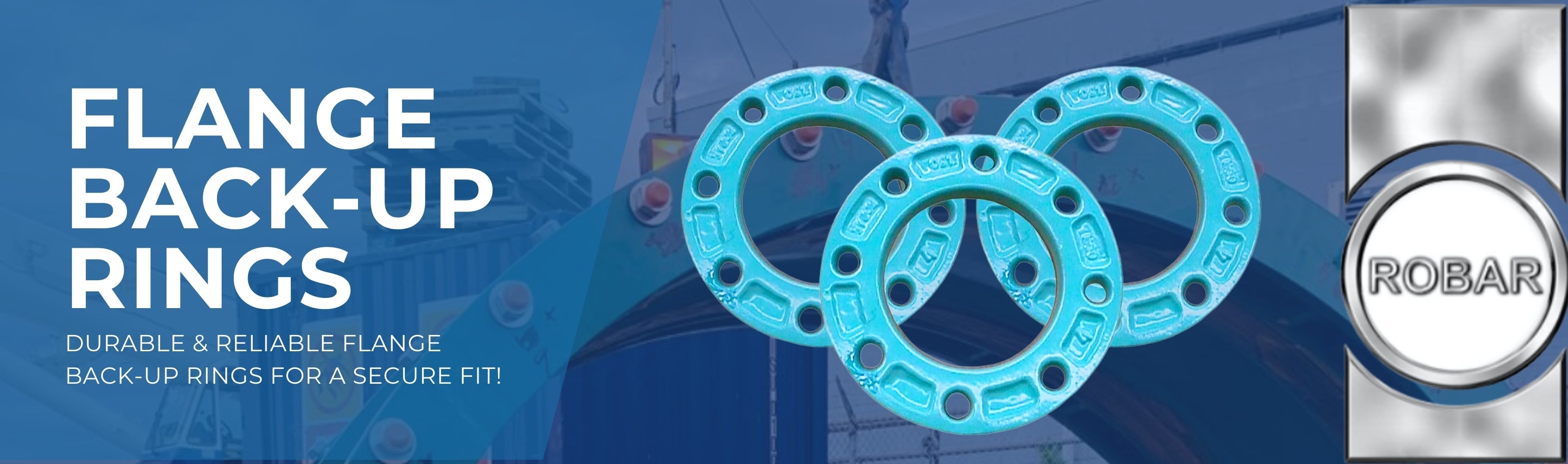

Robar Flange Back-Up Rings
1 product
Showing 1 - 1 of 1 product


Ductile Iron & Epoxy-Coated Backing Ring Flanges for FRP, Fiberglass, and Corrosion-Resistant Piping Systems
Robar flange back-up rings provide structural support for flanged connections on fiberglass reinforced pipe (FRP) and other non-metallic piping systems. These ductile iron backing ring flanges sit behind the pipe’s flange stub, distributing bolt load evenly across the joint to prevent cracking, gasket extrusion, and deformation under pressure.
As a Canadian distributor of Robar Industries products, we carry Robar’s line of epoxy-coated, cast ductile iron back-up flanges engineered to conform to ASA B16.5 with a 150-pound bolt pattern. These backing rings are rated for working pressures of 150 PSI and ship from our Canadian warehouse to locations across Canada and the USA.
Why Choose Robar Flange Back-Up Rings
Robar Industries has manufactured waterworks fittings in British Columbia since 1958. Their flange back-up rings are built to the same standard of durability that utility professionals expect across the full Robar product line.
- Heavy-duty construction: Cast ductile iron body per ASTM A536 for high mechanical strength and impact resistance
- Corrosion-resistant coating: Fusion-bonded epoxy coating per AWWA C-213 protects against corrosion in buried, submerged, and chemically aggressive environments
- Industry-standard bolt pattern: Conforms to ASA B16.5 with a 150-pound bolt pattern, compatible with standard flanged components across industrial and municipal piping systems
- 150 PSI working pressure: Rated for working pressures up to 150 PSI when installed per Robar’s specifications
How a Backing Ring Flange Works
Non-metallic pipes like FRP cannot be drilled for bolt holes or threaded directly to a steel flange. The material would crack under bolt-load stress. A backing ring flange solves this by acting as the structural bridge between the pipe and the mating flange.
The process works in three steps:
- The FRP pipe is formed with a flange stub and a flat lip at the pipe end that cannot support clamping force on its own
- The ductile iron backing ring slides behind the stub, sitting flush against it and providing a rigid surface with pre-drilled bolt holes
- Bolts pass through the backing ring and into the mating steel flange, compressing a gasket between the two faces to form a leak-free sealed joint
The backing ring absorbs all the bolt-load stress, while the FRP stub and gasket handle the sealing. This allows non-metallic pipe to connect directly to valves, pumps, and metallic piping without welding, threading, or adhesives.
The Robar 9500 Epoxy Coated Cast Ductile Back-Up Flange Rings [INTERNAL LINK: product page] are built exactly for this purpose, a cast ductile iron backing ring with fusion-bonded epoxy coating, available from 1” to 30” nominal pipe sizes.


Robar flange back-up rings are used wherever non-metallic pipe requires a bolted flanged connection to metallic components such as valves, pumps, or steel piping. Common applications include:
- FRP (fiberglass reinforced pipe) coupling
- Corrosive chemical transfer lines
- Water and wastewater treatment facilities
- Industrial process piping
- Pulp and paper manufacturing
- Chemical processing plants
- Mining and mineral processing
- Power generation cooling systems
- Desalination plants
- Pharmaceutical and food-grade piping systems
- Marine and offshore piping
- Acid and caustic handling systems
When Do You Need a Backing Ring Flange?
A backing ring flange is required whenever you need to create a bolted flanged connection on non-metallic pipe that cannot be welded or threaded directly to a standard steel flange.
In FRP piping systems, the pipe wall is too brittle to machine threads or sustain bolt-hole stress on its own. The ductile iron backing ring sits behind the FRP flange stub, distributes bolt load evenly across the joint, and prevents cracking or deformation under pressure.
Back-up flanges are most commonly specified on corrosive chemical lines applications, where FRP pipe is chosen specifically because metallic pipe would corrode. The epoxy coating on the ring provides an additional layer of corrosion protection, extending service life in aggressive chemical environments.
Order Robar Flange Back-Up Rings Online from Cleanflow
Cleanflow is an authorized Canadian distributor of Robar Industries waterworks products. Shop Robar flange back-up rings online with fast shipping across Canada and the USA. All products ship from our Winnipeg warehouse.
Frequently Asked Questions
What are flange back-up rings used for?
Flange back-up rings support bolted flanged connections on non-metallic pipe, such as FRP. They distribute bolt load evenly behind the flange stub, preventing cracking and gasket extrusion under pressure.
What materials are Robar flange back-up rings made from?
Robar back-up rings are cast from ductile iron per ASTM A536 and finished with a fusion-bonded epoxy coating per AWWA C-213 for corrosion protection in chemical environments.
Can flange back-up rings be used with HDPE pipe?
Not all backup rings are compatible with HDPE. Some Robar models are designed specifically for FRP pipe coupling. Always verify the product datasheet to confirm HDPE suitability before ordering.
What flange standard do Robar back-up rings conform to?
Robar flange back-up rings conform to ASA B16.5 with a 150-pound bolt pattern, making them compatible with standard flanged components in industrial and municipal piping systems.
How do I select the correct backing ring flange size?
Match the ring’s nominal diameter to your pipe size. Verify the ID, OD, bolt-hole diameter, and number of bolt holes against your mating flange using the manufacturer’s dimension chart.
Are flange back-up rings reusable after disassembly?
Metal back-up rings can often be reused if undamaged. Inspect the ring and epoxy coating for wear, deformation, or corrosion before reinstallation. Replace if the sealing surface is compromised.