

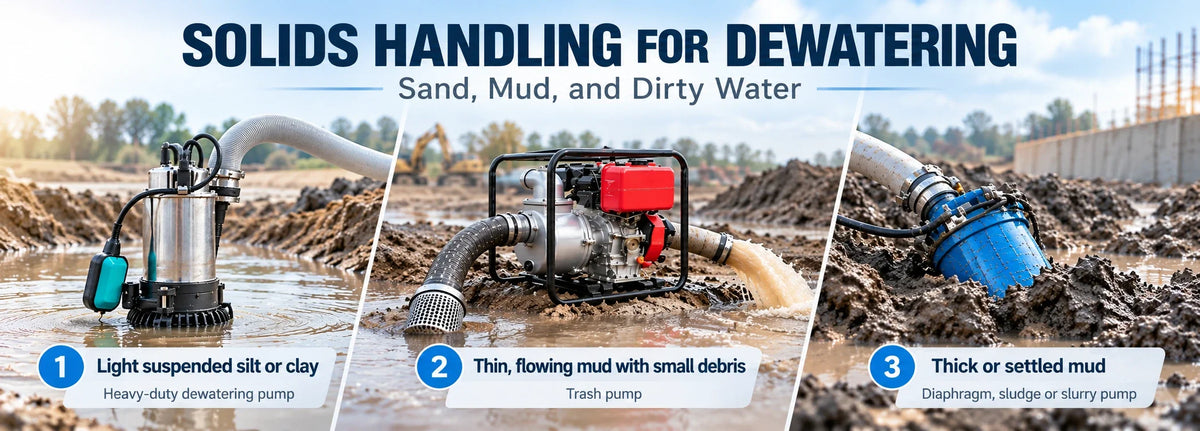
Water on a construction site is rarely clean. It often carries sand, silt, clay, gravel, leaves, or other debris. But choosing a pump based only on how dirty the water looks can lead to clogs, rapid wear, and poor performance.
The right pump depends on four things: the size of the solids, how much material is present, whether it is abrasive, and whether it settles. A pump that can pass a one-inch object may still wear quickly in fine sand. And a pump that works in silty water may struggle with thick, settled mud.
Here’s how to match the pump to the actual water condition.
Solids Handling Is More Than Particle Size
A pump’s published solids-handling rating usually describes the largest spherical solid that can pass through its internal passages. That matters, but it does not answer every question.
Before choosing a pump, consider:
- Particle size: Are you dealing with fine silt, coarse sand, gravel, or larger debris?
- Solids concentration: Is the water slightly cloudy or carrying a heavy load of material?
- Abrasiveness: Are the particles soft, or do they feel gritty?
- Shape: Are the solids round, sharp, stringy, or irregular?
- Settling rate: Do they remain suspended or quickly collect at the bottom?
- Fluid consistency: Does the mixture still flow like water, or has it become thick mud?
These details identify the real risk: clogging, abrasion, settling, or motor overload.
Sand, Mud and Dirty Water Create Different Problems
“Dirty water” is a broad description. Sand, mud, and larger debris behave differently inside a pump.

These are starting points. Always compare the water condition with the manufacturer’s published limits.
Can a Dewatering Pump Handle Sand?
Some dewatering pumps can handle sandy water, but not every dewatering pump is built for continuous sand exposure.
Fine sand may pass through the intake without causing an immediate clog. But as it travels through the pump, it can scour the impeller, volute, wear plate, and mechanical seals. The damage usually appears gradually.
Common signs of abrasive wear include:
- Flow falling even though the hose is clear
- The pump taking longer to lower the water level
- Increasing vibration or noise
- Worn impeller edges
- Enlarged internal clearances
- Seal leakage or contaminated seal oil
A pump used occasionally in lightly sandy water faces a different duty than one operating every day in an excavation cut through sand.
For water with light silt or limited sand, a model such as the HCP A-21 submersible dewatering pump may be suitable when the material remains within its published 3/8-inch solids limit. It uses a vortex-style open impeller, a bottom strainer, and a silicon-carbide lower mechanical seal.
But a solids rating alone does not guarantee suitability for continuous, high-concentration sand. Check the wet-end materials, seal protection, and allowable applications before assigning any pump to long-term abrasive service.
What Type of Pump Works for Muddy Water?
The answer depends on whether the mud is suspended, settled, or thick enough to stop behaving like water.
Light, Suspended Mud
A heavy-duty submersible dewatering pump may work when the mixture is mostly water carrying fine clay or silt.
Choose a model with:
- An open, semi-open or vortex impeller
- A suitable solids-passage rating
- Protected mechanical seals
- Replaceable wear components where available
- Thermal motor protection
- A strainer that excludes oversized material
Browse HCP submersible dewatering pumps to compare published flow, head, and solids-handling specifications.
Thin Mud With Small Debris
A submersible or engine-driven trash pump is often a better fit when the water contains small rocks, leaves, or clumps that could clog a regular drainage pump.
Trash pumps use wider internal passages to move larger material. Some also use vortex impellers that reduce direct contact between the impeller vanes and the solids.
For example, the Multiquip ST2040T submersible trash pump is rated for solids up to one inch. It uses a cast-iron vortex impeller with a neoprene overlay and is intended for debris-laden water.
For more help deciding when this pump type makes sense, read When You Need a Dewatering Trash Pump.
Thick or Settled Mud
Thick mud can overload a centrifugal pump even when its individual particles are small. The mixture is heavier and harder to move, and solids may settle around the intake.
A diaphragm trash pump is worth considering for:
- Thick mud or sludge
- High solids content
- Intermittent inflow
- Shallow water mixed with muck
- Conditions where dry running is possible
- Material that does not flow freely into a centrifugal pump
Diaphragm pumps generally move less water than comparable centrifugal trash pumps, but they can handle thicker mixtures and unpredictable water levels more effectively.

Solids Passage Does Not Equal Wear Resistance
This is the most important distinction in dirty-water pump selection.
A large solids passage helps prevent clogging. It does not automatically protect the pump against abrasion.
Consider two jobs:
- Water contains a few one-inch leaves and soft pieces of wood.
- Water contains millions of fine, sharp sand grains.
The first job needs enough open passage to avoid blockage. The second may require hardened or replaceable components even though every sand grain is much smaller.
Look beyond the maximum solids size and check for:
- High-chrome or abrasion-resistant impellers
- Urethane or rubber wear components
- Replaceable wear plates
- Silicon-carbide mechanical seal faces
- Additional seal protection
- Hardened volutes or casings
- Agitators for settled material
Tsurumi’s HS Series, for example, combines a shaft-mounted agitator, urethane semi-vortex impeller, and V-ring seal protection for water containing sand, solids, and debris.
An agitator helps place settled material into suspension so it can enter the pump. But it does not make a pump suitable for unlimited solids. The resulting mixture must remain within the pump’s density, particle-size, and performance limits.
Keep the Pump Off Loose Sand and Mud
Even the right pump can fail early if it is placed badly.
Do not drop a standard dewatering pump directly onto loose sand, silt, or clay. As the pump removes water, it may bury itself, block its intake, or pull in a concentrated rush of abrasive material.
Use one of these approaches:
- Place the pump on a stable plank or platform.
- Set it inside a perforated basket or screened container.
- Suspend it slightly above the bottom with an approved lifting chain.
- Create a sump where heavier material can settle away from the intake.
- Use an intake strainer suited to the expected debris.
- Never lift or suspend a submersible pump by its power cable.
Keeping the intake above the settled layer can greatly reduce unnecessary wear. If the project must remove the settled material too, use a pump designed for that duty rather than forcing a drainage pump to act as a slurry pump.

Do Not Ignore Flow and Total Dynamic Head
Solids handling is only one part of pump selection. The pump must still deliver the required flow at the site’s total dynamic head.
Total dynamic head includes:
- Vertical lift
- Discharge-hose friction
- Fittings, bends, and valves
- Required pressure at the discharge point
Mud and solids can increase resistance beyond what a clean-water estimate suggests. Long hoses, small hose diameters, and sharp bends make the problem worse.
Check the performance curve rather than relying on the pump’s maximum GPM. Maximum flow is normally measured under low-head conditions and does not represent every jobsite setup.
For larger sites without dependable electrical power, compare gas engine trash pumps. For longer runtimes and high-volume professional work, diesel engine trash pumps may provide a more suitable setup.
Protect the Pump During and After Operation
A few operating habits can prevent expensive damage.
During Operation
- Watch the discharge for sudden surging or reduced flow.
- Clear leaves and oversized debris from the strainer.
- Make sure the hose is not kinked, crushed, or sharply bent.
- Check that the pump remains upright and above loose sediment.
- Monitor motor amperage where possible.
- Stop the pump if it develops unusual vibration, grinding, or seal leakage.
A sudden loss of flow usually points to a blockage, air entry, or hose problem. A gradual decline over several jobs is more consistent with abrasive wear.
After Pumping
Flush the casing, impeller area, and hose with clean water after pumping mud, sand, or silt. If sediment dries inside the pump, it can restrict the impeller or damage seals during the next start.
Also inspect:
- The inlet screen
- Impeller clearances
- Wear plates
- Mechanical seals
- Hose interiors
- Couplings and gaskets
- Power cables and strain relief
Follow the model’s manual for inspection intervals and safe disassembly.
Handle Sediment-Laden Discharge Responsibly
Pumping the excavation dry does not make the sediment disappear. Releasing muddy water directly into a storm drain, ditch, stream, or lake may create erosion and water-quality problems.
Depending on the site and local requirements, the discharge may need to pass through:
- A settling tank
- A sediment bag
- A filter sock
- A vegetated area
- A temporary sediment basin
- Other approved treatment equipment
Protect the outlet from erosion and confirm the applicable provincial, municipal, and project requirements before pumping. Requirements vary by location, receiving environment, and water condition. British Columbia’s guidance for work around water provides examples of sediment and erosion controls, but the rules for the actual project location still apply.
How to Choose the Right Pump
Before selecting a pump for sand, mud, or dirty water, answer these questions:
- What is the largest material that may enter the pump?
- Is the material soft, abrasive, fibrous, or sharp?
- Is the water lightly cloudy or carrying a heavy solids load?
- Do the solids settle quickly?
- Does the mixture still flow easily?
- Must the pump remove only the water or the settled material too?
- What flow is required at the actual total dynamic head?
- Is electrical power available?
- Can the pump be kept above the loose bottom?
- How will the sediment-laden discharge be managed?
If any of these details are unknown, inspect or sample the water before choosing a model. A short site review is usually less expensive than repairing the wrong pump.
Find the Right Pump for the Water You Have
Do not select a pump just because the water looks dirty or because the discharge connection fits your hose. Identify the solids, determine whether clogging or abrasion is the greater risk, and then check the performance curve.
Cleanflow Utility Supply Company carries dewatering, trash, and diaphragm pumps for construction, utility, flood response, and industrial work. If the water condition is difficult to classify, contact Cleanflow with the required flow, total head, power supply, and a description or photo of the material. The team can help narrow down the appropriate pump type and model.
Frequently Asked Questions
Can a regular dewatering pump handle sand?
It may handle a small amount of fine sand if the manufacturer permits it. Continuous or concentrated sand exposure can rapidly wear a pump that lacks abrasion-resistant components and protected seals.
What is the best pump for thick mud?
A diaphragm, sludge, or slurry pump is usually a better starting point than a standard dewatering pump. The final choice depends on viscosity, solids concentration, particle size, required flow, and discharge head.
Should a submersible pump sit directly on the bottom?
Not on loose sand, silt, or clay. Place it on a stable base or suspend it slightly above the settled material unless the pump is specifically designed to agitate and remove those solids.
What specifications matter most for dirty water?
Check maximum solids passage, acceptable solids concentration, wet-end materials, impeller design, seal protection, flow at the required head, and the manufacturer’s permitted applications.