

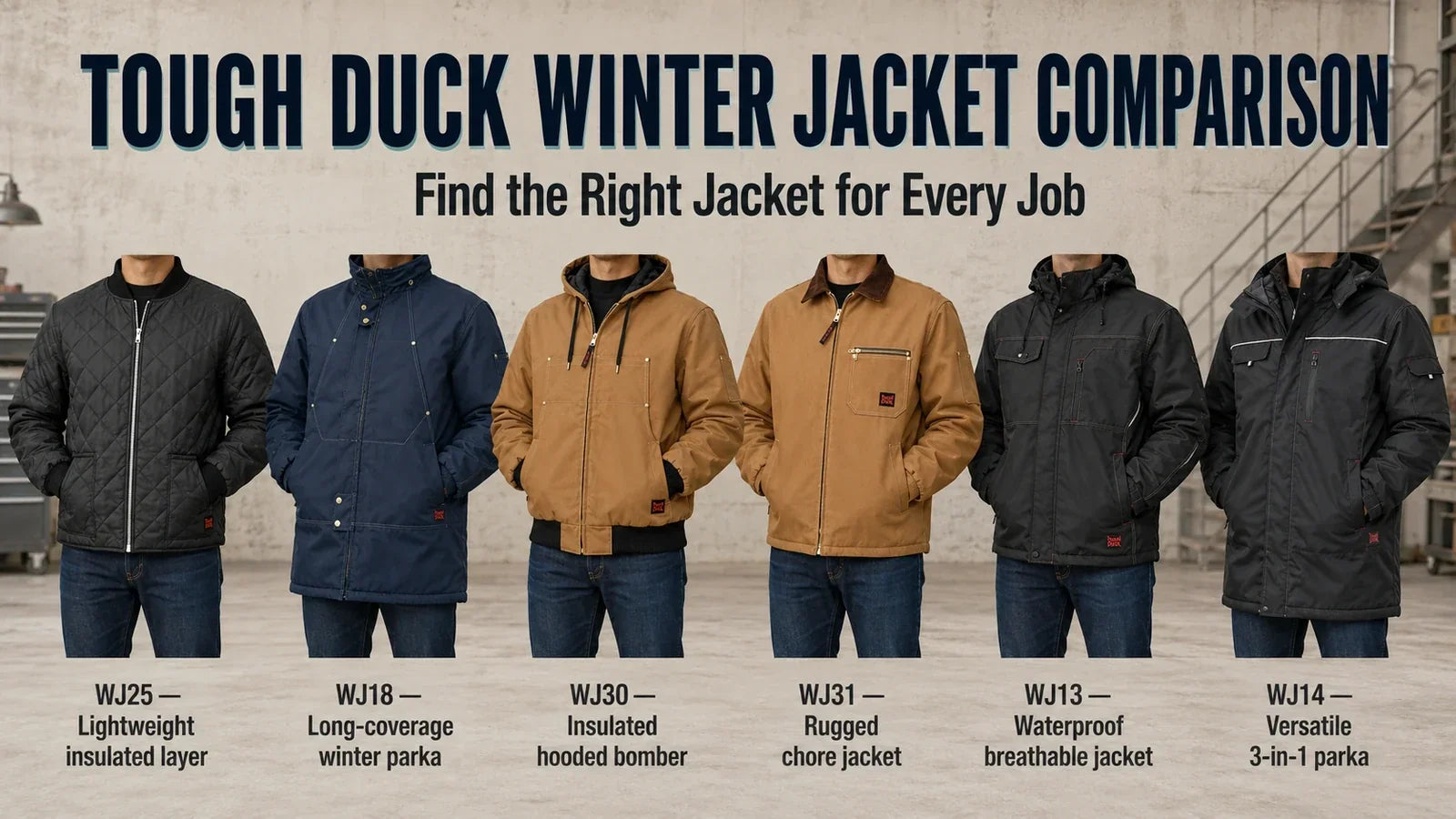
Outfitting a winter crew is rarely as simple as ordering one jacket in several sizes. A warehouse worker moving between loading bays and heated rooms has different needs from a utility worker spending an entire shift outdoors. A mechanic may want a hoodless jacket that stays clear of tools, while a roadside worker needs added visibility.
This Tough Duck winter jacket comparison covers six distinct options: the WJ25 Freezer Jacket, WJ18 Hydro Parka, WJ30 Bomber Jacket, WJ31 Chore Jacket, WJ13 Poly Oxford Jacket, and WJ14 3-In-1 Parka. The Tough Duck jacket review below compares insulation, shell construction, weather protection, coverage, and mobility so supervisors can match each model to the right job.
The best Tough Duck jacket depends on where and how each employee works. For many employers, a role-based jacket program will serve the crew better than a single model for every position.
Tough Duck Winter Jackets at a Glance
Each model fills a clear place in the Tough Duck winter workwear lineup. Use this quick comparison to narrow the options before looking at the detailed reviews.

Fast answer: Choose the WJ25 for a lighter layer, the WJ18 for the most insulation and cotton-duck coverage, the WJ30 for hooded mobility, or the WJ31 for a rugged general-purpose uniform. Choose the WJ13 for a shorter waterproof, breathable jacket or the WJ14 for a longer 3-in-1 system with a removable insulated liner.
How to Compare Winter Jackets for a Crew
Start With the Work Environment
The first question is not which jacket is heaviest. It is where the worker spends the shift. Employees moving between cold and heated spaces need manageable insulation, which makes the WJ25 a practical layer. Crews working outside can choose the structured cotton-duck shells of the WJ18, WJ30, or WJ31. Wet-weather roles are better matched to the waterproof, breathable 600D Poly Oxford shells of the WJ13 and WJ14.
Compare Insulation and Coverage Together
Insulation weight helps separate the models, but jacket length and liner design also change how each option works. The WJ25 uses 4 oz insulation. The WJ30 uses 6 oz insulation, while the WJ31 combines 6 oz body insulation with lighter 4 oz sleeve insulation. The WJ18 pairs 8 oz insulation with a longer cotton-duck parka profile. The WJ13 uses a warm quilted lining. The WJ14 adds a removable liner with 6 oz polyfill, allowing the shell, liner, or both to be worn as conditions change.
Match the Hood and Cuffs to the Task
A hood is useful outdoors, but it is not ideal around every machine, tool, or head-protection setup. The WJ30 has an attached hood. The WJ18, WJ13 and WJ14 use detachable hoods for more flexibility. The WJ25 and WJ31 stay hoodless, making them practical for layering under separate head protection or working where loose outer features are unwelcome.
Consider Movement, Storage and Crew Consistency
An action back, adjustable cuffs, and jacket length can matter as much as insulation to workers who climb, reach, or operate equipment. Pocket placement also affects daily convenience. Compare the tools employees carry, how often they drive, and whether the garment will be embroidered. All six models cover sizes S through 5XL, supporting consistent crew ordering across a broad range.
WJ25 Review: Best for Light Insulation and Layering

The Tough Duck WJ25 Freezer Jacket is the lightest-insulated option in this comparison. Its diamond-quilted polyester shell contains 4 oz polyester insulation, while the rib-knit collar and cuffs help create a close fit at common entry points for cold air. A drop-back hem adds coverage when bending or reaching.
Lower patch pockets provide quick hand or tool storage, and the interior pocket helps keep a phone or small personal item protected. The YKK front zipper supports simple on-and-off use during temperature changes.
Choose the WJ25 for warehouse employees, drivers, indoor technicians, and workers who need a flexible layer rather than a heavy outer jacket. It is also the most budget-friendly route for outfitting a larger group. The trade-off is clear: it does not provide the shell weight, hood options, or insulation of the cotton-duck jackets.
WJ18 Hydro Parka Review: Best for Insulation and Coverage

The Tough Duck WJ18 Hydro Parka is built for workers who need more coverage across the torso. It combines a 12 oz cotton-duck shell with 8 oz polyester insulation, the highest insulation weight among the six jackets. Its longer profile makes it better suited to extended outdoor work than a short bomber.
A detachable hood lets workers adjust the jacket to the task. Rib-knit storm cuffs sit inside the sleeves to help limit drafts, while an inside drawcord adjusts the waist. Four large scoop pockets make room for gloves and frequently used work items. Triple stitching, brass rivets at stress points, and a heavy-duty brass zipper support a rugged workwear build.
Choose the WJ18 for employees who spend long periods outside and value greater insulation and coverage. It will feel more substantial than the other models, so highly mobile workers or employees frequently entering heated spaces may prefer the WJ30 or WJ25.
WJ30 Bomber Jacket Review: Best Hooded Jacket for Active Work

The Tough Duck WJ30 Bomber Jacket places a 6 oz insulated lining inside a 12 oz cotton-duck shell. Its bomber length keeps the lower edge clear when workers climb, sit in equipment, or reach for tools. An action back adds room through the shoulders, while the rib-knit cuffs and waistband create a close fit.
The attached three-piece hood is always available when weather changes. Two upper chest pockets, two front scoop pockets, and a sleeve pencil pocket keep small work items accessible. Triple stitching and brass rivets reinforce the areas that typically take more strain.
Choose the WJ30 for construction, equipment operation, yard work, and other active outdoor roles where a hood and shorter jacket are practical. Compared with the WJ18, it gives up some insulation and lower-body coverage in exchange for a more compact profile.
WJ31 Chore Jacket Review: Best General-Purpose Crew Jacket

The Tough Duck WJ31 Chore Jacket is the most versatile all-around choice for a traditional work crew. Its 12 oz cotton-duck shell has 6 oz insulation through the body and lighter 4 oz insulation through the sleeves. That combination creates a substantial outer jacket while allowing less bulk around the arms than a uniform 6 oz lining.
An action back supports reaching and lifting. Adjustable cuffs and waist tabs let workers fine-tune the fit instead of relying on a fixed rib-knit waistband. The brass front zipper, lower welt pockets, sleeve pencil pocket, and interior storage provide a useful mix for maintenance and trade work.
Choose the WJ31 for mechanics, maintenance staff, farm crews, and general trades that want rugged cotton-duck construction without a hood. It is heavier and more expensive than the WJ25, but it fills a different role: the WJ31 is an outer work jacket, while the WJ25 is a lighter insulated layer.
WJ13 Poly Oxford Jacket Review: Best for Waterproof, Breathable Protection

The Tough Duck WJ13 Poly Oxford Jacket uses a seam-sealed, waterproof and breathable 600D Poly Oxford shell with 5000/5000 protection. A warm quilted lining with brushed tricot throughout the body supports cold-weather work.
Its detachable hood, adjustable storm cuffs, and shock-cord hem help workers change the fit. Reflective enhancements, media and security pockets, and an embroidery-access zipper support daily work and crew branding.
Choose the WJ13 for construction, industrial, mining, agriculture, and transportation roles that need a shorter waterproof insulated jacket. It is a simpler one-piece alternative to the WJ14, but its lining cannot be worn separately.
WJ14 3-In-1 Parka Review: Best for Modular Wet-Weather Protection

The Tough Duck WJ14 3-In-1 Parka combines a seam-sealed waterproof and breathable 600D Poly Oxford shell with a removable quilted liner. The 150D liner contains 6 oz polyfill and can be worn alone or joined to the shell.
The shell includes a detachable hood, double storm fly, adjustable cuffs, and a shock-cord hem. Reflective enhancements, multiple pockets, and an embroidery-access zipper support crew use and branding.
Choose the WJ14 for utilities, transportation, oil and gas, heavy-equipment operation, and other roles needing rain protection and flexible layers. It has more components than the WJ13, but its shell, liner, and combined configurations cover more conditions.
Which Tough Duck Jacket Fits Each Job?
Warehouse, Freezer and Mixed-Temperature Work: WJ25
The WJ25 is the practical starting point when workers regularly move between cold and heated areas. Its lighter construction is easier to layer, and employees can remove it without managing the bulk of a cotton-duck parka. It also makes sense for drivers who need insulation without a long jacket bunching behind them.
Long Outdoor Shifts: WJ18
The WJ18 provides the most insulation and coverage in this comparison. Choose it for employees whose work keeps them outside for long periods and who do not need the shorter profile of a bomber. The detachable hood also lets the same jacket adapt to changing tasks.
Active Outdoor Construction and Equipment Work: WJ30
The WJ30 balances a durable cotton-duck shell with a shorter cut, action back, and attached hood. It suits crews that climb, bend, drive, or move between work areas but still need a substantial insulated outer jacket.
Maintenance, Mechanics and General Trades: WJ31
The WJ31 is the most versatile hoodless cotton-duck option. Its adjustable cuffs and waist, action back, and work-pocket layout make it easy to standardize across several trade roles. It also leaves workers free to choose separate head protection.
Wet and Variable Conditions: WJ13 or WJ14
Choose the WJ13 when the crew needs a shorter waterproof, breathable insulated jacket for regular movement. Choose the WJ14 when workers benefit from longer coverage and a removable liner that can be worn separately. Both use abrasion-resistant 600D Poly Oxford shells with seam-sealed 5000/5000 protection.
Common Tough Duck Jacket Decisions
WJ18 vs WJ30
Choose the WJ18 when insulation and longer coverage are the priority. Choose the WJ30 when mobility, an attached hood, and a shorter bomber cut better match the work. Both use 12 oz cotton duck, but they solve different problems.
WJ30 vs WJ31
Choose the WJ30 for a hooded bomber with a rib-knit waistband. Choose the WJ31 for a hoodless chore jacket with adjustable cuffs and waist tabs. The WJ30 works well for outdoor movement; the WJ31 is easier to standardize across mechanics, maintenance, and general trades.
WJ25 vs WJ31
For buyers comparing Tough Duck WJ25 vs WJ31, the central difference is the jacket's role. The WJ25 is a lightweight polyester layer with 4 oz insulation. The WJ31 is a substantial 12 oz cotton-duck outer jacket with 6 oz body insulation and 4 oz sleeve insulation. Select the WJ25 for indoor work, layering, and lower purchasing cost. Use the WJ31 when the crew needs a rugged everyday outer jacket.
WJ13 vs WJ14
Choose the WJ13 for a simpler insulated jacket with a shorter cut. Choose the WJ14 when a longer parka and removable 6 oz insulated liner provide useful flexibility. Both use waterproof, breathable 600D Poly Oxford shells, detachable hoods, adjustable cuffs and reflective enhancements.
How to Outfit a Crew Without Overbuying
A good crew workwear program starts with job groups, not individual preferences. Sort employees by environment and task, then choose the smallest number of jackets that cover those roles.
Use One Standard Jacket When Roles Are Similar
If most employees perform similar work, one core model simplifies ordering, embroidery, and replacements. The WJ31 is a strong standard for general trades and maintenance. The WJ30 is the better single-model choice when most employees work outdoors and regularly need a hood.
Use a Two-Tier Program for Mixed Crews
Mixed operations usually need a lighter and a heavier option. Issue the WJ25 to warehouse staff, drivers, and indoor technicians. Reserve the WJ18 or WJ30 for employees who spend longer periods outside. This avoids paying for heavier construction where it adds little practical value.
Separate Cotton-Duck and Waterproof Roles
Use the WJ30 or WJ31 as the standard uniform for dry, abrasive work environments. Issue the WJ13 or WJ14 to employees whose roles regularly involve wet conditions. Keeping cotton-duck and waterproof Poly Oxford options in separate job groups makes ordering clearer and avoids paying for technical weather protection where it adds little value.
Add Bib Overalls or Coveralls When a Jacket Is Not Enough
A jacket protects the upper body, but exposed outdoor work may also call for insulated leg and seat coverage. The Tough Duck WB03 insulated bib overall adds a 12 oz cotton-duck option with a waterproof seat and knees. The 7910 insulated bib overall uses a waterproof, breathable 600D polyester shell for wet winter work. For visibility-focused full-body coverage, consider the S787 insulated safety coverall.
Pairing the right jacket with the appropriate lower-body protection creates a more complete winter workwear system.
Choose the Jacket That Matches the Work
There is no single best Tough Duck jacket for every employee. The WJ25 is the lighter layer. The WJ18 provides the most stated insulation and long cotton-duck coverage. The WJ30 combines a hood with a mobile bomber cut, and the WJ31 is the general-purpose chore jacket. The WJ13 adds waterproof, breathable protection in a shorter jacket, while the WJ14 provides longer coverage and 3-in-1 flexibility.
Compare each employee group's environment, movement, coverage, and visibility needs before ordering. Confirm the crew's sizes, select the right model for each role, and shop the full Tough Duck collection. For a broader uniform program, browse additional workwear and review available volume discounts before checkout.
Frequently Asked Questions
Which Tough Duck jacket has the most insulation?
The WJ18 Hydro Parka has the most insulation in this six-jacket comparison, with 8 oz polyester insulation. Its longer parka cut also provides more torso coverage than the bomber and chore styles.
Which Tough Duck jacket is best for indoor work?
The WJ25 is the best fit for indoor, warehouse, and mixed-temperature work. Its 4 oz insulation and polyester construction make it easier to layer and manage when workers move between cold and heated areas.
What is the difference between the WJ30 and WJ31?
The WJ30 is a hooded bomber with 6 oz insulation, an action back, and a rib-knit waistband. The WJ31 is a hoodless chore jacket with 6 oz body insulation, 4 oz sleeve insulation, adjustable cuffs, and waist tabs. Choose WJ30 for hooded outdoor mobility and WJ31 for a versatile trade or maintenance uniform.
What is the difference between the WJ13 and WJ14?
The WJ13 is a one-piece insulated waterproof jacket with a shorter profile. The WJ14 is a longer 3-in-1 parka with a waterproof shell and removable 6 oz insulated liner. Choose the WJ13 for straightforward wet-weather mobility and the WJ14 when workers need modular layers and more coverage.