

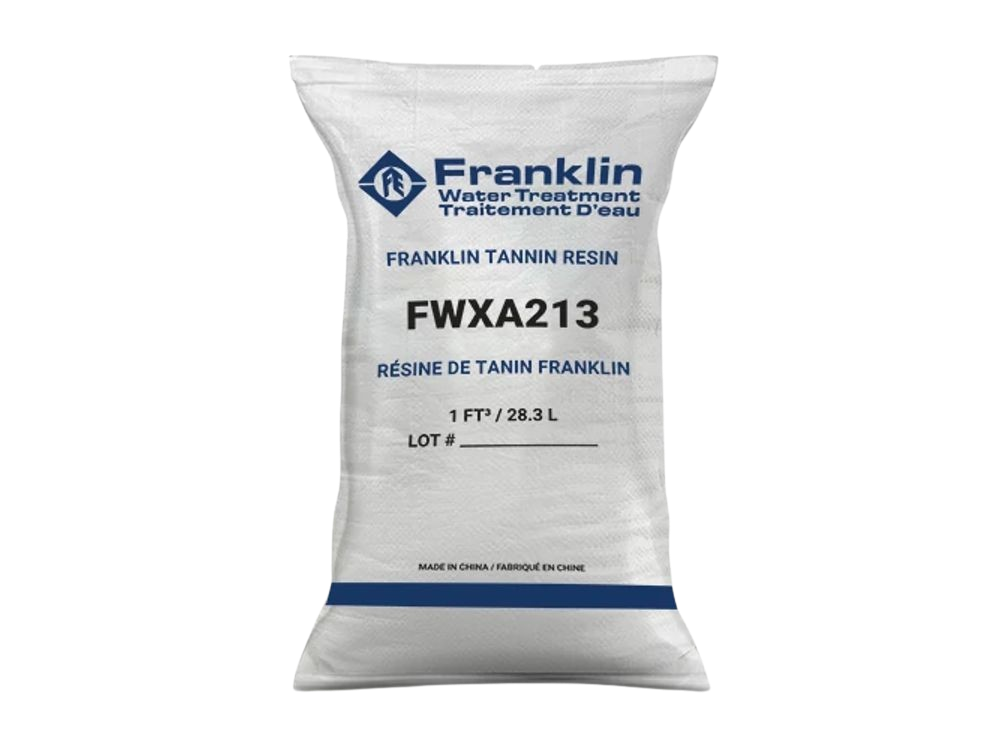

Description
Type I Anion Resin for Organic Scavenging
Franklin FWXA213 is an industrial-grade macroporous Type I strong base anion exchange resin. It is used for water demineralization, organic scavenging and sugar decolorization.
The resin has a polyacrylic matrix crosslinked with divinylbenzene (DVB). Its macroporous structure adsorbs soluble organic molecules and supports their release during regeneration. It also provides resistance to oxidation, osmotic shock and mechanical stress.
FWXA213 can be used in multi-bed demineralization systems to help protect downstream resin from organic fouling. It is supplied in chloride form or hydroxide form when ordered as FWXA213-OH.
Best Suited For
- Organic scavenging in industrial water-treatment systems
- Tannin and dissolved-organic treatment
- Pretreatment in multi-bed demineralization systems
- Protection of downstream resin from organic fouling
- Sugar decolorization processes
- Water with elevated soluble organic content
Key Features of Franklin FWXA213 Macroporous Strong Base Anion Resin
- Macroporous polyacrylic structure
- Type I quaternary amine functional group
- Adsorbs soluble organic molecules
- Supports organic release during regeneration
- Resists oxidation and osmotic shock
- Withstands repeated mechanical stress
- Available in Cl⁻ or OH⁻ ionic form
- Maximum operating temperature of 80°C
Technical Specifications
| Property | Specification |
|---|---|
| Resin Type | Strong base anion, Type I |
| Application | Demineralization, organic scavenging and sugar decolorization |
| Polymer Matrix | Macroporous polyacrylic crosslinked with DVB |
| Functional Group | Quaternary amine, Type I (trimethylamine) |
| Appearance | White, opaque spherical beads |
| Ionic Form as Shipped | Cl⁻ or OH⁻ when ordered as FWXA213-OH |
| Maximum Operating Temperature | 80°C (176°F) |
| pH Range | 0 to 12 |
| Service Flow Rate | 8 to 40 BV/h |
| Regenerant | 2–10% NaCl or 2–6% NaOH |
| Total Exchange Capacity | ≥0.8 eq/L |
| Moisture Retention | 65–72% |
| Particle Size Range | 0.315–1.25 mm for ≥95% of beads |
| Effective Size | 0.4–0.6 mm |
| Homogeneous Coefficient | <1.7 |
| Whole Uncracked Beads After Attrition | ≥96% |
| Bulk Density | 0.65–0.73 g/mL |
| Specific Gravity | 1.04–1.10 |
| Reversible Swelling, Free Base to Cl⁻ | <20% |
| Free Moisture | <2% |
How FWXA213 Supports Organic Removal
Dissolved organic material can foul anion resin and reduce its operating performance. FWXA213 uses a macroporous structure that allows soluble organic molecules to reach the resin's active sites.
Its polyacrylic matrix also supports the release of adsorbed organics during regeneration. This makes FWXA213 suitable for organic scavenging and pretreatment before downstream resin beds.
Actual performance depends on the feed-water chemistry, organic loading, bed design, flow rate and regeneration procedure.
Selecting the Correct Resin
Choose FWXA213 when the treatment system requires a macroporous Type I anion resin for organic scavenging or demineralization pretreatment. Before ordering, confirm:
- Feed-water analysis
- Required resin volume
- Service flow rate
- Regeneration method
- Chloride or hydroxide ionic form
- Tank size and minimum bed depth
- Intended treatment objective
For other resin types and treatment applications, browse the Franklin Water Treatment collection.
Order Franklin FWXA213 from Cleanflow
Buy Franklin FWXA213 macroporous anion resin online for shipment across Canada and the United States. Review the technical specification sheet before selecting the resin quantity and ionic form.
For help confirming whether FWXA213 fits your system, contact Cleanflow with your feed-water analysis, tank size, service flow and treatment goal. Orders over $199 qualify for free shipping, and all purchases are backed by a 30-day return policy.
Frequently Asked Questions
What is Franklin FWXA213 used for?
FWXA213 is used for water demineralization, organic scavenging and sugar decolorization. It can also serve as pretreatment in a multi-bed demineralization system to help protect downstream resin from organic fouling.
Can FWXA213 be used for tannin treatment?
FWXA213 is a macroporous organic-scavenging resin that may be used in systems designed to treat tannins and other soluble organic material. Suitability and capacity depend on the water analysis and system design.
What ionic form does FWXA213 use?
Standard FWXA213 is supplied in chloride form. The hydroxide form is available when ordered as FWXA213-OH. Confirm the required ionic form before purchasing.
What regenerant does FWXA213 require?
The manufacturer lists 2–10% sodium chloride or 2–6% sodium hydroxide as regenerants. The correct chemical, concentration and procedure depend on the ionic form and treatment-system design.
What is the maximum operating temperature?
The maximum operating temperature listed for Franklin FWXA213 is 80°C, or 176°F.
Manuals & Documentation
Similar Products
Featured collection


