

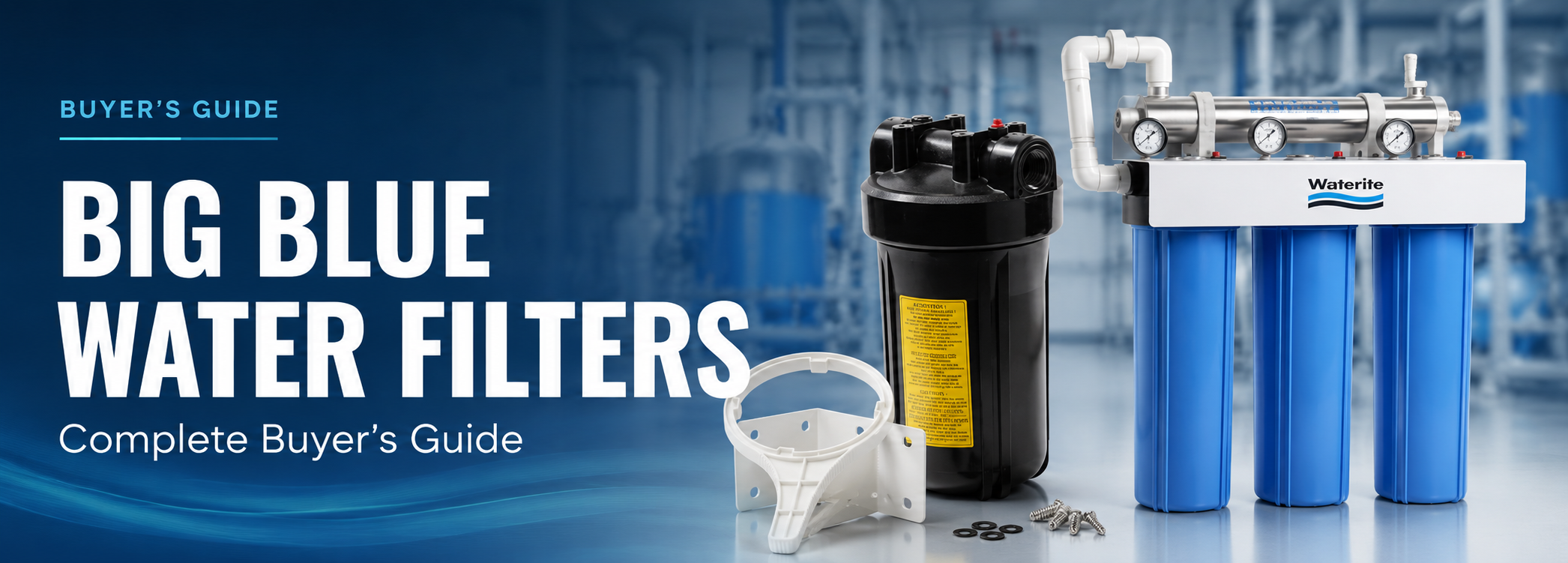
How to Compare 10- and 20-Inch Cartridges, Single, Duplex, Triplex and UV-Equipped Systems
|
Quick answer A Big Blue-style housing accepts a wide 4.5-inch cartridge. Choose the housing length, number of stages, cartridge media, and micron rating based on tested water conditions and the required peak flow. Add UV only when microbiological risk and the selected system's rating justify it. |
A Big Blue water filter can protect plumbing, appliances, and downstream treatment from suspended sediment. With the correct cartridge, it can also reduce chlorine-related taste and odour.
However, the housing does not determine what the system treats. Its results depend on the cartridge, water chemistry, flow, and maintenance.
This guide explains how to compare the Big Blue housings, cartridges, and UV-equipped systems available from Cleanflow.
What Is a Big Blue Water Filter?
Big Blue commonly describes wide filter housings that use cartridges approximately 4.5 inches in outside diameter. Cleanflow carries compatible housings and cartridges in nominal 10- and 20-inch lengths.
The wider cartridge provides more room for filter media than a standard 2.5-inch cartridge. Actual flow, dirt capacity, and service life still depend on the chosen cartridge and operating conditions.
|
Compatibility check Match the cartridge diameter and nominal length to the housing. Also confirm the end configuration, gasket, temperature limit, and manufacturer specifications before ordering. |
What Can a Big Blue System Treat?
A Big Blue housing is a pressure vessel for a replaceable cartridge. It does not remove a contaminant until suitable media is installed.

Should You Choose a 10- or 20-Inch Housing?
Housing length affects cartridge size, installation space, and potential media capacity. It should not be chosen from bathroom count alone.

Do You Need a Single, Duplex or Triplex System?
Single, Duplex, and Triplex describe the number of cartridge housings. Duplex and Triplex systems place their treatment stages in series.


|
Flow reminder Adding housings in series adds treatment stages. It does not automatically increase flow. Every cartridge adds some resistance, which rises as sediment accumulates. |
Which Big Blue Cartridge Should You Use?
Select cartridge construction after identifying the water problem. Micron rating alone does not tell you how a cartridge is built or what it can treat.

Cleanflow carries current Franklin FWPS spun polypropylene cartridges, FWSW string-wound cartridges, and FWCB carbon blocks in Big Blue sizes.
Which Micron Rating Should You Choose?
A micron rating indicates the particle size a cartridge is designed to reduce under stated test conditions. Confirm whether a rating is nominal or absolute before comparing products.

Do not automatically select the smallest number. Start with water testing and particle conditions, then balance capture, pressure loss, and service frequency.
Which Cartridge Should Go First?
Water normally moves from coarser pretreatment toward finer or adsorptive treatment. The correct order protects downstream media and reduces avoidable pressure loss.

|
These are examples Do not use a standard cartridge sequence as a substitute for water testing. Iron, manganese, hardness, tannins, and microbiological concerns may require other treatment. |
When Should You Add UV Disinfection?
Consider UV when testing or source vulnerability identifies a microbiological risk. Private well owners should follow their provincial or territorial testing guidance.
UV damages microbial genetic material and prevents susceptible organisms from reproducing. It does not remove sediment, hardness, dissolved salts, chlorine, or other chemicals.
- Use pretreatment that meets the UV manufacturer's incoming-water requirements.
- Select a rated UV flow that meets the building's peak simultaneous demand.
- Keep the quartz sleeve clean and replace the lamp as directed by the system timer and manual.
- Confirm the required certification and performance class for the intended water source.
Cleanflow's Waterite UV-equipped Big Blue listings combine two or three cartridge stages with an Excelight UV chamber. Listed features include a 304 stainless-steel chamber, quartz sleeve, lamp alarm, and 9,000-hour lamp rating.
Compare the current Duplex 10-inch UV system, Duplex 20-inch UV system, Triplex 10-inch UV system, and Triplex 20-inch UV system. Available variants and flow ratings can change, so confirm the selected listing before ordering.
How Should You Size a Big Blue System?
Size the complete treatment train, not the empty housing. A large housing cannot compensate for a restrictive cartridge or an undersized UV chamber.
- Test the water. Identify suspended sediment, chlorine, hardness, iron, manganese, and microbiological concerns.
- Calculate peak demand. Use expected simultaneous fixture flow, not average daily consumption.
- Check pressure loss. Review every cartridge at the planned flow and allow for loading over time.
- Confirm connections. Match the line size, housing ports, valves, and fittings to the installation.
- Measure service space. Leave enough room below each sump to remove the housing and cartridge safely.
- Check operating limits. Verify pressure, temperature, and indoor or freeze-protection requirements for every component.

Which Big Blue System Matches Each Need?

Browse the full Big Blue Water Filters collection for current availability.
For a single housing, compare the Franklin FWHL Series.
For multiple stages, compare the Waterite Duplex 10-inch, Duplex 20-inch, Triplex 10-inch and Triplex 20-inch systems.
How Should You Maintain a Big Blue System?
Maintenance intervals vary with water quality, cartridge type, total use, and the manufacturer's instructions. A fixed calendar interval cannot cover every installation.
- Replace a sediment cartridge when pressure loss or reduced flow reaches the manufacturer's service limit.
- Replace carbon media at its rated capacity or when treatment performance declines, whichever comes first.
- Isolate and depressurize the system before opening any housing.
- Inspect the O-ring, sealing surfaces, and sump during every cartridge change.
- Use only the lubricant and tightening method allowed by the housing manufacturer.
- Keep UV equipment powered and serviced according to its manual, lamp timer, and alarm status.
Cleanflow carries a Waterite Big Blue housing wrench for loosening compatible sumps and replacement Waterite O-rings in single, duplex, and triplex pack quantities.
Which Buying Mistakes Should You Avoid?
- Choosing a 1-micron cartridge only because it sounds more thorough.
- Assuming the housing removes a contaminant without checking the installed cartridge.
- Using a carbon cartridge before controlling a heavy sediment load.
- Treating dissolved iron or hardness with an ordinary sediment cartridge.
- Selecting UV from bathroom count instead of peak flow and verified performance.
- Using a high-temperature cartridge inside a housing that is not rated for that temperature.
- Installing the housings without enough clearance for safe cartridge changes.
- Ignoring cartridge pressure loss when several stages operate in series.
What Questions Do Buyers Ask About Big Blue Filters?
Does a Big Blue water filter remove bacteria?
Not by default. Ordinary sediment and carbon cartridges are not disinfection systems. Use a properly selected and maintained UV or other disinfection process when testing shows microbiological risk.
Can different cartridge brands fit the same housing?
Many standard 4.5-inch cartridges fit Big Blue-style housings of the matching nominal length. Confirm the exact dimensions, end configuration, gasket, and housing specifications first.
Can a Big Blue filter remove iron?
A sediment cartridge may capture oxidized iron particles within its rated range. Dissolved iron usually requires oxidation and dedicated iron-removal treatment before filtration.
Why did water pressure fall after installation?
Possible causes include an overly fine cartridge, accumulated sediment, undersized ports, several restrictive stages, or inadequate source pressure. Diagnose the complete system rather than the housing alone.
How often should a Big Blue cartridge be changed?
Follow the cartridge and system instructions. Use pressure loss, flow decline, treatment capacity, water quality, and service time instead of relying on one universal schedule.
Can a Big Blue housing filter hot water?
Only when every component is rated for the operating temperature. A high-temperature cartridge does not raise the temperature limit of a standard plastic housing.
Should UV be installed before or after the filters?
UV normally follows the required filtration and conditioning stages. Pretreatment helps meet the UV unit's incoming-water requirements and reduces sleeve fouling or light interference.
How Can Cleanflow Help You Choose?
Before contacting Cleanflow, gather your water source, test results, peak flow, line size, available wall space, and treatment goals. These details help narrow the housing, cartridge, and UV options.
Browse all Big Blue Water Filters.
|
Product note Prices, inventory, product variants, and specifications can change. Confirm the current product page and applicable manual before purchase or installation. |