

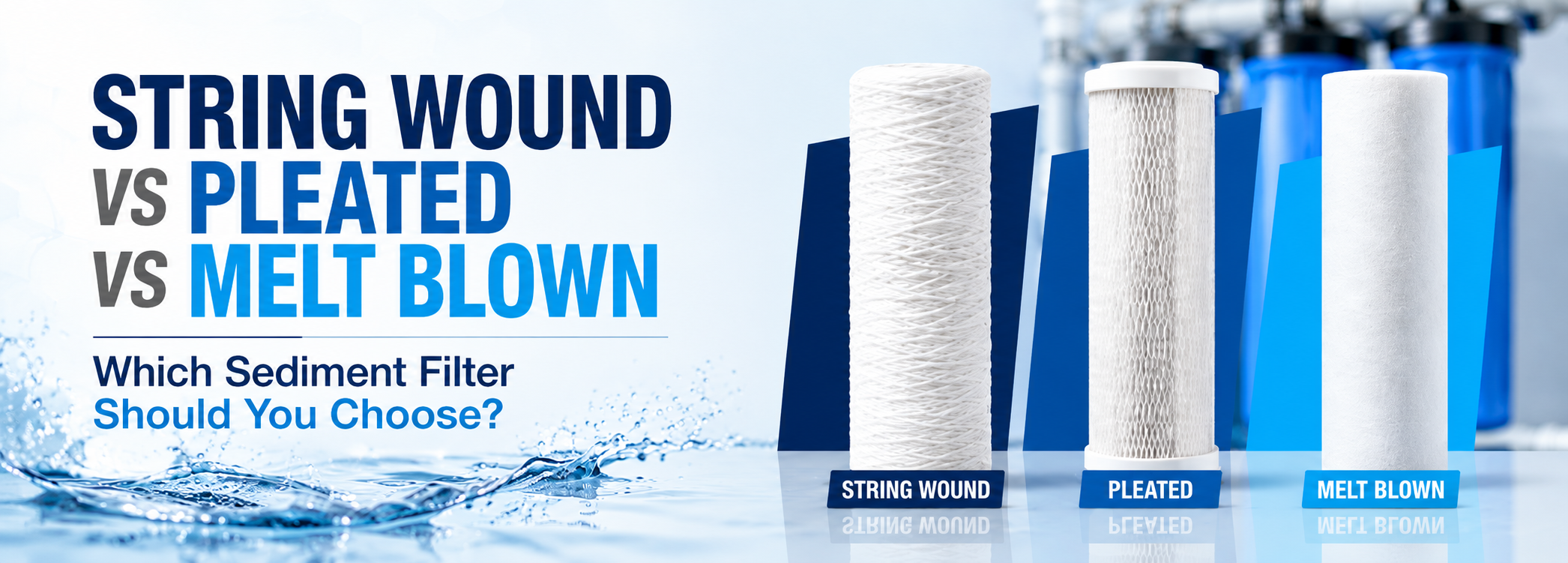
Choosing the wrong sediment filter can cause weak pressure, frequent cartridge changes, or poor sediment control. The right choice depends on particle size, water flow, temperature, and maintenance needs.
This guide compares Franklin Water filter cartridges only. It explains the main sediment filter cartridge types and helps you choose a practical starting point. Always confirm the model, housing size, micron rating, and temperature limit before ordering.
|
Quick answer Choose Franklin FWSW for heavy sediment. Choose FWPL when high flow and washability matter. Choose FWPS for general-purpose depth filtration. Consider FWPS-DG when the water carries both coarse and fine particles. |
What Is the Difference Between String Wound, Pleated, and Melt Blown Filters?
String wound and melt blown cartridges are depth filters. They store particles throughout the media. Pleated cartridges mainly collect sediment across a folded surface.
A string wound vs pleated filter comparison usually comes down to sediment load, flow, and cleaning. Melt-blown filters add another disposable depth-filtration option for general sediment control.


How Do Franklin String-Wound Filters Work?
Franklin FWSW cartridges wind polypropylene cord around a polypropylene core. The winding creates paths that hold particles through the cartridge depth. Outer layers catch larger sediment, while inner layers capture smaller particles.
This design often suits wells with sand, silt, rust, or scale. It can also work as a first stage before a finer cartridge. Franklin offers 1, 5, 20, and 50 micron options in standard and 4.5-inch formats.
String-wound cartridges are disposable. Replace the filter when pressure drop rises or water flow becomes weak. Avoid using a heavily loaded cartridge because unstable flow or pressure can affect performance.
Compare options: View Franklin FWSW 4.5-inch string-wound cartridges
When Should You Choose a Franklin Pleated Filter?
Franklin FWPL cartridges fold their media into pleats. These folds create more exposed surface than a flat sheet. This can support higher flow with a lower initial pressure drop than many same-size depth cartridges.
Are pleated water filters reusable? Franklin FWPL cartridges are washable and reusable. Gentle cleaning may reduce replacement frequency when rinsing restores flow, and the media remains sound.
Replace the cartridge if the pleats tear, remain clogged, or stop recovering flow. Cleaning does not make a damaged cartridge new again.
Franklin lists 1, 5, 20, and 50 micron options. The 1 micron FWPL option is listed as absolute-rated. Do not convert that rating into a removal percentage unless the exact product data provides one.
The 2.5 by 10 inch FWPL cartridge has a listed maximum temperature of 37.8°C (100°F). Check the entire system because the lowest-rated component sets the operating limit.
Compare options: View Franklin FWPL washable pleated cartridges
When Should You Choose a Franklin Melt-Blown Filter?
Franklin FWPS cartridges are spun polypropylene filter cartridges. They are also called melt-blown water filters. Their fibres are thermally fused without chemical glues or binders.
The layered media catches larger particles outside and smaller particles deeper inside. FWPS is a practical general-purpose choice for sediment prefiltration. It comes in several lengths and in standard or 4.5-inch diameters.
Selected FWPS models appear in NSF listings for NSF/ANSI 42 material requirements. This does not mean every model reduces a specific contaminant. Check the exact model and certification scope when documented compliance is required.
Compare options: View Franklin FWPS spun-poly cartridges
When Does a Dual-Gradient Filter Make Sense?
A single micron rating can load quickly when water contains large and small particles. Franklin FWPS-DG cartridges combine two density zones in one spun-poly cartridge. Available combinations include 25/1, 50/5, and 75/25 micron.
The coarse outer zone catches larger sediment first. The fine inner zone handles smaller particles. This design provides staged depth filtration inside one compatible 4.5-inch housing.
Compare options: View Franklin FWPS-DG dual-gradient cartridges
Which Sediment Filter Is Best for Well Water?
The best sediment filter for well water depends on the sediment type, amount, and particle size. Water flow and service access also matter. Start with a water test instead of choosing by micron rating alone.
| Well-water condition | Franklin starting point | Why |
|---|---|---|
| Heavy sand or visible grit | FWSW at 20 or 50 micron | Depth loading handles coarse sediment |
| Mixed coarse and fine sediment | FWPS-DG | Two density zones stage the filtration |
| Moderate general sediment | FWPS at 5 or 20 micron | Disposable depth filtration keeps service simple |
| Flow matters and sediment rinses away | FWPL | Pleated media is washable and reusable |
A staged system often works better than one very fine cartridge. A coarse first stage protects the finer filter from rapid plugging. This may improve service life and reduce sudden pressure loss.
Should You Choose a 1, 5, 20, or 50 Micron Filter?
A smaller micron number targets smaller particles. It can also clog faster when the water carries heavy sediment. Choose the coarsest rating that meets the treatment goal, then add a finer stage when needed.
For a 5 vs 20 micron sediment filter, start by checking the sediment load. A 20 micron cartridge usually handles more visible sediment before clogging. A 5 micron cartridge provides finer protection for downstream equipment.
- 50 micron: a coarse first stage for heavy visible sediment.
- 20 micron: a first stage for moderate sand, rust, and silt.
- 5 micron: general sediment control before other treatment equipment.
- 1 micron: fine polishing where flow and sediment load allow it.
|
Important rating note Nominal and absolute ratings are not interchangeable. Efficiency definitions can vary by product. Compare the rating method and test data for the exact model. |

Should You Use a Standard or Big Blue Cartridge?
Standard cartridges are about 2.5 inches in diameter. Big Blue sediment filter cartridges are about 4.5 inches. A larger cartridge generally provides more media capacity within the same product family.
The extra capacity can support more flow or a longer service interval. However, diameter is not the only factor. Housing length, connection size, pressure rating, and available space must also match.
Confirm whether the system accepts a 10-inch or 20-inch cartridge. Also check the housing label before ordering a replacement.
Which Franklin Filters Handle Hot Water?
Standard FWSW string-wound cartridges are rated to 55°C (131°F). Current Cleanflow information lists FWPS cartridges to 65°C (150°F).
For hotter service, Franklin FWSW-HW is a hot-water sediment filter cartridge. It uses polypropylene cord on a stainless-steel core. Its listed continuous limit is 120°C (245°F).
The housing, seals, valves, and piping must also handle the operating temperature and pressure. Never use the cartridge rating as the complete system rating.
Compare options: View Franklin FWSW-HW hot-water cartridges
Can These Sediment Filters Remove Every Water Problem?
No. Sediment filters do not normally remove hardness, salt, or dissolved iron. They also cannot correct every taste or odour problem.
Sediment cartridges do not replace disinfection when bacteria, viruses, or other pathogens are a concern. A sediment filter alone does not make unsafe water safe.
Use a water test to identify the problem. Carbon, softening, iron treatment, reverse osmosis, or UV equipment may be required after sediment filtration.
How Do You Choose the Right Franklin Cartridge?
First, identify the sediment and choose a micron rating. Next, match the cartridge diameter and length. Then check the flow, temperature, housing, and exact model number.
| Choose this Franklin type | When this need matters most |
|---|---|
| FWSW string wound | Heavy sediment and disposable depth filtration |
| FWPL pleated | Washability and higher flow |
| FWPS melt blown | General-purpose spun polypropylene filtration |
| FWPS-DG | Coarse and fine particles in one cartridge |
| FWSW-HW | Hot-water service within the complete system rating |
Still unsure which filter fits your housing? Note the cartridge diameter, length, micron rating, water temperature, and existing model number. Cleanflow can use these details to help match a compatible Franklin cartridge.