

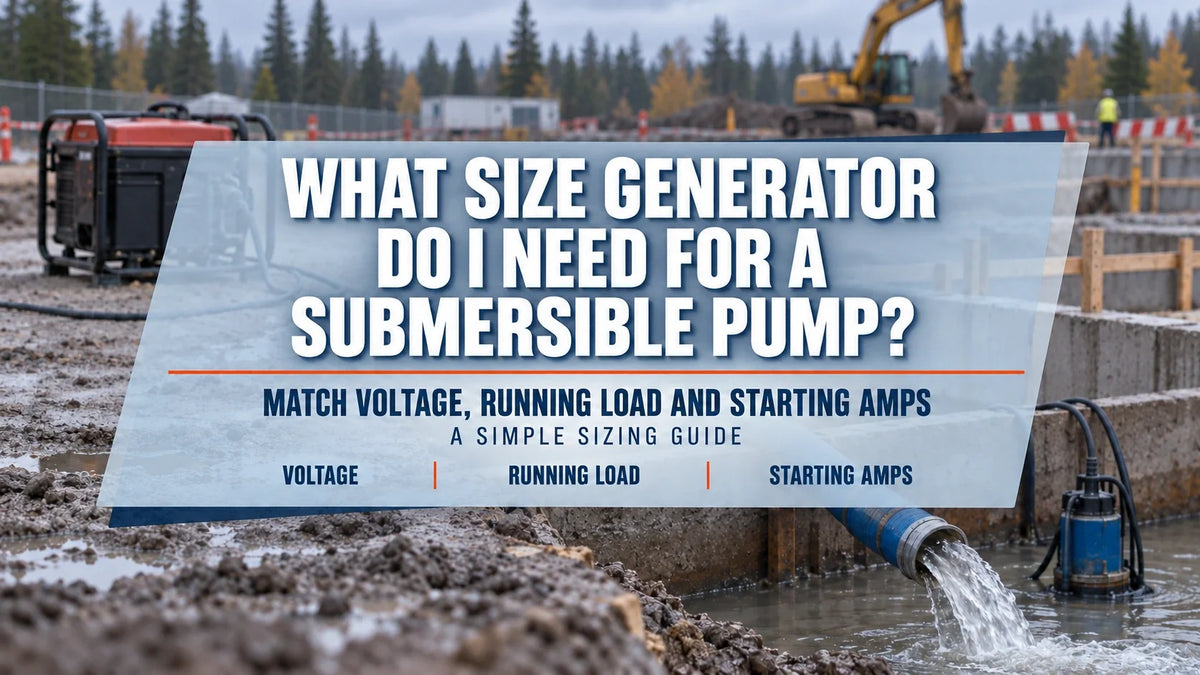
To size a generator for a submersible pump, match the pump’s voltage, phase, and frequency; add its running load to other equipment operating at the same time; and confirm that the generator can supply the pump’s starting amps. For a 115 V single-phase pump with a 25 A starting current, the initial requirement is 2,875 VA, or about 2.9 kVA, before other loads. A 3,000-watt label alone does not guarantee startup because the generator’s voltage dip and surge duration still matter.
This guide focuses on portable electric dewatering pumps. Deep-well systems can use different motor designs, controls, and manufacturer generator-sizing tables.
Start With These Five Numbers
Before choosing a generator, find these values on the pump nameplate, manual, or manufacturer’s data:
- Pump voltage
- Single-phase or three-phase power
- Required frequency, normally 60 Hz in Canada and the United States
- Running amps or input watts
- Starting amps, locked-rotor amps (LRA), or a manufacturer starting requirement
Locked-rotor amps (LRA) is the current a motor may draw before it begins turning.
Also list every other load that may run from the generator. Lights, tools, controls, and a second pump reduce the capacity available for pump startup.
Running Watts vs. Starting Watts
A pump motor normally draws more current while accelerating than after it reaches operating speed. A generator can therefore carry the pump after startup but still fail to start it.
Do not estimate this difference from horsepower alone. One horsepower equals about 746 watts of mechanical output, not the pump’s complete electrical input. Motor efficiency, power factor, and starting design change the electrical demand.
Honda’s generator wattage guide illustrates the variation: its examples list about 3,000 starting watts for one 1 HP capacitor-start induction-run motor and about 2,300 starting watts for a 1 HP capacitor-start capacitor-run motor. Both examples list 1,000 running watts. The same horsepower label can therefore produce different starting requirements.

Calculate a Starting-Load Screening Estimate
For a single-phase pump, use the manufacturer starting current:
Starting VA = voltage × starting amps
For a three-phase motor:
Starting VA = 1.732 × line-to-line voltage × line current
Generator labels normally emphasize watts, while motor-start calculations often use VA. Because a motor draws reactive current, the two values should not automatically be treated as equal. Use this formula as an initial check, then confirm the proposed generator with its manufacturer or supplier.
If the pump manufacturer requires a generator size, use that instruction instead of a generic formula.
Example: A 1 HP Portable Dewatering Pump

The Multiquip ST2037 is a 115 V, single-phase submersible dewatering pump. Multiquip publishes a 25 A starting current and a 25 ft power cable for this model.
Using the starting current:
115 V × 25 A = 2,875 VA
The generator must therefore be evaluated against a starting-load estimate of about 2.9 kVA before adding other loads.
This is not a recommendation to buy a generator based only on a 3,000 W label. Verify all of the following:
- The generator supplies 115/120 V, single-phase, 60 Hz power
- Its continuous output exceeds the pump’s running input plus other continuous loads
- Its motor-start or surge capability can support the pump for the required duration
- Startup voltage and frequency remain within the pump manufacturer’s limits
- The outlet, breaker, plug, and cable arrangement are compatible
- Altitude, temperature, and site conditions do not reduce available output below the requirement
Check the Generator in This Order
1. Match voltage, phase, and frequency
A generator that cannot supply the pump’s required electrical system is not suitable, regardless of its advertised wattage.
2. Check the continuous load
Add the pump’s electrical input to every load that will operate at the same time. Use input watts or amps from equipment data, not motor horsepower converted directly to watts.
3. Check motor-start performance
Look for a published motor-start rating or written confirmation of how well the generator holds voltage when the pump switches on. A brief peak-watt number without its duration may not show whether the generator can start the motor.
4. Check the outlet and breaker
The correct voltage on the label is not enough. Confirm the receptacle, plug, breaker, and any distribution equipment are rated and configured for the application. Do not bypass a breaker or alter a plug to force a connection.
5. Check the cable
A long or undersized cable creates voltage drop. This reduces starting torque, so the pump may accelerate slowly, fail to start, trip its protection, or overheat. Keep the run short, use outdoor-rated cable of the required conductor size, and include the pump’s attached lead in the total length.

6. Account for the site
Generator output can be affected by altitude, ambient temperature, and operating conditions. Cummins also notes that motor type, allowable voltage and frequency dip, other loads, and duty affect generator sizing.
What If Other Equipment Uses the Generator?
Add loads that will be operating when the pump starts. For a simplified screening example:
Pump starting estimate: 2,875 VA
Other running loads: 1,000 VA
Screening total: 3,875 VA
This total is only a first check. The generator must also maintain acceptable voltage and supply enough real power during startup.
For two pumps, a common screening method is the largest pump’s starting requirement plus the running demand of pumps already operating. If controls can start both pumps together, size for simultaneous starting or use controls that prevent it. Confirm the final arrangement with the equipment manufacturers.
Common Generator-Sizing Mistakes
- Sizing from running watts only
- Using horsepower × 746 W as the generator requirement
- Assuming all 1 HP pumps have the same startup demand
- Treating peak watts as a motor-start guarantee
- Ignoring cable length and conductor size
- Forgetting lights, tools, heaters, chargers, or a second pump
- Applying a deep-well pump chart to a portable dewatering pump without checking the motor and controls
- Choosing a generator before confirming the pump’s nameplate data
Safe Jobsite Setup
- Follow the pump and generator manuals and applicable electrical rules
- Use required ground-fault protection; Multiquip instructs users of these portable submersible pumps to connect through a GFCI-protected circuit
- Operate an engine-driven generator outdoors, away from doors, windows, and occupied areas
- Keep plugs, receptacles, and connections out of standing water
- Use only properly sized, outdoor-rated cords, and fully uncoil them before operation. Never use a damaged cord.
- Never bypass protective devices
For a hardwired pump, transfer equipment, or jobsite distribution system, use a qualified electrician.
Six Checks Before Choosing a Generator
☐ Pump voltage, phase, and frequency match the generator
☐ Continuous output covers the pump and all other running loads
☐ Motor-start capability covers the published starting requirement
☐ Outlet, breaker, plug, and cable are compatible
☐ Cable length and conductor size keep voltage drop within the manufacturer’s limits
☐ Altitude, temperature, and expected site conditions are included
Choosing the Right Generator Size for a Submersible Pump
There is no reliable universal chart that converts submersible-pump horsepower directly into generator size.
Use the pump’s voltage, phase, running input, and starting current. Calculate starting VA as a quick check, add simultaneous loads, and verify motor-start performance, voltage regulation, outlet, cable, and any output reduction caused by altitude or high temperature.
The final generator may need more capacity than the calculated starting VA, depending on its design and the jobsite.
Browse Cleanflow generators and portable submersible dewatering pumps, then confirm the exact pump-generator pairing before purchase.
Frequently Asked Questions
Can a 3,000-watt generator run a 1 HP submersible pump?
Possibly, but horsepower and peak watts alone cannot answer the question. Check the pump’s starting current or manufacturer requirement, then verify the generator’s motor-start performance, continuous rating, outlet, and cable.
Why will my generator run tools but not start the pump?
The pump may demand more current during startup than the generator can deliver without excessive voltage or frequency dip. A long cable, other connected loads, low generator output at altitude, or a pump problem can make the symptom worse.
Do I need an inverter generator for a submersible pump?
Not automatically. Generator type is less important than verified voltage, frequency, continuous capacity, motor-start response, receptacle, and protection. Check both manufacturers’ requirements.
Can one generator run two pumps?
Yes, if it is sized for the running load of equipment already operating and the starting requirement of the next pump. If both can start together, the generator and controls must be designed for that event.
Can I use an extension cord?
Only if the pump manufacturer permits it and the cord is outdoor-rated, correctly sized, and as short as practical. Include both the extension and attached pump cable when checking voltage drop.