

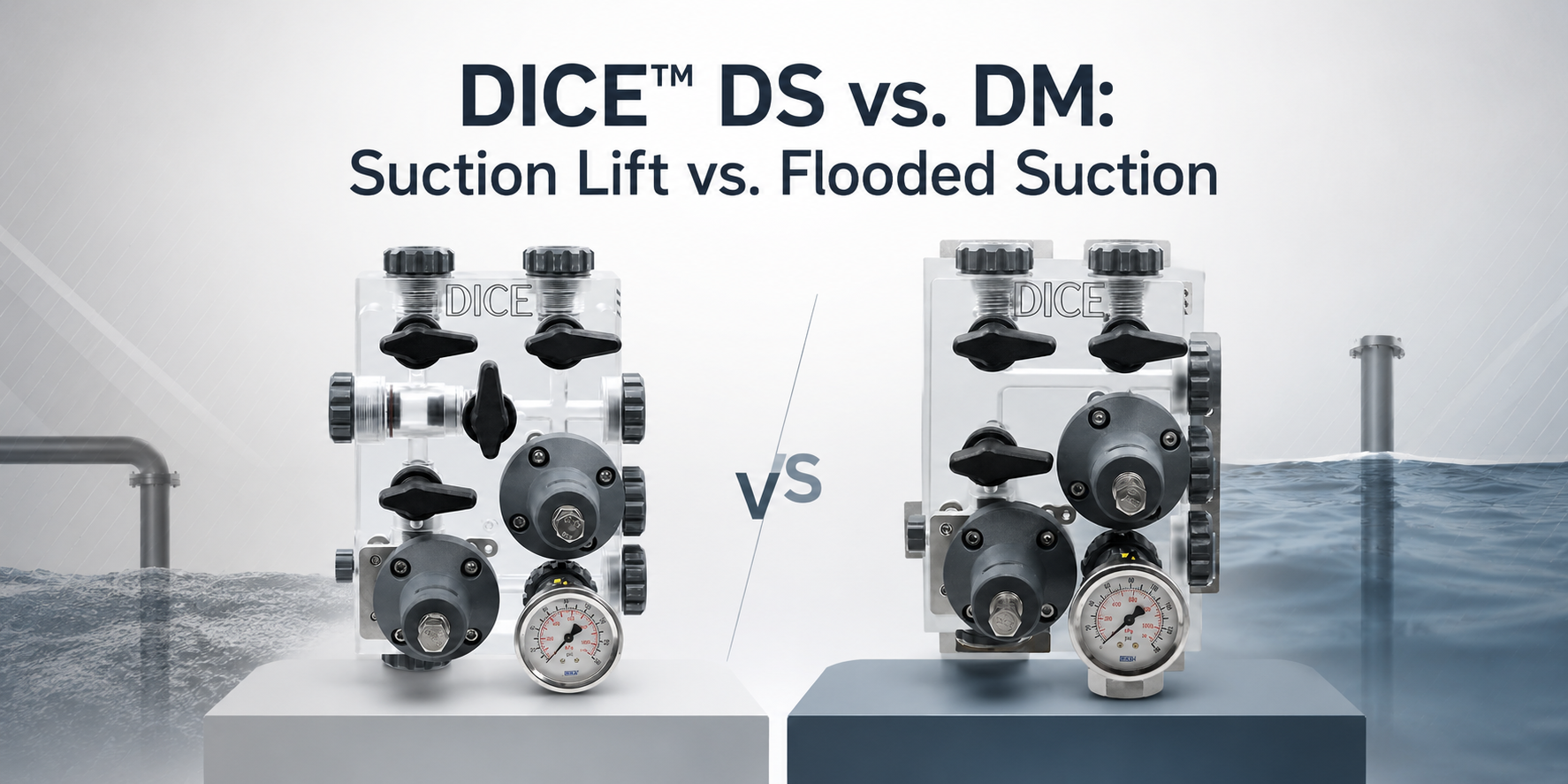
The DICE™ DS and DICE™ DM are the two calibration-capable DICE™ dosing modules. They share the same parts list (back-pressure valve, pressure-relief valve, pressure gauge with isolator, bleed valve, and three auxiliary ports), and they operate the same way day to day. The only structural difference is one extra ball valve in the middle of the DM. That single valve is what lets the DM handle flooded suction applications while still doing everything the DS does.
-
DICE™ DS is designed for suction lift only.
-
DICE™ DM is designed for flooded suction, but also handles suction lift, making it the more versatile choice when the application can swing either way.
If your fluid level varies (full tank one week, near-empty the next) the DM is usually the safer specification.
Inside a DICE™ Module: The Anatomy
Both the DS and DM are a single machined block that replaces the cluster of fittings, valves, gauges, and tubing that normally sits between a metering pump and the injection point. Every DICE™ module integrates these six components:

-
Ball valves for the outlet, calibration column, and drainage
-
Auxiliary ports for pulsation dampener, washing/dilution water, and secondary pumps
-
Adjustable back-pressure valve for stable discharge pressure
-
Adjustable pressure-relief valve for system protection
-
Pressure gauge with isolator for in-process monitoring
-
Bleed valve for safe depressurization before maintenance
Suction Lift vs. Flooded Suction (the 30-second refresher)
Suction lift means the chemical tank’s fluid level sits below the pump inlet. The pump has to create a vacuum to draw fluid up.
Flooded suction means the chemical tank’s fluid level sits above the pump inlet, so the inlet has a constant positive pressure. There’s no vacuum required to start dosing.
In real installations, the same tank can shift between the two states. A bulk storage tank that’s flooded suction when full can become suction-lift when it’s near empty, which is why a DM-grade module gives you headroom.


What’s identical between DS and DM
Both modules ship with the same general specification:
-
Standard design that fits all your essential needs
-
Extensive reliability and durability
-
Fully resistant to leaks (no threaded or glued connections)
-
Extremely compact design, minimal footprint
-
Easy retrofit on new or existing systems (3 supporting bolts, 4 connections)
-
Compatible with any chemical dosing pump (diaphragm, peristaltic, gear, vane, progressive cavity)
-
1 module can serve 3 pumps (single injection point, 3 pumps)
-
Calibration capability with the correct suction head and discharge pressure
-
Compatible with the widest range of chemicals
-
Lockout option available
-
Hydrostatic testing is included on every module
Normal operation is the same on both: chemical is pumped from the tank, through the DICE™, with the back-pressure valve maintaining a stable discharge, and into the process.
The three auxiliary ports
Both modules carry three auxiliary ports for connecting accessories without adding extra fittings to your skid. Each port can host any of the following:
-
Secondary pump (e.g., redundant dosing line)
-
Pulsation dampener to smooth pump output
-
Dilution or washing water for sticky/viscous chemistries
-
Other accessories per your application

What’s different: the one extra ball valve
The DM has an extra ball valve in the middle of the module. That single valve unlocks two flooded-suction capabilities:
-
It lets you drain the calibration column with the pump. In suction lift, the DS drains its calibration column back to the tank by gravity (easily, because the tank sits below the column). In flooded suction, there’s positive pressure at the pump suction, so gravity won’t drain the column. The DM’s extra ball valve routes the column contents through the pump instead.
-
It enables drawdown calibration. When you want to verify pump output by drawdown (timing the column emptying as the pump runs), the DM’s valve gives you that path. The DS doesn’t.
Emptying the calibration column, DS vs. DM behavior
Both models can be used to perform a pump calibration. How the calibration column drains depends entirely on which configuration you’re in.
DS (suction lift): After calibration, open the bleed valve, and the column drains back to the chemical tank by gravity. No pump needed.

DM (flooded suction): Positive pressure at the pump suction means gravity won’t drain the column. Open the extra ball valve and let the pump draw the column contents through. The same path also enables drawdown calibration if your QA protocol requires it.

Pressure relief: same valve, different routing
If a downstream pipe gets blocked, an injection quill plugs, or an isolation valve closes, the pressure-relief valve opens and cycles the excess pump fluid somewhere safe. Where that “somewhere” is depends on the configuration.
DS (suction lift configuration): The relief is plumbed back to the chemical tank. Excess pump fluid simply cycles back to bulk storage through a dedicated return line.

DM (flooded suction configuration): The relief can be looped back to the pump suction in a closed loop. Because the suction is already flooded, the entire installation runs on a single feed line from the storage tank: fewer fittings, fewer leak points, cleaner skid.

Why a DICE™ module beats a traditional piping build
A typical dosing skid uses a network of threaded/glued fittings, ball valves, tees, gauges, and tubing to assemble the same functions DICE™ integrates into one block. That traditional approach creates four chronic problems DICE™ solves:
-
Leak points multiply. Each threaded or glued connection is a future leak. DICE™ uses zero threaded or glued connections inside the block.
-
Pulsation fatigues fittings. Pump pulsation vibrates traditional piping. Over time, connections crack and components loosen. DICE™’s machined block is rigid by design.
-
Footprint balloons. Spread-out fittings need wall space. DICE™ collapses the same functions into a compact block that mounts to the wall.
-
Connection quality varies. Field-built piping depends on each technician’s skill. DICE™ is machined and hydrostatically tested at the factory.
Technical specifications (DS and DM)
|
Specification |
Value |
|---|---|
|
Size |
1/2" |
|
Connections |
Hose, Socket, NPT |
|
Body Material |
Clear Acrylic (PMMA), PVC, PVDF |
|
Component Material |
PVC, CPVC, PVDF |
|
Valve Seat Material |
PTFE |
|
Valve Handle Material |
Black ABS |
|
Diaphragm Material |
VITON, EPDM |
|
Seal Material |
VITON, EPDM |
|
Pressure Relief Valve Range |
0 to 150 PSI or 0 to 250 PSI |
|
Back-Pressure Valve Range |
0 to 150 PSI or 0 to 250 PSI |
|
Pressure Gauge Range |
0 to 150 PSI or 0 to 250 PSI |
Other materials available on request.
P&ID reference

DS vs. DM at a glance
|
Feature |
DICE™ DS |
DICE™ DM |
|---|---|---|
|
Designed for |
Suction lift |
Flooded suction (also handles suction lift) |
|
Extra ball valve in module |
No |
Yes |
|
Calibration column drain method |
Gravity to tank |
Through the pump |
|
Drawdown calibration capable |
No |
Yes |
|
Pressure relief routing |
Back to tank |
Closed loop to pump suction |
|
Single-feed-line skid possible |
No |
Yes |
|
Three auxiliary ports |
Yes |
Yes |
|
Lockout option |
Yes |
Yes |
|
Hydrostatic test on every unit |
Yes |
Yes |
Which one should you specify?
Use this quick decision rule:
-
Tank always below the pump? Specify the DICE™ DS.
-
Tank always above pump, or sometimes above / sometimes below? Specify the DICE™ DM.
-
Need drawdown calibration as part of your QA protocol? Specify the DICE™ DM.
-
Want to minimize the feed-line count on the skid? Specify the DICE™ DM (single loop is possible).
When in doubt, the DM is the more forgiving spec. It doesn’t lose any DS capability. It just adds flexibility.