

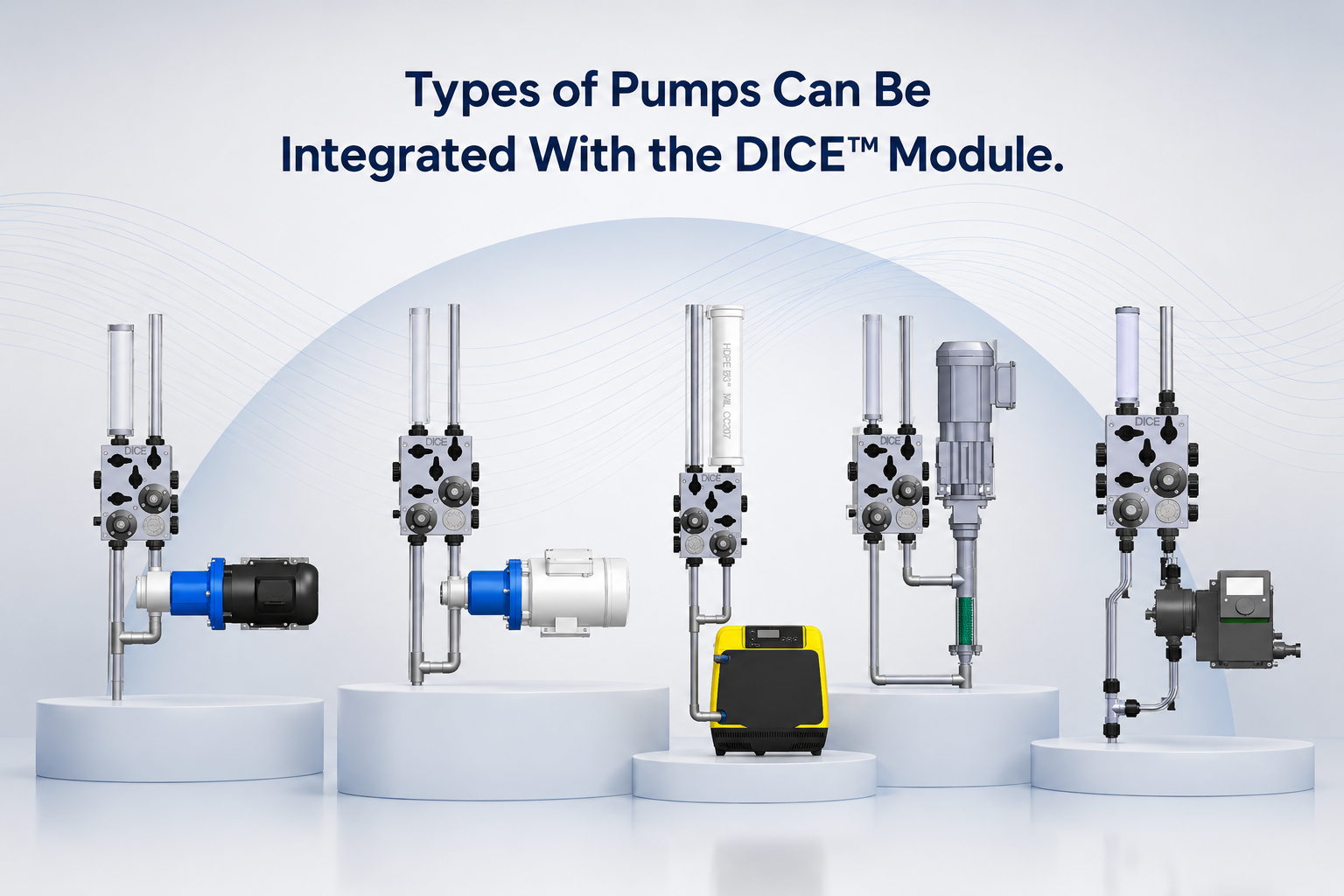
The DICE™ chemical dosing modules are designed to work with virtually any common dosing pump on the market. The most typical installation pairs DICE™ with a diaphragm metering pump, but the module is equally at home with progressive cavity pumps (a popular choice for polymer applications), peristaltic pumps, gear pumps, and vane pumps.
The only thing that changes between pump types is how you set up the DICE™ diaphragm spring-loaded valve. The rest of the integration (pressure gauge, isolation valves, calibration column, injection point, auxiliary ports) works exactly the same regardless of the pump.
The 5 Pump Types Compatible With DICE™
Diaphragm Pump
Typical installation

Progressive Cavity Pump
Polymer applications

Peristaltic Pump
Sensitive to outlet pressure

Gear Pump
Constant flow output

Vane Pump
Self-priming behavior

What the Spring-Loaded Valve Actually Does
Every DICE™ module ships with a diaphragm spring-loaded valve that serves three jobs at once. One valve, three functions, no extra fittings to source or maintain.
| Back-Pressure Valve | Non-Return Valve | Anti-Siphon Valve |
| For diaphragm dosing pumps, the valve holds a constant discharge pressure for precision and reliability. |
The diaphragm design allows for great non-return capability with extremely efficient sealing. |
The spring-loaded action blocks gravity-driven siphoning when the injection point sits below the chemical tank. |
How to Set the Valve Set-Point for Each Pump Type
The set-point is the only configuration variable that changes between pump types. Get this right and the
DICE™ behaves predictably. Get it wrong and you’ll either waste pump head or chew through valve life.
Diaphragm Dosing Pumps
Set the valve slightly HIGHER than process pressure. The valve behaves as a true back-pressure valve. The pump sees a stable discharge head, which is what diaphragm pumps need for precision dosing.
Progressive Cavity, Gear & Vane Pumps
Set the valve LOWER than process pressure. The valve sits open during normal pump operation (minimal pressure loss) while still snapping closed to act as a check valve when needed.
Peristaltic Pumps
Peristaltic pumps are sensitive to outlet pressure. Extra back-pressure shortens tube life, so set the valve LOWER than process pressure so the pump isn’t fighting unnecessary head.
About the DICE™ Dosing Modules
DICE™ (Dosing Integrated Compact Equipment) replaces the cluster of fittings, valves, gauges, and tubing that normally sits between a metering pump and the injection point. One machined block, four connections, three supporting bolts. Two configurations cover almost every installation:
DICE™ DS
Suction Lift
Designed for installations where the chemical tank sits below the pump, and the chemical must be lifted up to the suction side. Ideal for above-grade pump locations and tank-in-a-pit layouts.
-
1/2" size, NPT / socket / hose connections
-
Wetted parts: Clear acrylic, PVC, CPVC, or PVDF
-
Pressure ranges: 0 to 150 PSI or 0 to 250 PSI
-
Hydrostatic-tested on every unit
DICE™ DM
Flooded Suction
Designed for installations where the chemical tank sits above the pump, and the chemical flows down to the pump under gravity. Standard configuration for most municipal and industrial dosing rooms.
-
Same compact, leak-resistant block design as the DS
-
Three auxiliary ports for pulsation dampener, dilution water, or secondary pump
-
Adjustable back-pressure and pressure-relief valves
-
Lockout option available
Both modules share the same core features: standard design, extensive reliability, fully resistant to leaks (no threaded or glued connections), extremely compact footprint, easy retrofit (3 supporting bolts + 4 connections), capable of running 3 pumps from a single injection point, lockout option, and hydrostatic testing on every unit.
Why This Matters for Your Dosing Skid Design
This pump-agnostic compatibility is one of the reasons DICE™ has been adopted by OEMs as a packaged dosing module: a single, standardized hardware footprint that drops onto whatever pump the application requires. For end users, it means you don’t need to redesign your skid every time the chemical or duty changes. Swap the pump, retune the valve set-point, and the rest of the system stays put.
Not sure which DICE™ module fits your pump?
Cleanflow is an authorized DICE™ distributor. Send us your pump model and process pressure, and we’ll spec the right module and valve set-point.