

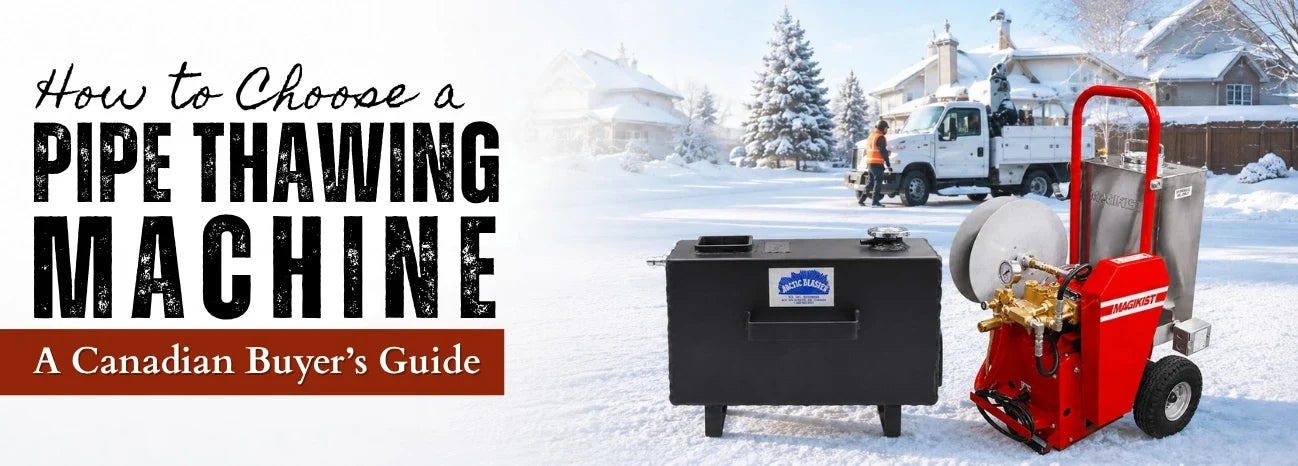
A frozen pipe doesn’t wait for business hours. When a sewer line locks up at -30°C on a January morning, you need a machine that works fast, without electricity, and without causing more damage than the freeze already has.
The right pipe thawing machine can clear a residential line in 15 minutes.
The wrong method can crack a plastic pipe, start a fire, or leave you waiting hours for results.
Why Canadian Winters Demand Professional Thawing Equipment
Most Canadians have heard the advice: let a tap drip, insulate exposed pipes, and know where your shutoff valve is. But for professionals working in infrastructure, farming, or construction, freeze-ups are an occupational reality, not a once-a-decade event.
Water expands roughly 9% when it freezes. Inside a confined pipe, that expansion generates pressure exceeding 2,000 PSI, enough to crack cast iron and split copper. Underground service lines in regions like Manitoba, Saskatchewan, and northern Ontario can freeze several feet deep during sustained cold snaps. Waiting for a natural thaw can mean days of lost water service.
The tools most people reach for first, propane torches, heat guns, and electric heat tape, all have serious limitations. Torches create fire hazards near insulation and wood framing, are illegal for use on plastic pipe, and can’t reach blockages more than a foot or two from the access point. Heat guns and electric cables require power and take hours. Neither method works on a 50-foot underground line.
Professional pipe thawing machines solve all of these problems. Two technologies dominate the Canadian market: steam thawing and pulse jet de-icing. Understanding the difference is the key to buying the right tool for your work.
Method 1: Steam Thawing — How a Pipe Steamer Works
Steam thawing is the go-to method for plumbers and contractors who deal with frozen sewer lines, culverts, septic systems, and larger-diameter pipes. It works on a simple but powerful principle.
A pipe steamer uses a propane torch to heat a water tank, typically 2 gallons, until it produces pressurized dry steam reaching up to 230°F (110°C). That steam is fed through a flexible hose directly into the frozen pipe. As it travels through the line, the steam condenses against the ice, releasing intense heat and melting the blockage from the inside out. The resulting water drains away naturally, and you work the hose deeper as the ice retreats.
Because no electricity is required, a pipe steamer works anywhere a propane tank can go: remote farms, off-grid job sites, underground crawl spaces, and roadside culverts. A standard 2-gallon tank provides roughly 15 minutes of continuous steam, enough to clear most residential lines in a single session. Longer runs or commercial-grade blockages may require refills, but the process remains fast compared to passive methods.
What steam thawing works best on
-
Sewer lines (3–10-inch diameter)
-
Culverts and storm drains
-
Septic system inlet and outlet pipes
-
Drain lines in remote or off-grid locations
-
Cast iron, ABS, and PVC drain pipes
-
Engine blocks, frozen valves, gutters, and downspouts (multi-purpose use)
-
Any application where electricity is unavailable
The Arctic Blaster: Canada’s Leading Pipe Steamer
The most widely used pipe steamer in Canada is the Arctic Blaster Portable Steam Thawing Device, manufactured in Alberta. It’s a 2-gallon propane-heated unit that generates steam up to 230°F and comes with dual hose sets: a 50-foot ¼″ hose for water lines and a 50-foot ⅜″ hose for sewer lines. Optional extension hoses reach up to 100 feet, covering the vast majority of residential and commercial freeze-up scenarios.
The machine heats up in 8–10 minutes and can be operated by a single person.
For context: a steam truck service call typically costs $600 or more per visit. Most contractors report that the Arctic Blaster pays for itself after three or four uses. It also doubles as a decal remover, stain cleaner, and engine defroster, making it a year-round tool, not just a winter emergency purchase.

Method 2: Pulse Jet De-Icing — How It Works
Pulse jet de-icing is the preferred method for municipal public works crews and contractors dealing with residential water service lines, especially plastic pipe, which steam thawing can occasionally stress under extreme conditions.
A pulse jet machine like the Magikist PJDX-C uses a 120V heating element to warm a large reservoir (9 gallons on the Magikist) and then pulses pressurized hot water through a thin probe that is fed directly into the frozen service line. The probe is self-feeding, meaning it advances through the line as the ice melts ahead of it, working from the ground-level access point to the blockage without open flames.
Because there is no combustion at the nozzle, pulse jet de-icers are safe to use indoors, in confined mechanical rooms, and near flammable materials where a propane setup would create liability. Many municipalities specify pulse jet systems for exactly this reason.
What pulse jet de-icing works best on
-
¾″ to 1″ residential water service lines
-
Plastic (PEX, CPVC, PE) water lines where flame-free operation is essential
-
Indoor applications: mechanical rooms, crawl spaces, basement utility lines
-
Municipal water service maintenance programs
-
Lines where access to electricity is available
Steam Thawing vs. Pulse Jet: Side-by-Side Comparison
Neither method is universally better. The right choice depends on your pipe type, job site, and the kind of freeze-up you face most often. Here’s how they stack up:
|
STEAM THAWING (e.g., Arctic Blaster) |
PULSE JET DE-ICING (e.g. Magikist PJDX-C) |
|
|
Electricity required? |
No — propane-powered |
Yes — 120V outlet or generator |
|
Works off-grid / remote? |
Yes ✔ |
No ✘ |
|
Safe for plastic pipe? |
Yes (at proper hose distance) |
Yes ✔ — no heat risk |
|
Open flame at the nozzle? |
No ✔ (flame on tank only) |
No ✔ |
|
Best pipe diameter |
2″– 10″ (drain/sewer) |
3/4″–1″ (water service) |
|
Max line length |
100 ft (with extension hose) |
100 ft (with tubing) |
|
Time to clear avg. line |
10–15 minutes |
10–30 minutes |
|
Sewer lines/culverts? |
Yes ✔ |
Not recommended |
|
Multi-purpose utility? |
Yes — decals, engines, gutters |
No — water lines only |
|
Approx. entry price (CAD) |
~$2,250 (Arctic Blaster) |
~$3,500–$4,500 (Magikist) |
|
Best for |
Plumbers, contractors, farmers, and municipal drain crews |
Municipal water utilities, residential plumbers, and facility managers |

When to Choose a Pipe Steamer
Steam thawing is the right call when one or more of these apply:
-
You work on sewer lines, culverts, or septic systems — steam is the only portable method that can navigate these larger-diameter pipes effectively.
-
Your job sites are remote or off-grid — farms, highway projects, rural infrastructure. No power outlet? No problem.
-
You need multi-purpose versatility — the same machine that thaws your sewer in January can remove decals, steam-clean surfaces, or deice valves the rest of the year.
-
You want the fastest ROI — a single steam truck service call costs $600+. The Arctic Blaster pays for itself in three to four jobs.
-
You are a plumbing contractor or drain technician who handles freeze-ups as a service offering.
Browse steam thawing machines at Cleanflow.
When to Choose Pulse Jet De-Icing
Pulse jet is the right call when one or more of these apply:
-
You work primarily on residential water service lines, the small-diameter plastic lines that run from the municipal main to a house.
-
Your work is indoors or in confined spaces where propane use is restricted or undesirable.
-
You are a municipal public works crew operating a city water maintenance program. Pulse jet systems are often specified in municipal procurement for this reason.
-
Your freeze-ups happen on plastic PEX or PE service lines, where the no-flame, no-heat-stress approach is preferred.
-
You have reliable access to 120V power at the job site.
Shop Magikist water service line de-icers.
Choosing the Right Hose Length for a Pipe Steamer
If you’re buying a steam thawing machine, hose length is the second most important decision after the machine itself. Here’s how to think about it:
50-foot hose (included with most units)
Covers the majority of residential and light commercial freeze-ups. A typical house service line from the street to the basement is 20–40 feet. A 50-foot hose gives you working room and handles most single-family home scenarios without an extension.
75-foot hose
The practical workhorse length for drain contractors and plumbers who handle both residential and small commercial work. Covers deeper lines, longer basement-to-street runs, and most above-ground culvert applications.
100-foot hose
Required for commercial buildings, larger culverts, municipal drain lines, and any application where the access point is far from the blockage. If you’re unsure, the 100-foot hose is the safe choice. You can always pull back unused length.

|
💡 Pro tip: the Arctic Blaster includes both a 50-ft ¼″ hose for water lines and a 50-ft ⅜″ hose for sewer lines. Replacement and extension hoses are available separately in 50, 75, and 100-foot lengths. |
What Does a Pipe Steamer Cost in Canada?
Price varies significantly depending on whether you’re looking at a portable propane-powered unit or a full electric pulse jet system.
|
EQUIPMENT TYPE |
PRICE RANGE (CAD) |
NOTES |
|
Arctic Blaster Portable Steam Thawing Device |
~$2,250 |
Includes dual 50-ft hose set. Propane torch sold separately. |
|
Arctic Blaster replacement/extension hoses |
$230–$350 |
Available in 50, 75, and 100-ft lengths. |
|
Propane torch kit (required accessory) |
~$280 |
Comfort grip, 15-ft hose, CSA/ETL rated. |
|
Magikist PJDX-C Pulse Jet De-Icer |
~$3,500–$4,500 |
Includes 100 ft of tubing, 9-gal tank, and probe tip. |
|
Steam truck service call (for comparison) |
$600–$1,200+ per visit |
No equipment asset. Reoccurring cost. |
Viewed as a capital purchase, the ROI on a pipe steamer is straightforward: if you respond to 3–4 freeze-up calls per winter or eliminate 3–4 service calls you’d otherwise subcontract out, the Arctic Blaster pays for itself in the first season. For farms and municipalities that deal with frozen lines every year, the payback period is often a single job.
Safety Tips for Using a Pipe Steamer
Steam at 230°F is safe when handled correctly. Follow these precautions every time:
-
Wear insulated gloves and safety glasses whenever handling steam hoses or connections.
-
Ensure adequate ventilation when operating propane combustion indoors, which requires airflow.
-
Keep a fire extinguisher within reach whenever the propane torch is in use.
-
Never exceed the recommended operating pressure specified in the machine’s manual.
-
Inspect steam hoses before every use. Replace any hose showing cracks, wear, or deformation.
-
Always allow the unit to cool before disassembly, and drain the tank before storage.
-
Disconnect the propane source before transporting the unit between job sites.
Shop Pipe Thawing Equipment at Cleanflow
Cleanflow Utility Supply Company is a Winnipeg-based supplier of professional pipe thawing equipment, serving plumbers, contractors, municipalities, and farmers across Canada since 2001. We stock the complete Arctic Blaster lineup, the steam thawing machines, all hose sizes, and the propane torch kit, as well as Magikist pulse jet systems for water service line work.
All orders over $199 ship free across Canada and the USA from our Winnipeg warehouse. No cross-border brokerage fees, no US import delays. Equipment ships fast and is ready to work.