

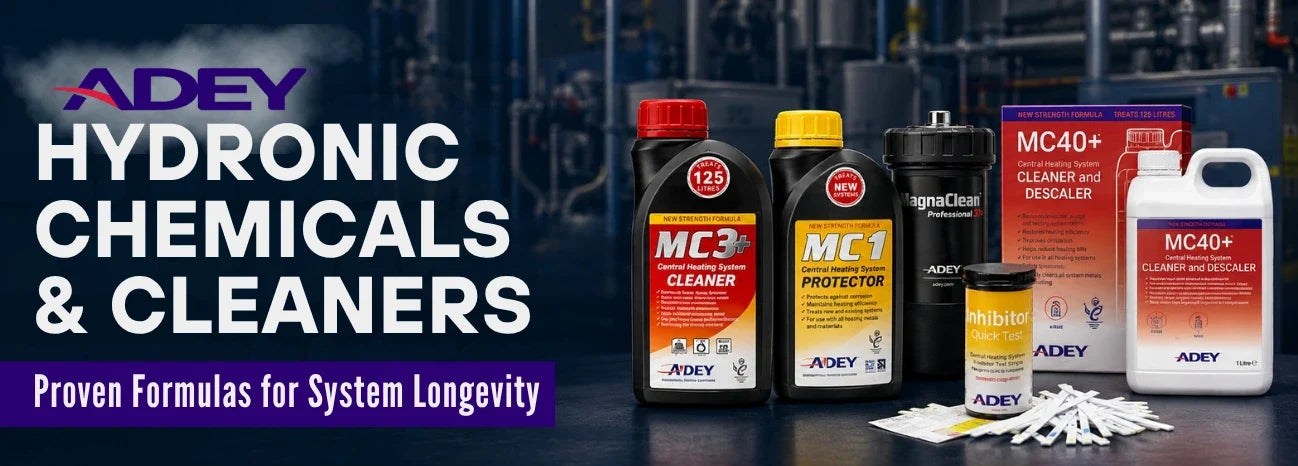
A radiator that runs cold across the bottom has a water problem, not a boiler problem. Corrosion inside steel pipework produces magnetite, a black iron oxide sludge that settles where flow slows and abrades everything it passes through on the way.
Hydronic heating system chemicals deal with the cause. ADEY makes three of them across five formats, and the useful part is not what each bottle does on its own. It is the order they go in.
What Goes Wrong Inside a Hydronic System
Steel corrodes in contact with oxygenated water. The reaction produces magnetite, and because magnetite is magnetic, it clumps rather than staying suspended. That is also what makes magnetite sludge removal possible, chemically and mechanically.
The damage compounds. Sludge settles in radiators as a cold band along the bottom of the panel. It reaches the heat exchanger and restricts the narrow passages first. It circulates through the pump and the valves, wearing the moving parts that cost the most to replace. Each of those reduces heat transfer, so the boiler fires longer for the same room temperature.
Limescale is the other half. In hard water, calcium deposits on the hottest surfaces, which is exactly where efficiency is decided.
New systems are not exempt. ADEY states that MC3+ removes greases and fluxes alongside sludge, and those are installation residues rather than corrosion products. A system commissioned without a clean starts its life with debris already circulating.
The Order of Operations

Clean, protect, filter, verify. The sequence is not arbitrary and getting it wrong wastes the chemical.
Cleaning comes first because a central heating inhibitor dosed into a dirty system spends itself on the sludge instead of protecting the metal. The protection is consumed, the debris stays, and the contractor is back in twelve months. It is the most common and most expensive mistake made with hydronic heating system chemicals.
Protection comes second, once the water is clean. ADEY treats the two products as a pair: MC1+ is formulated to compensate for up to 20 percent of MC3+ left in the system after draining, which is a frank acknowledgement that no drain-down is ever complete.
Filtration runs continuously after that, catching what forms between service visits. Chemicals and filters are not alternatives to each other.
Verification closes the loop, because inhibitor depletes and a system protected two years ago may not be protected now.
When to clean a heating system is a simpler question than it looks. Clean before commissioning anything new, before fitting a boiler onto existing pipework, and any time the symptoms point at circulation rather than the appliance.
Cleaning: MC3+ and MC40+
Hydronic heating system chemicals split the cleaning work in two, and ADEY makes a product for each half. One lifts sludge, the other is a heating system descaler for mineral deposits.

MC3+ for sludge
MC3+ is the general cleaner. It targets sludge, debris, greases and fluxes, and can be left in the system for up to 28 days when a longer soak suits the job. ADEY notes that raising the system water temperature improves its performance. Magnetite sludge removal is what it is for, and it covers most calls.
MC40+ for scale
MC40+ is the heavy-duty step, and it is a different kind of chemical. ADEY describes it as a citric-based acidic cleaner that dissolves limescale and dislodges hardened sludge deposits. One container treats 125 litres, the figure quoted as 33 US gallons on the product page. Reach for a heating system descaler when the deposits are mineral rather than metallic, or when a system has gone years without treatment.
The powder goes in dry when it is added slowly into a RapidFlush canister or a mechanical flushing device. For dosing through a filling loop, a radiator or a MagnaClean filter, ADEY says to dissolve it in warm water first. The domestic pack includes neutraliser sachets, which is worth knowing before an acidic cleaner goes into a system, and larger or heavily scaled systems may need more than one container.
For heavily fouled systems, there is a mechanical option alongside the chemistry. The MagnaCleanse is a portable flush unit with twin magnetic canisters and an agitator, and it handles magnetite sludge removal in around two hours without a full power flush. A heating system descaler and a mechanical flush are often used on the same job.
Protection: MC1+ and MC1+ Rapide
Once the water is clean, it has to stay that way, and that is what an inhibitor is for.
MC1+ is a central heating inhibitor: a blend of corrosion inhibitors, scale inhibitors and buffers. ADEY describes it as protecting all metals commonly found in a heating system, and states the Rapide version is compatible with all metals including aluminium.
That matters more than it sounds. A hydronic circuit mixes steel, copper, brass and often aluminium in the same water, and a multi-metal corrosion inhibitor has to protect every one of them without attacking any. An inhibitor that suits a steel system and pits an aluminium heat exchanger has done more harm than no inhibitor at all.
A multi-metal corrosion inhibitor is dosed by system volume. ADEY gives 500 ml of MC1+ per 125 litres, or up to 15 single panel radiators. The label and technical data sheet govern the actual dose on any given system.
Two things worth knowing before it goes in. MC1+ contains no phosphates, EDTA, nitrates or nitrites. And it is not for use in single-feed indirect cylinders, an exclusion ADEY states for MC3+ Rapide and MC40+ as well.
Standard Bottle or Rapide
The formula does not change. What changes is how it gets into the system.
A standard 500 ml bottle of central heating inhibitor is dosed through the MagnaClean canister, a radiator, or the feed and expansion tank. In most cases, that means opening the system.
A quick-dose inhibitor goes in through a radiator, an air vent, a boiler filling loop or a filter air vent, using the adaptor supplied. ADEY states a 125 litre system dosed in about 20 seconds, and 300 ml of MC1+ Rapide covers that volume, or up to 15 single panel radiators.
On a service call, that is the difference between a twenty-second task and opening the system. The same choice exists on the cleaner side, between MC3+ and MC3+ Rapide, and a quick-dose inhibitor is worth specifying wherever the system is sealed, and the job is billed by time.
Verification and the Annual Check
A central heating inhibitor depletes. It is consumed by the corrosion it prevents, and diluted every time the system is topped up or partly drained. That makes it the one part of a hydronic heating system chemicals routine that gets re-checked rather than fitted and forgotten.
ADEY works to BS 7593, the British code of practice for preparing and maintaining central heating water. It covers the clean as well as the check, and calls for the inhibitor level to be tested annually and after any work involving a drain-down. Canada has no equivalent water treatment code. CSA B214 covers hydronic installation rather than water chemistry, so the annual check here is best practice rather than an obligation.
Test strips make it a two-minute job at the end of a service. ADEY supplies inhibitor test strips for protection level, and quick test corrosion strips that read dissolved iron, which is an early signal that corrosion has started again.
Where Filtration Fits
Chemicals treat the water. A filter catches what the water is carrying. A magnetic filter such as the MagnaClean Micro2 captures magnetite continuously between visits, which is what keeps a cleaned system from fouling again inside a season. Hydronic heating system chemicals without a filter mean re-cleaning. A filter without chemicals means catching corrosion products instead of preventing them.
Putting the Sequence Into Practice
Hydronic heating system chemicals are consumables, and the systems that stay efficient are the ones where somebody is tracking them. Clean it, protect it, filter it, check it once a year. The full ADEY range is stocked at Cleanflow and ships across Canada and the USA.
Frequently Asked Questions
Do you clean the heating system before adding an inhibitor?
Yes, clean first. Inhibitor dosed into a dirty system spends itself neutralising sludge instead of protecting the metal, so the protection is used up and the debris stays put. When to clean a heating system is simple: before dosing, and before commissioning. ADEY formulates MC1+ to tolerate up to 20 percent of MC3+ remaining after a drain-down.
How often should central heating inhibitors be replaced?
Check it annually and top up after any work that drains the system. ADEY ties the annual check to BS 7593, the British code of practice. Canada has no equivalent water treatment standard, so treat it as best practice rather than a requirement. Inhibitor test strips give a reading in about two minutes.
Can you dose a sealed heating system without draining it?
Yes, with a quick-dose inhibitor. ADEY states a 125 litre system can be dosed in about 20 seconds through a radiator, air vent, boiler filling loop or filter air vent, using the adaptor supplied. A standard bottle usually requires opening the system, which is the practical difference between the two.
What is the difference between MC1+ and MC3+?
MC1+ protects, and MC3+ cleans. They run in sequence rather than as alternatives. MC3+ removes sludge, debris, greases, and fluxes from a fouled or newly installed system. MC1+ is dosed afterwards to slow the corrosion that produced the sludge in the first place, so the clean holds.