

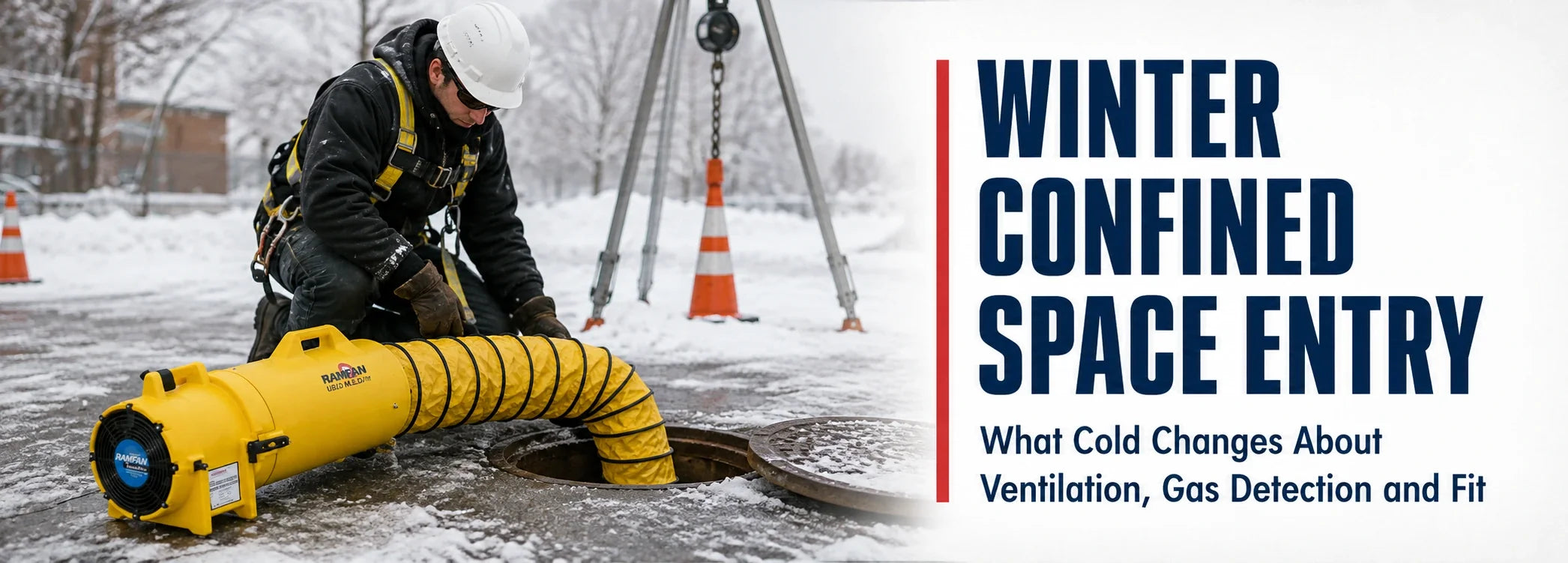
A manhole at minus 25 is not a different confined space. It is the same confined space with three new problems. The supply air is cold enough to drive a crew out in twenty minutes, the gas monitor is running outside the range it was calibrated in, and the harness that fit in September now goes over a parka.
Crews get the first one wrong most often. Warm air is easy to make. Warm air that is safe to breathe is not.
| Quick answer: Heat supply air with an indirect-fired unit only. A direct-fired heater puts carbon monoxide, carbon dioxide, nitrogen dioxide, and water vapour into the airstream. Check your gas monitor's normal operating range, not its rated minimum. Refit harnesses over the layer actually worn. |
Warm Air Is Easy. Warm Air That Is Safe to Breathe Is Not.
The ventilation requirement does not relax in winter. WorkSafeBC requires continuous ventilation while a worker is inside, at a minimum of 50 cfm of clean respirable air per worker. So the instinct to throttle the blower back and keep the space warmer trades a comfort problem for an atmosphere problem.
That is where heater type stops being a preference. A direct-fired heater passes air across an open flame, and everything combustion produces goes where that air goes: carbon monoxide, carbon dioxide, nitrogen dioxide, and water vapour. An indirect-fired unit burns fuel in a sealed chamber, warms the air across a heat exchanger, and vents the combustion gases separately through a flue.
No regulation names heater types here. It does not have to. Forced air ventilation must draw from a clean source and must not increase the hazards in the space. A direct-fired heater fails that test by design.
The Ramfan UB20 in-line confined space heating system uses a heat exchanger for that reason. It puts out 55,000 BTU, runs up to 10 hours on a 20 lb propane tank, and carries CSA and UL certification. The kit pairs the Ramfan UB20 blower with the heater and quick-couple ducting. Our guide to direct and indirect heaters covers the same physics above ground.
| One honest limitation. Propane vaporization falls as the cylinder gets colder, and frost on the wall insulates it further. A small cylinder hits that wall sooner than a large tank. Rotate a warm spare on deep cold days. |
Your Gas Monitor Has Two Temperature Ratings
The MSA ALTAIR 4XR has a normal operating range of minus 10 to 40 degrees Celsius and an extended range of minus 40 to 60. Minus 10 is an ordinary January morning on the Prairies, so most Canadian winter entries run in the extended range.
That difference is not academic. MSA publishes LEL reproducibility of 3 percent in the normal range and 5 percent in the extended one. The instrument works. It is less precise where you use it.
Chemistry adds a second limit. Electrochemical sensors use an aqueous electrolyte that can freeze below minus 20 for a sustained period, and oxygen usually goes first. Battery run time can halve. Keep the monitor inside your coat, and bump test at the temperature you will work in.
Fit the Harness to the Layer They Are Wearing
The industry does not agree on this one, which is worth knowing before someone argues with you on site. One position is harness over the jacket. Trainers at Gravitec argue you need the D-rings accessible, and that a jacket worn over a harness that stretches during arrest risks taking a zipper to the throat. Bulk also eats strap tail, so a worker who runs out of adjustment needs the next size up, not a looser buckle.
The other position is base layer only, because a harness has to sit flush against the body to control fit and reduce orthostatic intolerance in suspension.
Both sides agree on the part that matters: refit at the layer being worn, not the layer it was fitted over in September. Outerwear with pass-through slots settles most of it. Peakworks rates its recovery mechanism self retracting lifelines from minus 40 to plus 50. Most manufacturers publish no low temperature rating at all, so check the cable for ice before it goes on the tripod.
What Gets Added to the Pre-Entry Check in Winter
Winter confined space entry does not call for different equipment. It calls for different checks.

- Confirm the heater is indirect fired and the flue is clear of snow.
- Bump test at working temperature, not in the truck cab.
- Refit every harness over the outer layer that the worker will wear in.
- Check the SRL and winch cables for ice and free travel before rigging.
- Sand the ice around the opening. The attendant cannot leave it.
Confined Space Equipment Shipped Across Canada and the USA
Cleanflow Utility Supply Company is a Winnipeg-based supplier serving municipalities, public works crews, and contractors across Canada since 2001. We stock the Ramfan UB20 confined space blower, the in-line heating system, ducting, and the M.E.D. manhole entry device that keeps air moving while a worker climbs through.
See the full range of confined space ventilation equipment, or the Peakworks fall protection line.
All orders over $199 ship free across Canada and the USA from our Winnipeg warehouse. No duty, no brokerage, no border delays.
Sizing a system for winter confined space entry? Call 1-866-335-1078, Mon to Fri, 7:30 AM to 4:30 PM CST.
Frequently Asked Questions
Is it safe to use a propane heater in an enclosed space?
Not inside one. Heat the supply air outside the space with an indirect-fired unit that separates combustion gases from the airstream and vents them through a flue. A direct-fired heater adds carbon monoxide to the air a worker breathes.
What temperature can a 4-gas monitor operate in?
Most publish two ranges. The MSA ALTAIR 4XR lists a normal range of minus 10 to 40 degrees Celsius and an extended range of minus 40 to 60, with reduced LEL accuracy in the extended one. Check both numbers, not just the minimum.
Should a full body harness be worn over or under winter clothing?
The industry is split. Some trainers say over the jacket for D-ring access and to avoid a zipper injury during arrest. Others say base layer only for fit. Either way, refit at the layer worn and size up rather than loosening buckles.
Is it too cold to enter a confined space?
Canadian regulations do not set a minimum entry temperature. What limits you in practice is your equipment's rated operating range and cold stress on the crew. Check the gas monitor range first, because it is usually the narrowest.
How long will a 20 lb propane tank last on a confined space heater?
The Ramfan UB20 in-line system runs up to 10 hours on a 20 lb cylinder. Expect less in deep cold, because vaporization falls with temperature and frost on the cylinder restricts heat transfer.