

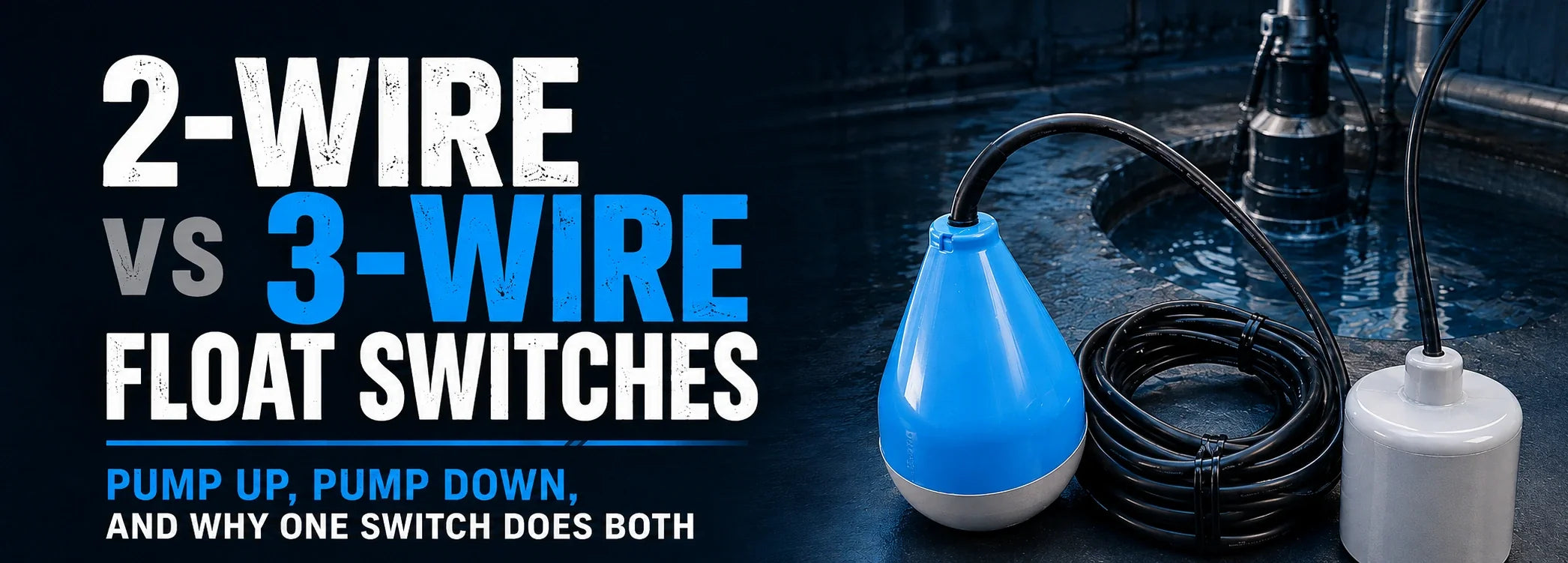
A float switch has one job. It turns a pump on or off when the water reaches a certain height. The confusion is not the job. It is the vocabulary.
Normally open. Normally closed. Pump down. Pump up. Two-wire. Three-wire. SPST. SPDT. Eight terms, and most catalogues use all of them on the same page.
They describe two things. What you want the pump to do, and whether the switch can change its mind later.
| Quick answer: A 2-wire float switch does one job, and the factory already chose which one. A 3-wire float switch can be wired either way in the field. Normally open empties a tank. Normally closed fills one. If you are hardwiring into a panel, the 3-wire is usually the better item to stock. |

The bottom row is the purchasing decision. Everything above it is naming.
SJE Rhombus states the equivalence directly on every pump switch spec sheet. Pump down is normally open contacts for emptying. Pump up is normally closed contacts for filling. Once you know that, four of the eight terms collapse into two.
Decision One, Pump Down or Pump Up
Both terms describe the switch at rest, with the float hanging down. That resting position is the reference point for everything else.
In a normally open switch, the contacts are open when the float hangs down. No current passes. Water rises, the float tips up, the contacts close, and the pump starts. It runs until the level drops and the float falls again. That empties the pit.
A normally closed switch does the reverse. The contacts are closed when the float hangs down, so the pump runs while the level is low. Water rises, the float tips up, the contacts open, and the pump stops. That fills the tank.
Sump pits, sewage basins, effluent chambers, and municipal lift stations all pump down. Cisterns, potable water storage, and booster feeds pump up. Alarms follow the same logic in reverse: a high level alarm uses normally open contacts, a low level alarm uses normally closed.
Decision Two, One Contact With Two Destinations
This is where most explanations stop short. The third wire is not an extra feature bolted onto the switch. It is a second destination for the same moving part.
A 2-wire float switch has one pair of contacts and one path. The circuit is either made or broken. Whichever direction the factory is built in is the direction you get.
A 3-wire float switch has one moving contact, called the common, and two fixed contacts it can land on. Tip the float one way, and the common touches the normally closed contact. Tip it the other way, and it touches the normally open contact. Nothing is added. The same moving part simply arrives somewhere different.
SJE puts it in one sentence. An SPDT is a 3-wire float that can be wired to be used as either pump up or pump down.
The wiring follows from that. SJE publishes a colour convention for its control switches: the common is white, the normally open leg is black, and the normally closed leg is red. Land the common and the black leg for pump down. Land the common and the red leg for pump up. Same switch, same three conductors, opposite behaviour.
SJE does not publish a colour table for its pump switches, so check the wiring figure on the installation sheet that ships with yours. What SJE does confirm is that the two switchable legs are red and black, and that one of them gets capped.
The SJE PumpMaster SPDT is the pump duty version of that arrangement. It carries 13 amps, controls pumps up to 1/2 HP at 120 VAC and 1 HP at 230 VAC, and adjusts across a 7 to 36 inch pumping range.
Which Wire Do You Cap
This is the question the internet does not answer, and the answer carries a warning with it.
You cap the leg you are not using. On an SJE control switch, wiring for pump down means capping the red. Wiring for pump up means capping the black. On the pump switches, including the SJE PumpMaster SPDT, confirm which leg is which against the wiring figure on the installation sheet before you cap anything.
SJE is specific about why it matters. "On SPDT Models, insulate unused red or black wires with a wire nut. Wire can become electrically hot."
An unused leg on an SPDT switch is not a dead wire. Leave it bare in a junction box, and you have a live conductor sitting loose in a wet enclosure.
Three more instructions from the same installation sheet apply to every job. "Disconnect power before installing or servicing this product. A qualified service person must install and service this product according to applicable electrical and plumbing codes." And on higher voltage work: "In 230 VAC installations, one side of the line going to the load is always HOT. This condition exists if the switch is on or off. Install double pole disconnect on all 230 VAC circuits."
Every Piggyback Switch Arrives With Its Direction Already Chosen
A piggyback float switch carries a moulded plug with a receptacle in its back. The switch plugs into the wall. The pump plugs into the float switch. The switch sits between the outlet and the pump and decides when power reaches it.
Order matters. SJE specifies inserting the switch's piggyback plug into the outlet first, then plugging the pump into the piggyback plug. Two conditions come with it: "Electrical outlet must not be located in pump chamber" and "Electrical outlet voltage, piggy-back plug voltage, and pump voltage must match."
Here is what buyers rarely notice. Across the SJE line, the switches that can be field wired either way are all direct wiring only. SJE states it plainly: PumpMaster SPDT models are available without plug only, for direct wiring. The PumpMaster WPS and the AmpMaster have no piggyback version either. Meanwhile, every piggyback float switch in the range has its direction set by part number before it ships.
So the connection method is the configuration decision. Choose plug and play and you are choosing pump up or pump down at the order screen. Choose field configurable and you are hardwiring into a junction box or a panel. The PumpMaster Plus is the piggyback route, and it ships pump up or pump down according to the part number you order.
How to Tell What You Already Have
An unmarked switch pulled from a pit can be identified in about a minute with a multimeter.
- Disconnect power and remove the switch from the circuit.
- Set the meter to continuity.
- Hold the float so it hangs straight down. On a 2-wire switch, probe the two leads. On a 3-wire float switch, probe the common against each of the other two in turn.
- Continuity with the float hanging down means those contacts are normally closed. No continuity means normally open.
SJE also colour codes the caps on its control switches, which is faster than a meter when the switch is still new enough to read. Yellow is normally open. White is normally closed. Green is SPDT. Blue and orange mark the MilliAmpMaster and the MilliAmpMaster WPS. The SignalMaster uses that convention.
When a 2-Wire Switch Is the Better Buy
A 3-wire float switch is not automatically the right answer. If a site only ever pumps down, a 2-wire piggyback switch is cheaper, faster to install, and has one less conductor to terminate wrong.
The mistake worth avoiding is a different one. Pump switches and control switches are not interchangeable. SJE prints the warning on every pump switch spec sheet. A pump switch is designed for horsepower-rated loads and is not suitable for control applications. It will fail prematurely when switching loads less than 1 amp at 120 VAC.
Put a 20-amp pump switch on a panel input, and it will not last. Send full motor current through a 1-amp control switch, and it will not last either. Match the switch to the load first, then worry about direction.
There is also a ceiling on direct pump control. The AmpMaster handles 1-1/2 HP at 125 VAC and 3 HP at 250 VAC at 20 amps. Above that, no float switch controls the pump on its own, and the job needs a control panel.
Frequently Asked Questions
What is the difference between a 2-wire and 3-wire float switch?
A 2-wire float switch does one direction only, and that cannot change after it ships. A 3-wire float switch has a common contact plus a normally open and a normally closed leg, so it can be wired for either pump up or pump down in the field.
Which wire do you cap on a 3-wire float switch?
Cap the leg you are not using. On SJE control switches, common and black give pump down, so you cap the red. Reverse it for pump up. Check the installation sheet for pump switches, then insulate the unused wire with a wire nut, because it can become electrically hot.
How do you tell if a float switch is normally open or closed?
Disconnect power, remove the switch, and set a multimeter to continuity. Hold the float hanging straight down and probe the leads. Continuity in that position means normally closed. No continuity means normally open. On SJE control switches, a yellow cap is normally open and white is normally closed.
Can one float switch do both pump up and pump down?
Yes, if it is a 3-wire float switch with SPDT contacts. The same switch wires either way. A 2-wire switch cannot be reversed, because the direction is built in at the factory and there is no second contact to move to.
How does a piggyback float switch work?
A piggyback float switch plugs into the wall outlet, and the pump plugs into the back of its plug. The switch controls when power reaches the pump. Plug the switch in first, then the pump, and make sure the outlet, plug, and pump voltages all match.