

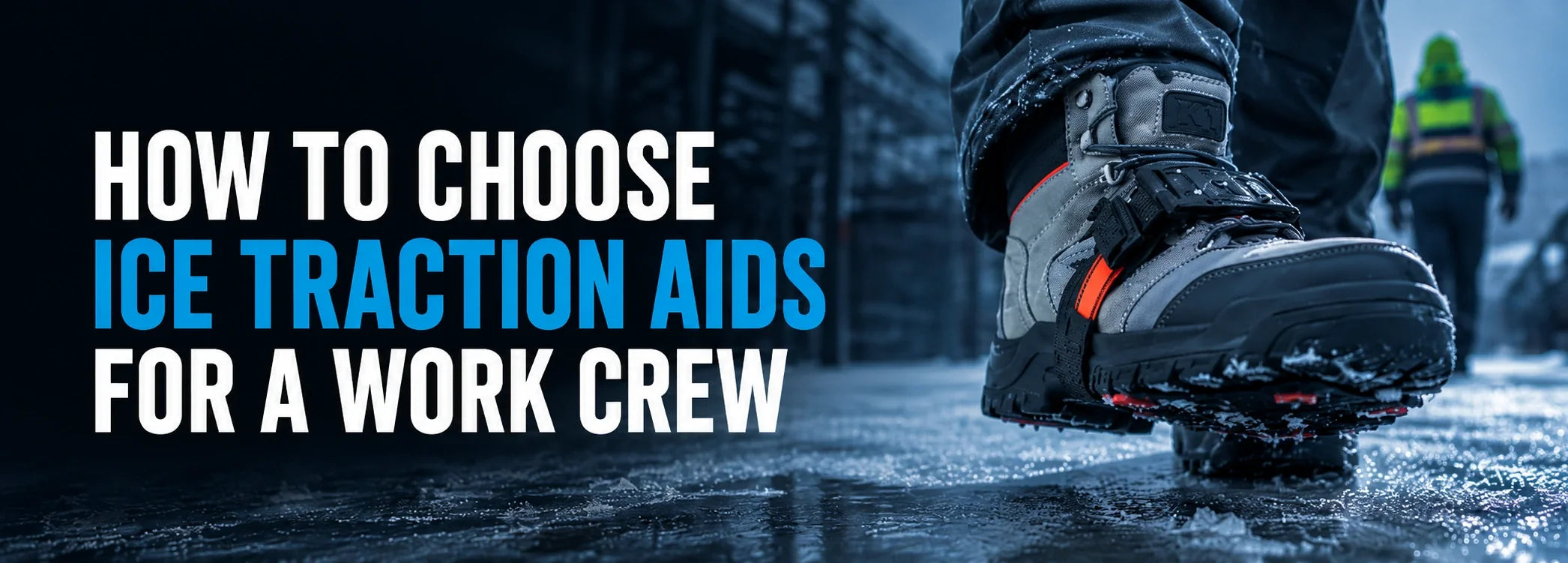
Slips, trips and falls account for more than a quarter of the workplace injuries that keep people off work, according to National Safety Council figures. Winter adds a surface that ordinary footwear was never able to grip, and most published advice on the subject stops at walking slowly and holding the rail.
What follows covers the specification instead. Which type of traction aid suits which work, how to match a cleat to the boots a crew already owns, what wears out, and the handful of details that decide whether the things are still being worn in February.
Why Winter Safety Boots Do Not Replace Ice Traction Aids
Insulated boots solve cold. They do not solve ice, because the two are answered by different mechanisms. A rubber outsole grips by friction against a surface, and ice offers very little to work against. Metal points grip by penetrating, which is not a property any sole compound provides.
The Canadian Centre for Occupational Health and Safety states this without hedging. Its guidance on preventing slips and falls notes there is no footwear with anti-slip properties suitable for every condition, and recommends consulting manufacturers rather than assuming a sole will cope.
In practice winter safety boots and ice traction aids belong on the same purchase order rather than competing for the same line on it.
The Indoor Removal Problem in Winter Traction Programs
Every winter safety notice issued in North America carries the same instruction. Remove ice cleats before entering a building, because studs mark floors and lose grip on tile and terrazzo.
The advice is correct, and it creates the problem that undermines most programs. A worker who has to stop at every threshold stops refitting them somewhere around the third week, and traction aids sitting in a locker prevent nothing. Winter traction programs fail on compliance far more often than they fail on equipment.
Two designs remove the instruction rather than working around it. Heel-only aids sit behind the ball of the foot and stay clear of pedals. Rotating mid-sole cleats turn the spiked pad to the top of the boot, so nothing leaves the foot at all. Either lets a crew keep the aid on through a shift that crosses in and out of buildings.
Types of Ice Traction Aids and the Work Each Suits
The first question is how much of a shift is genuinely spent on ice.

| Type | Suits | Trade-off |
|---|---|---|
| Full-foot | Sustained outdoor exposure. Yard work, snow clearing, site patrol. | Most spike coverage. Has to be removed indoors. |
| Heel-only | Drivers and anyone in and out of a cab through the day | Grip at heel strike rather than through the whole stride |
| Rotating mid-sole | Shifts broken up by cabs, ladders, plant floors and offices | Stays on the boot, so nothing is set down and lost |
The common specification error is buying maximum coverage for a crew that spends half its day indoors. The most aggressive cleat available prevents nothing from a shelf.
How to Match Ice Cleats to Work Boot Soles
A mid-sole cleat sits beneath the middle of the boot, and whether its studs reach the ground depends entirely on the sole above them. Turn the boot over before ordering.
| Sole | Profile |
|---|---|
| Flat, walking or athletic shoe | Slim |
| Shallow tread, little or no defined heel | Low |
| Conventional work boot with a defined heel | Original |
| Deep lugs, high arch, aggressive heel | High |
Two failures follow from getting it wrong. A cleat that sits too tall lifts the foot and rocks under load. A cleat that sits too low never reaches past the tread, so the studs do not contact ice at all. Neither is apparent until somebody is standing on it, which is why fit complaints usually arrive as returns.
One detail worth knowing before the first order. If studs on a correctly matched cleat still are not reaching through a deep tread, spacers and shims add depth. They are a low-cost part sold separately, and they resolve a complaint that otherwise gets logged as the wrong product entirely.
Sizing shapes the order as much as the profile does. Cleats on an adjustable strap fit any work boot on a crew, which removes sizing from a bulk purchase. Sized products need a roster, and assembling a roster is one of the more common reasons an order slips past the first freeze.
What Wears Out on an Ice Cleat and What Can Be Replaced
Most mid-sole cleats carry molded-in studs. The studs are formed into the rubber during manufacture rather than fitted afterwards, which means nothing can work loose and nothing can be replaced on its own. When studs wear down, the pad is replaced as a unit.
That is a genuine trade rather than a shortcoming. Products with screw-in or riveted studs allow individual replacement, and they also carry a fastener that can back out on rough ground. Neither approach is better in the abstract, but the choice determines what a replacement order looks like three winters from now.
Straps are the other wear point and they usually are replaceable. On the K1 range, replacement straps, suspension components, comfort pads and spacers are all available as separate parts. On heel-only models the hook and loop closure is normally the first thing to go.
For a program of any size, order a small quantity of straps and spacers alongside the cleats. The parts are inexpensive, they arrive on the same shipment, and a strap that fails in February will otherwise take a cleat out of service for the rest of the season.

Non-Sparking Ice Cleats for Classified Areas
Standard traction aids are not specified for areas where gas, vapour or dust could ignite. Certified intrinsically safe models exist for that work, and two things about them are routinely missed.
The certification covers the cleat, not the worker. K1 states its intrinsic models must be worn with appropriate ESD footwear, so cleat and boot are specified together or the classified area is not covered. A certified cleat on an unrated boot changes nothing.
Certification does not vary by profile. The same certification applies across the range, so profile remains purely a fit decision. The hazard determines whether a certified cleat is needed at all, and the boot determines which one.
Dust is the classification most often overlooked. Gas is the obvious case in digester buildings, wet wells and fuel handling, but grain handling and feed milling are dust environments, and dust ignites.
The authority on where those areas begin and end is the site's hazardous area classification drawing rather than any product page. The certified non-sparking models sit alongside the confined space equipment the same crews already carry.
Reading a Part Number Before the Order Goes In
Traction aid product names are inconsistent between distributors, and the same physical item appears under several. Part numbers are the more reliable identifier, and on some ranges they are readable once the pattern is known.
On the K1 mid-sole range, the V9770 prefix indicates the standard line and V8770 indicates intrinsic. The final two digits carry the strap: 50 for hi-viz, 70 for black, 60 for intrinsic. The digit ahead of those encodes the profile.
The practical value is verification rather than ordering. On a bulk purchase where several profiles ship together, the boxes look alike and the product names differ only by a word. A part number confirms in seconds what a product title takes a phone call to establish.
Six Checks Before Specifying a Winter Traction Program
- Count who works outside and for how much of a shift. That determines type before it determines brand.
- Look at what those crews actually wear on their feet. Profile is a fit decision, and a crew running two kinds of boot needs two profiles.
- Check for classified areas. If any exist, that crew needs certified cleats and ESD footwear specified together.
- Choose a design that survives the threshold. Anything that has to come off at the door will eventually stay off.
- Order spares with the initial purchase. Straps and spacers cost little and ship on the same order.
- Order before the freeze. Stock tightens across the category through November and lead times extend precisely when the need appears.
On regulatory obligation: OSHA's winter weather guidance directs US employers to clear ice promptly and train workers on footwear with good traction. In Canada, occupational health and safety is provincial, so the duty depends on jurisdiction. Neither is a reason to defer the six checks above.
Cleanflow Utility Supply Company stocks ice traction aids from K1 Series and Due North, with free shipping on orders over $199 across Canada and the USA.
Frequently Asked Questions
Are slip-resistant boots enough on ice?
Usually not on their own. Slip resistance is generally tested against wet or oily indoor flooring rather than ice, and rubber grips by friction where ice removes it. A traction aid adds metal points that penetrate, which is a different mechanism from any tread pattern.
Can ice cleat studs be replaced?
On most mid-sole cleats, no. The studs are molded into the pad rather than fitted, so a worn pad is replaced as a unit. Straps, comfort pads and spacers are generally available separately, and ordering a few with the initial purchase keeps cleats in service through the season.
Does an employer have to provide ice cleats?
It depends on jurisdiction. OSHA advises US employers to clear ice and train on footwear traction, which is guidance rather than a requirement to supply cleats. In Canada the duty sits in provincial legislation, so the answer varies by province.
Do ice cleats damage floors?
Metal studs can mark tile, terrazzo and finished flooring, and they lose grip on smooth interior surfaces. That is why standard guidance is to remove them indoors. Rotating and heel-only designs address it by moving the spikes off the floor rather than off the boot.
When should ice traction aids be ordered?
Ahead of the season. Stock tightens across the category through November and December, and a crew still waiting on delivery in January has already had the falls the order was meant to prevent.