

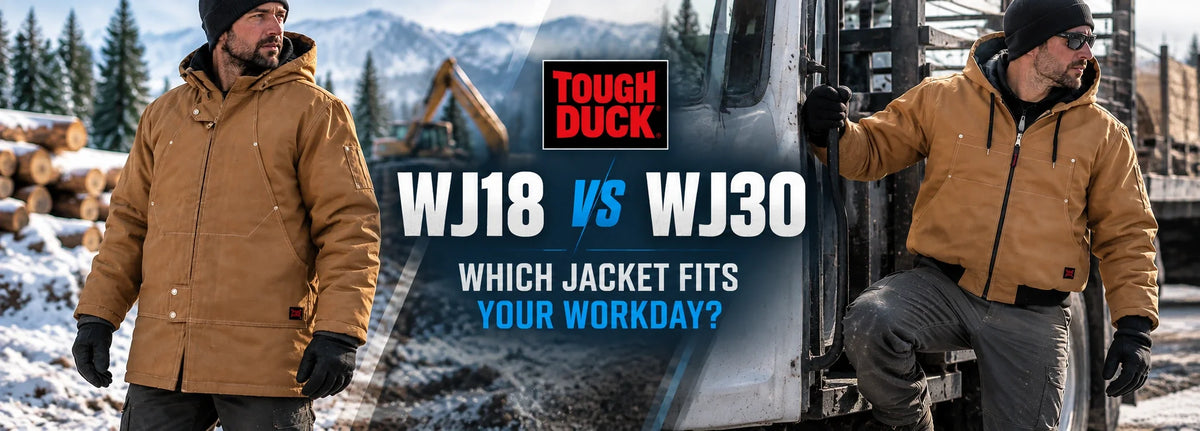
Choosing between the Tough Duck WJ18 and Tough Duck WJ30 is largely a matter of coverage versus movement. Both start with a 12 oz cotton duck shell. But the WJ18 Abraham Hydro Parka adds 8 oz insulation and a longer cut for more time outdoors. The WJ30 Classic Hooded Bomber uses 6 oz insulation, a shorter waist, and an action back for easier bending, climbing, and driving.
This Tough Duck WJ18 vs. WJ30 comparison explains which design is best for each workday.

The Better Match at a Glance
The Tough Duck hydro parka vs. bomber choice starts with one question: does the job demand more weather coverage or more freedom of movement? Choose the WJ18 when more insulation, a longer cut and a removable hood matter most. Choose the WJ30 for frequent bending, climbing, reaching or driving.
Both jackets use water- and wind-repellent cotton duck, brass hardware, triple stitching and rivets at stress points. Pick by exposure first, then movement.
Tough Duck WJ18 vs WJ30 Comparison
Insulation, jacket cut, hood design and mobility create the biggest differences.

The WJ18 pairs 8 oz insulation with a longer parka cut, giving the body more coverage during slower outdoor work. The WJ30 pairs 6 oz insulation with a short waist and action back, leaving less material to bunch when the wearer bends, climbs, or sits.
Which Jacket Is Warmer?
The WJ18 is the stronger choice when warmth and body coverage come first. It uses 8 oz polyester insulation, compared with 6 oz in the WJ30. Its parka cut also covers more of the body during long outdoor shifts.
But insulation weight isn't a temperature rating. Base layers, wind, moisture, work pace, and time outside all affect warmth. The WJ18 suits long stretches outdoors or steadier tasks. The WJ30 may feel better during continuous lifting, climbing, or other high-output work.
Coverage vs Mobility
The parka covers more of the body. The bomber leaves more room to move at the waist and shoulders. That is the key tradeoff.
The WJ18 has an inside drawcord that lets the wearer tighten the waist and reduce open space around the midsection. Its longer cut suits outdoor crews, yard work and lower-activity tasks where exposure lasts longer.
The WJ30 ends at a rib-knit waistband and adds an action back for shoulder movement. Its shorter body leaves less material around the hips, which helps when driving, climbing ladders or working in a crouch. If the job changes position often, the WJ30 is the more practical choice.
Hoods, Cuffs and Pocket Layouts
Weather can change during a shift, so hood design matters. The WJ18 has a detachable snap-off hood with a drawcord. Keep it on for open outdoor work, or remove it when a hood gets in the way. The WJ30 uses an attached three-piece hood, so it is always ready.
At the wrists, the WJ18 uses rib-knit storm cuffs. The WJ30 pairs rib-knit cuffs with a rib-knit waistband to close the shorter bomber profile. The WJ18 also has snap tabs at the top and bottom of its brass zipper. The WJ30 uses a full-zip brass closure.
Storage is generous on both jackets, but the layout differs. The WJ18 has four large scoop pockets. The WJ30 has two chest patch pockets and two front scoop pockets.
Both include a sleeve pencil pocket and lining pockets with media storage. Both are also embellishment-friendly, include an embroidery access zipper, and are listed for industrial laundry. That combination supports uniform programs and company-logo orders.
Is Either Jacket Waterproof?
No. Both jackets are water repellent, not waterproof. Their 12 oz cotton duck shells use a durable water-repellent finish that helps shed light rain and light moisture. Both are also wind repellent.
Cotton duck can soak through during long rain or repeated spray. Use purpose-built waterproof outerwear when the job requires extended wet-weather protection. Follow the care label to help maintain the water-repellent finish.
WJ18 Review: More Coverage for Outdoor Work
Choose the Tough Duck WJ18 Abraham Hydro Parka when long stretches outside matter more than constant movement. Its 8 oz insulation, parka cut, storm cuffs, and zip-through corduroy collar help close gaps around the body. The detachable hood adds flexibility when weather or work conditions change.
Four scoop pockets keep gloves, small tools, and work items close at hand. But the extra length and insulation may feel bulky during fast-paced work, repeated crouching, or long periods in a heated cab. The WJ18's strength is coverage, not maximum mobility.
WJ30 Review: A Shorter Jacket for Active Work
Choose the Tough Duck WJ30 Classic Hooded Bomber Jacket when the workday includes bending, reaching, driving, or climbing. The action back supports shoulder movement. The short rib-knit waist also keeps extra material away from the hips. Its 6 oz insulation is lighter than the WJ18's 8 oz build.
The attached hood is always ready. Its chest pockets also separate smaller items from the lower scoop pockets. The tradeoff is less body coverage and no option to remove the hood. For drivers, equipment operators, and active crews, easier movement may matter more than the extra length of a parka.
Which Tough Duck Jacket Should You Choose?
Choose the WJ18 for longer outdoor exposure, 8 oz insulation, a parka cut, and a detachable hood. Choose the WJ30 for active work that benefits from an action back and shorter waist.
If the goal is the best Tough Duck parka for colder, lower-activity work, the WJ18 is the better match. For frequent bending, climbing, or driving, choose the WJ30. Compare more winter jackets in the Tough Duck collection.
Neither jacket replaces required high-visibility, flame-resistant, or waterproof protective clothing.