

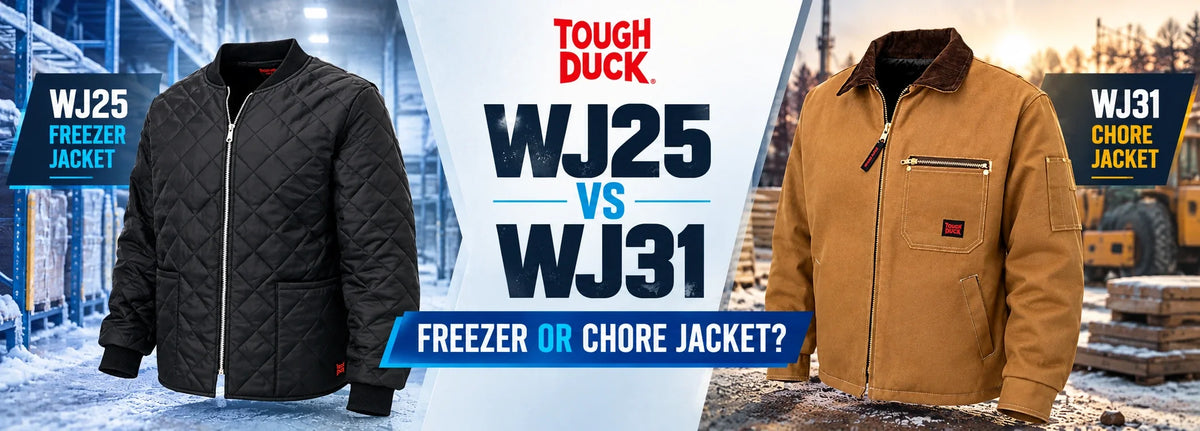
The word “freezer” may make the WJ25 sound like the more substantial cold-weather jacket. The specifications tell a different story. The Tough Duck WJ25 Freezer Jacket is a light polyester layer with 4 oz insulation. The Tough Duck WJ31 Chore Jacket is a heavier cotton-duck outer jacket with 6 oz body insulation.
This Tough Duck WJ25 vs WJ31 comparison comes down to the job. Choose the WJ25 for active indoor work, changing temperatures, or layering. Choose the WJ31 when outdoor exposure, shell strength, and work-focused storage justify the higher price.

Evaluation Criteria for the WJ25 and WJ31
The choice comes down to six practical factors: intended role, insulation, shell durability, weather handling, workday features, and price. Together, these details show which jacket fits the work environment and how it will be worn.
Insulation weight, shell material, weather protection, movement, storage, and price provide the clearest basis for comparison. The WJ25 prioritizes lightweight layering, while the WJ31 adds core insulation and a tougher shell for exposed work. Comfort will also depend on activity level, base layers, wind, moisture, and exposure time.
WJ25 Review: A Lightweight Insulated Layer
The WJ25 uses a 100% polyester shell and lining, quilted to 4 oz polyester insulation. Its diamond-quilted build keeps the jacket simple and light. Wear it on its own in cool conditions or use it as an insulating layer when temperatures drop.
Rib-knit cuffs and a rib-knit collar help close gaps at the wrists and neck. A YKK zipper closes the front. The drop-back hem adds rear coverage. Two lower patch pockets and lining pockets provide basic storage.
The main benefit is flexibility. A warehouse worker, driver, or equipment operator can wear it without the weight of cotton duck, then add an outer shell when conditions change.
That light build creates limits. The WJ25 has less body insulation than the WJ31. It also lacks the WJ31’s water- and wind-repellent protection and has fewer specialized work pockets. Choose it as an economical insulated layer rather than a heavy outdoor coat or dedicated freezer system.
WJ31 Review: A Rugged Cotton-Duck Outer Jacket
The WJ31 starts with a 12 oz cotton-duck shell treated with a durable water-repellent finish. The shell is also wind repellent. The body has 6 oz polyester insulation, while the sleeves use 4 oz. This adds warmth through the core without placing the same insulation weight through the arms.
Its construction is aimed at demanding work. The jacket has triple stitching and brass rivets at stress points. A heavy-duty brass zipper closes the front, and a second brass zipper secures the chest pocket. Adjustable shank buttons at the cuffs and two waist tabs let the wearer close or loosen key areas.
An action back supports shoulder movement during lifting and reaching. Storage includes two lower welt pockets, a sleeve pencil pocket, and lining pockets with media storage. Embroidery access and industrial-laundry compatibility also make the WJ31 practical for uniform programs.
The tradeoffs are price and weight. The WJ31 costs much more and has a heavier, more structured shell. Workers who spend most of the shift indoors may not need those added features.
Tough Duck WJ25 vs WJ31 Head-to-Head
| WJ25 FREEZER JACKET | WJ31 CHORE JACKET |
|---|---|
| Insulation: 4 oz polyester | Insulation: 6 oz body; 4 oz sleeves |
| Shell: Polyester diamond quilt | Shell: 12 oz cotton duck |
| Closure: YKK zipper | Closure: Heavy-duty brass zipper |
| Cuffs: Rib knit | Cuffs: Adjustable shank buttons |
| Best role: Light layer or mid-layer | Best role: Substantial outer jacket |
| Starting price: $42.88 CAD | Starting price: $126.88 CAD |
Both jackets are available in sizes S–5XL. Use the product links to confirm available colours, sizes, and current pricing.
Insulation and Layering
The WJ31 has the insulation advantage through the body. Its 6 oz body insulation is greater than the WJ25’s 4 oz build. However, that does not make the WJ31 the right choice for every shift.
The WJ25 works as part of a layered system. Wear it alone during active work, then add a shell as exposure increases. The WJ31 works better as a substantial outer jacket.
Shell Durability and Weather Handling
The shell creates the biggest performance difference. The WJ25’s polyester diamond quilt keeps weight down. The WJ31’s 12 oz cotton duck, triple stitching, and rivets suit work around rough surfaces, equipment, and materials.
The WJ31 also adds water- and wind-repellent protection for light moisture and exposed work. It is not waterproof, so extended rain or repeated spray still calls for purpose-built waterproof outerwear.
Closures and Workday Movement
The WJ25 uses a YKK zipper with rib-knit cuffs and collar. These parts support a simple design that is easy to layer. Its drop back helps keep the rear covered as the wearer changes position.
The WJ31 uses brass front and chest-pocket zippers. Adjustable cuffs and waist tabs let the wearer fine-tune the fit around gloves and additional layers. Its action back adds room across the shoulders for lifting, reaching, and other active tasks.
Pocket Organization
The WJ25 covers basic storage with two lower patch pockets and interior pockets. That may be enough for keys, a phone, and small personal items.
The WJ31 divides storage among a zippered chest pocket, two lower welt pockets, a sleeve pencil pocket, and interior compartments. Workers carrying pens, small tools, or personal items receive a more organized layout and quicker access.
Price and Overall Value
At the starting prices shown above, the WJ25 costs $42.88 CAD and the WJ31 costs $126.88 CAD. The WJ31 starts at close to three times the price.
The additional cost buys a 12 oz cotton-duck shell, greater body insulation, a water- and wind-repellent finish, reinforced construction, more adjustment and more storage. That added construction earns its cost only when the job requires it.
The WJ25 offers better value for light insulation or layering. The WJ31 makes less sense when work stays indoors and rarely tests the shell.
Which Jacket Fits Your Job?
Choose the WJ25 when:
- You work mainly indoors or move between different temperatures.
- You want a light jacket that can fit into a layered system.
- Basic pockets meet your needs.
- Keeping the initial cost down matters most.
Choose the WJ31 when:
- You spend long periods working outdoors.
- The jacket will contact rough equipment or work surfaces.
- Wind and light moisture are regular concerns.
- You need more pocket organization and adjustable features.
The WJ25 wins for lightweight insulation and lower cost. The WJ31 wins as a rugged standalone outer jacket. The right choice depends on whether the job calls for a flexible layer or a stronger shell.
Neither jacket replaces required high-visibility, flame-resistant, or waterproof protective clothing.
Compare Tough Duck Work Jackets at Cleanflow
Choose the WJ25 when a light insulated layer can handle the shift. Choose the WJ31 when outdoor exposure and rugged work justify its heavier construction and higher price.
Browse the Tough Duck collection to compare more work jackets for your crew or jobsite.