



Description
When system water turns acidic or too alkaline, it corrodes metal components quietly and expensively. The ADEY Quick Test pH Strips give engineers an instant, on-site pH reading in seconds, no lab equipment or setup required, so problems get caught before they become boiler failures.
Order ADEY pH Test Strips today for fast, accurate system testing and reliable corrosion prevention.
What the ADEY Quick Test pH Strips Do
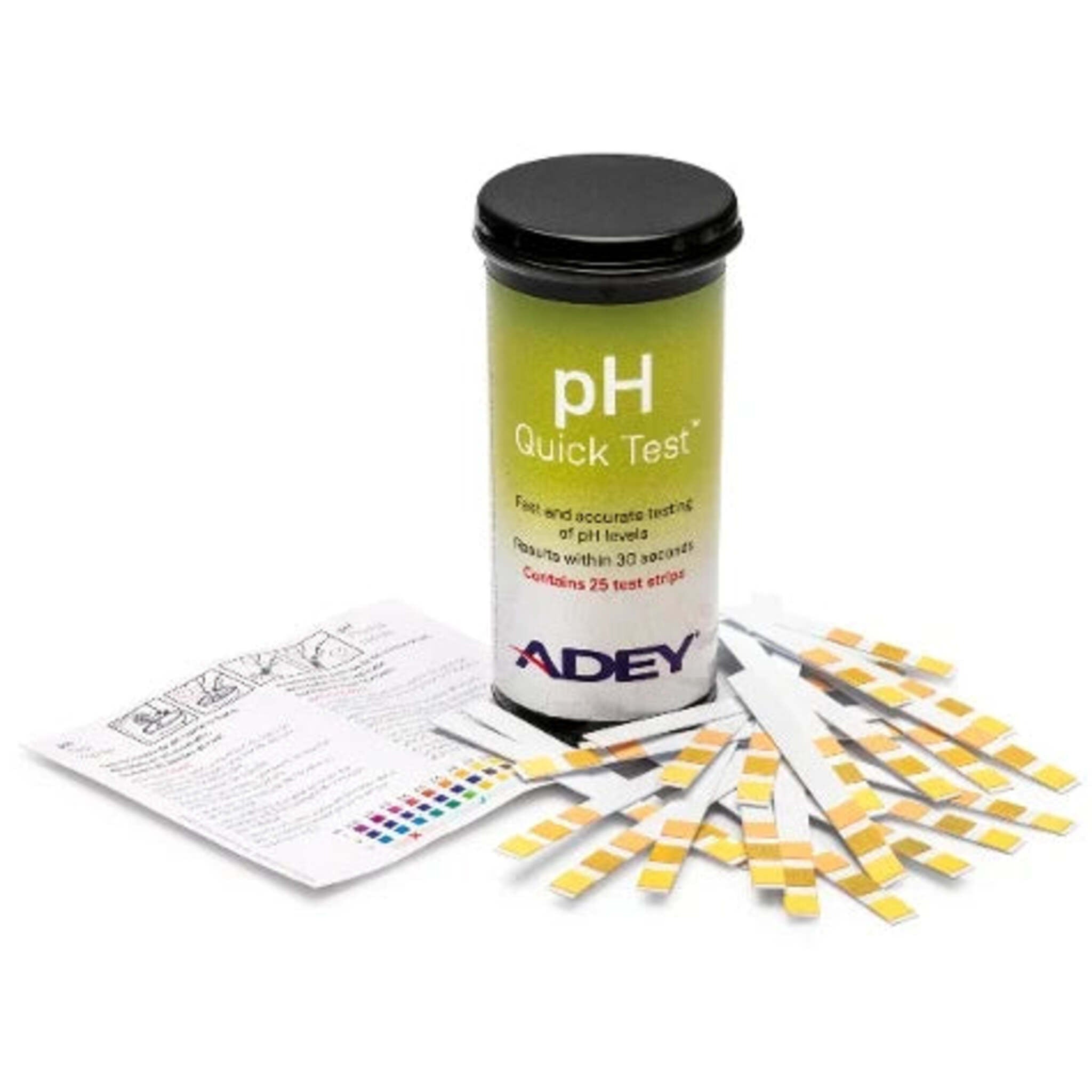
The ADEY Quick Test pH Strip is a single-use colorimetric test strip that measures the acidity or alkalinity of hydronic heating system water in under 30 seconds. It identifies whether pH has dropped into the corrosive range or risen into the range where aluminium components become vulnerable, giving the engineer an actionable result without removing the system from service.
Adey Quick Test pH Strips Key Features
- Fast & Accurate Testing: Quickly assess the water's pH level, crucial for preventing corrosion in heating systems.
- User-Friendly: Simple, no-fuss application with immediate results.
- Onsite Convenience: No initial setup required, perfect for on-the-go testing.
- Immediate Results: Obtain your pH readings in seconds.
- Cost-Effective: A budget-friendly alternative compared to other market options.
- Durable Packaging: Supplied in airtight, waterproof canisters for longevity and safety.
- Quantity: Each canister contains 25 test strips.
How to Use the ADEY Quick Test pH Strip
The ADEY pH test strip requires no meters, reagents, calibration, or power supply. The full test takes under two minutes from drawing the water sample to reading the result.
Step-by-Step Test Procedure
Step 1: Draw a small sample of system water. Use the system drain valve or a bleed point to collect a representative sample. The sample only needs to be large enough to dip the strip into completely.
Step 2: Dip the strip in the water for 2 to 3 seconds. Submerge the coloured pad end fully. Hold steady and remove cleanly.
Step 3: Shake off excess liquid. A single firm shake removes surface water without disturbing the reaction pad.
Step 4: Leave for 30 seconds. Allow the water to soak into the pad. Do not blow on the strip or wipe it. The colour change develops during this wait period.
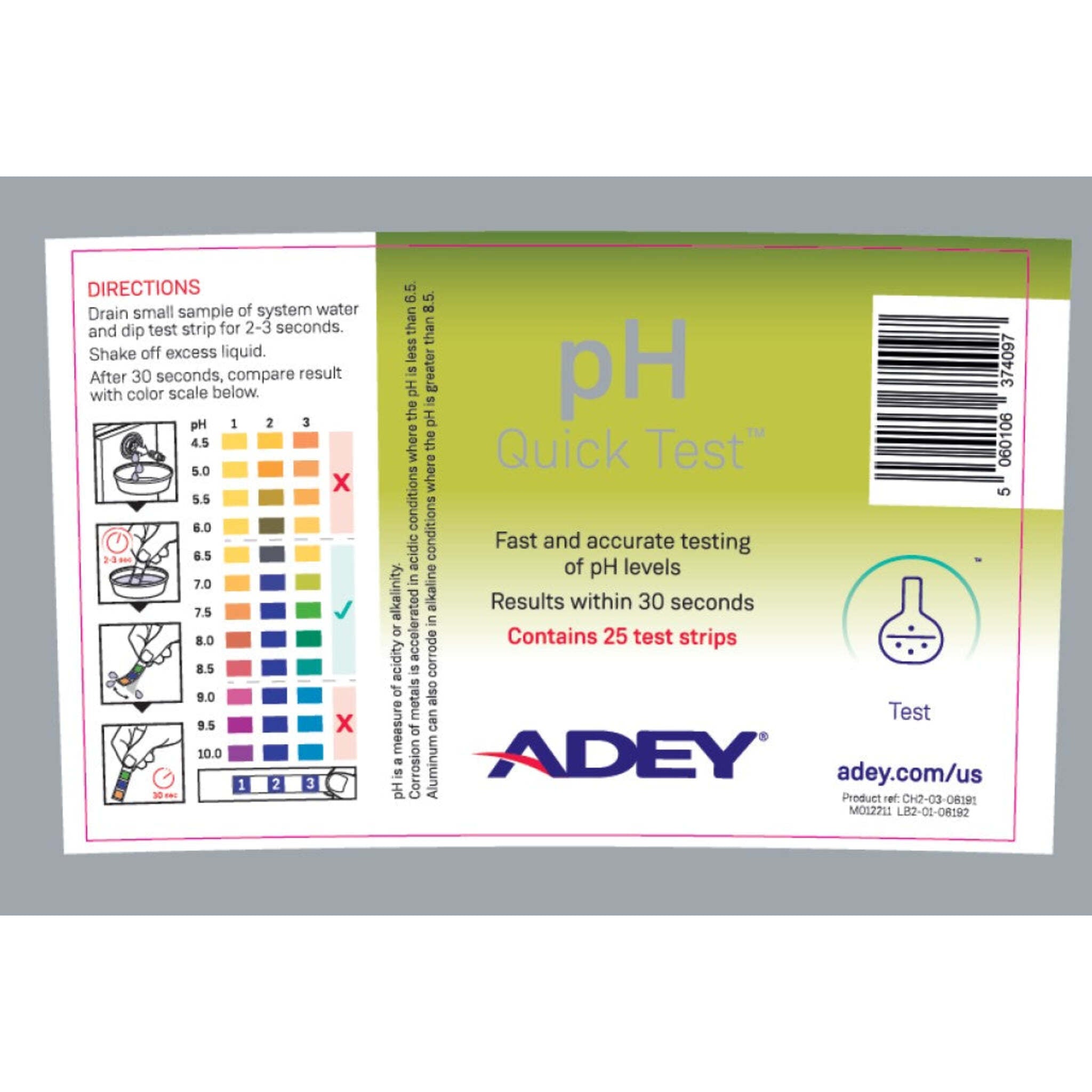
Step 5: Compare the result against the colour scale on the side of the canister. Match the pad colour to the nearest shade on the printed scale. The corresponding number is the system water pH reading.
Step 6: Record and act. If pH is below 6.5, the system requires pH correction and a corrosion assessment. If pH is above 8.5, the inhibitor formulation or dose should be reviewed. If pH reads within the safe band, document the result and proceed to inhibitor concentration testing.
What the Colour Scale Shows
The colour scale printed on the side of the airtight canister maps directly to pH values across the full range the strip detects. Engineers do not need a separate reference chart or smartphone app to read the result. The canister itself is the reference, which means the test is fully self-contained on site.
The colour scale is protected inside the canister lid. It is not a loose instruction sheet that can be lost or soaked during a job.
ADEY pH Strip Key Test Parameters
| Parameter | Details |
|---|---|
| Dip Time | 2 to 3 seconds |
| Development Time | 30 seconds after removal |
| Reading Method | Colour comparison against canister scale |
| Hazard Classification | Non-hazardous and non-toxic |
| Quality Standard | ISO 9001 |
| Certification | NSF certified |
| Pack Size | 25 strips per airtight waterproof canister |
What Makes the ADEY pH Strip Different from Generic Test Strips
Generic pH strips sold for pool or aquarium testing are not designed for the chemical environment inside a hydronic heating system. System water contains corrosion inhibitors, antifreeze glycol in some installations, dissolved iron oxide particles, and residual cleaning chemistry. These additives can interfere with the colour reaction on strips not calibrated for that environment.
The ADEY Quick Test pH Strip is formulated and tested for hydronic heating system water chemistry. The colour scale on the canister is calibrated for that specific application, not for pool water, soil, or food-grade liquids.
Packaging That Preserves Strip Accuracy
pH test strips degrade when exposed to air, moisture, and heat, which is why ADEY supplies the Quick Test strips in airtight, waterproof plastic canisters. A strip drawn from a canister left open on a van shelf for six weeks may give a false reading, not because the strip failed, but because it absorbed atmospheric moisture before use.
The ADEY canister seals after every use. Each strip is in the same condition as the day it was packed until the moment the engineer opens the canister. On a 25-strip canister used across multiple jobs over several months, consistent packaging directly translates to consistent test accuracy.
Storage Instructions
- Store in a cool, well-ventilated area away from direct heat
- Keep the canister sealed between uses
- Keep out of reach of children
- Avoid contact with eyes and skin during use
- In case of eye contact, bathe with running water for 15 minutes
- Dispose of used strips in accordance with local regulations
Who Uses the ADEY Quick Test pH Strip
This Quick Test pH Strip by Adey serves any qualified engineer who tests hydronic heating system water quality as part of a service, installation, or maintenance call. It requires no specialist training to use and produces a result any engineer can interpret against the canister scale without reference to additional documentation.
Engineer and Contractor Types
- Gas Safe registered engineers performing annual boiler service and water quality checks
- HVAC contractors commissioning new hydronic systems and verifying pre-handover water quality
- Heating engineers carrying out post-flush system verification after a MagnaCleanse or power flush
- Plumbers installing new boilers onto existing pipework and checking legacy system water chemistry
- Mechanical and engineering contractors maintaining light commercial hydronic heating installations
Applications Where pH Testing Is Essential
- Pre-treatment diagnosis before introducing MC5 Rapid Flush Cleaner or MC3+ Cleaner
- Post-flush verification that residual cleaning chemistry has been fully removed from the circuit
- Annual inhibitor service calls where full system water quality review is part of the visit
- New build commissioning under BS 7593 where system water quality documentation is required
- Heat pump installations where system water pH directly affects long-term aluminium component integrity
- Properties with known hard water where scale and pH interaction is an ongoing maintenance concern
Buy ADEY Quick Test pH Strip Online
The ADEY Quick Test pH Strip from Cleanflow is the fastest, lowest-cost way to confirm whether your hydronic heating system water is inside the safe pH band. No meters. No calibration. No lab wait. Dip, wait 30 seconds, read the result. Each canister holds 25 strips, sealed airtight to preserve accuracy across every job. NSF certified. ISO 9001 produced. Non-toxic.
Order ADEY pH Test Strips Now. Get fast, accurate readings and keep your heating system protected with reliable, on-site testing.
What does the reaction pad on the strip actually detect?
The pad contains a pH-sensitive dye that changes colour when it contacts water. The colour shift corresponds directly to the hydrogen ion concentration in the sample. More acidic water produces one end of the colour range. More alkaline water produces the other. The canister scale translates that colour into a pH number.
Why does the strip need exactly 2 to 3 seconds in the water?
Less than 2 seconds does not fully saturate the reaction pad, which produces an incomplete or inaccurate colour change. More than 3 seconds can over-saturate the pad and distort the reading. The 2 to 3 second window is the calibrated contact time for the strip chemistry to absorb a representative water sample.
What happens during the 30-second wait after removing the strip?
The water absorbed into the pad reacts with the pH-sensitive dye during this period. The colour develops progressively from the moment the strip leaves the water. Reading the strip before 30 seconds have passed catches the colour mid-reaction and gives a lower or incorrect pH reading. The 30-second wait is a hard requirement, not a suggestion.
Why is the colour scale printed on the canister rather than supplied as a separate card?
The canister is the reference tool the engineer holds in hand during every test. Printing the scale directly on the canister eliminates the risk of losing a separate card on site. It also keeps the reference surface dry and legible regardless of working conditions. The strip is matched to the canister it came from, so the calibration is always paired correctly.
What makes the airtight canister critical to test accuracy?
pH test strips absorb atmospheric moisture through the reaction pad. A strip exposed to humid air before use begins reacting before it contacts the water sample. The airtight canister blocks that pre-exposure. Every strip opened from a sealed ADEY canister is in the same factory-fresh condition, which is what makes 25 consistent readings possible across a canister's full working life.
Can the strip detect both acidic and alkaline failure conditions in one test?
Yes. A single dip identifies whether the system water is acidic (below pH 6.5), safe (pH 6.5 to 8.5), or too alkaline (above pH 8.5). The colour scale covers the full range in one comparison. Engineers do not need separate strips for acidic and alkaline conditions.
Does the strip change colour permanently after the test?
Yes. Once the pad reacts with system water, the colour is fixed. The used strip can be photographed next to the canister scale and included in a job record or customer report as visual documentation of the pH result at the time of the test.
Similar Products
Featured collection


