

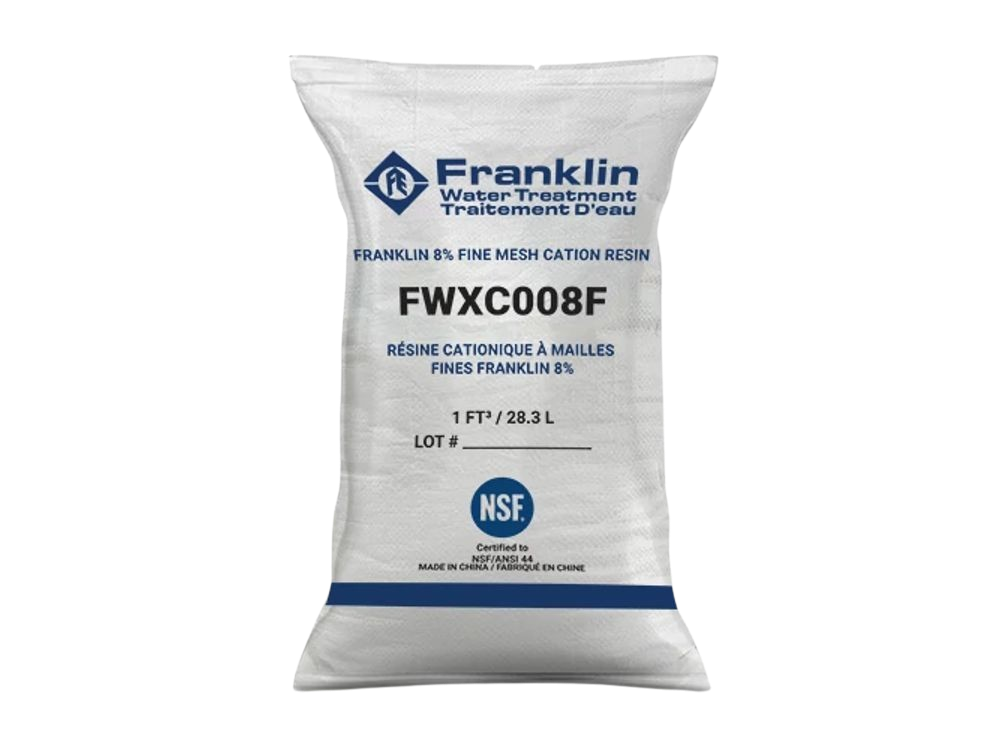

Description
Fine Mesh Resin for High TDS Applications and Faster Ion Exchange Performance
Overview
The Franklin FWXC008F is a gel-type strong acid cation exchange resin manufactured using sulfonated styrene-divinylbenzene (DVB) copolymers with a fine mesh bead structure. The smaller beads increase surface area and reduce diffusion distance, which delivers faster ion exchange, higher operating capacity, and more efficient regeneration than standard mesh resin in high TDS environments.
In sodium form, FWXC008F is used for water softening to reduce total hardness. In hydrogen form, it is used for water demineralization. It is suited to high TDS solutions and applications where fast kinetics are needed. Sold per 1 cubic foot bag (28.3L).
Key Features of Franklin FWXC008F Strong Acid Cation Fine Mesh Resins
- Fine mesh bead structure (0.25-0.45 mm effective size) for faster ion exchange kinetics than standard mesh.
- Higher operating capacity due to increased surface area per volume of resin.
- More efficient regeneration with 10-15% NaCl, reducing chemical usage per cycle.
- Designed for high TDS water where standard resin underperforms.
- Strong acid cation (SAC), 8% DVB crosslinked, full pH range (0-14).
- 120°C max operating temperature for high-temperature water treatment systems.
- Suitable for both softening (Na+ form) and demineralization (H+ form).
Core Specifications
| Attribute | Value |
|---|---|
| Resin Type | Strong Acid Cation (SAC) |
| Structure | Gel-type polystyrene crosslinked with DVB |
| Functional Group | Sulphonic Acid |
| Appearance | Amber spherical beads |
| Ionic Form | Na+ (standard), H+ optional |
| Mesh Type | Fine Mesh |
Operating Conditions
| Parameter | Specification |
|---|---|
| Max Operating Temperature | 120°C |
| pH Range | 0-14 |
| Service Flow Rate | 5-50 BV/h |
| Regenerant | 10-15% NaCl |
Performance and Physical Properties
- Total Exchange Capacity: ≥ 2.0 eq/L
- Particle Size Range: ≥ 95% between 0.20-0.56 mm
- Effective Size: 0.25-0.45 mm
- Uniformity Coefficient: < 1.4
- Whole Uncracked Beads After Attrition: ≥ 96%
- Specific Gravity: 1.26-1.30
- Moisture Retention: 43-48%

Why Fine Mesh Resin Matters
Standard mesh resin works well for most residential and light commercial softening. But in high-demand systems with elevated TDS, high flow rates, or inconsistent water quality, standard beads cannot exchange ions fast enough to keep up. Fine mesh resin solves this with smaller beads that create more contact points per volume:
- Faster ion exchange at higher flow rates.
- Better hardness removal and demineralization efficiency.
- More efficient regeneration, reducing salt or acid usage per cycle.
- Consistent performance in high TDS water that causes standard resin to break through early.
FWXC008F is the right choice when water quality is challenging, systems need higher throughput, or standard resin is underperforming. For standard TDS applications, the Franklin FWXC008 mesh resin is the more cost-effective option.
Typical Applications
- High TDS water softening systems
- Demineralization systems (paired with strong base anion resin for full deionization)
- Industrial and commercial water treatment
- Cartridge-based specialty applications
- Systems requiring fast ion exchange kinetics
Buy Fine Mesh Cation Exchange Resin from Cleanflow
Cleanflow stocks the Franklin FWXC008F fine mesh cation exchange resin as part of the full Franklin Water catalog, alongside standard mesh resins, macroporous resins, anion resins, and mixed bed media. Sold per 1 cubic foot bag (28.3L).
Free shipping on orders over $199. 30-day return policy. Ships across Canada and the United States. Email info@cleanflow.ca for help selecting the right resin for your system, volume orders, or returns and exchanges.
Frequently Asked Questions
What is the advantage of fine mesh resin?
Fine mesh beads have more surface area and shorter diffusion paths than standard mesh. This means the resin exchanges ions faster and reaches higher operating capacity per regeneration cycle. The practical result is better performance in systems where standard resin cannot keep up with the incoming hardness or TDS load.
When should I use fine mesh instead of standard resin?
When the water has high TDS, the system operates at high flow rates, or standard resin is breaking through before the expected regeneration interval. The physical difference: standard mesh beads are typically 0.30-1.20 mm, while fine mesh beads are 0.25-0.45 mm. The smaller beads provide more surface area and shorter diffusion paths for faster ion exchange. The trade-off is higher pressure drop across the bed, so the system must be designed for it. Fine mesh is also used in specialty cartridge-based applications where space is limited.
Can this be used for demineralization?
Yes. In hydrogen form, FWXC008F is suitable for demineralization applications. For full deionization, pair it with a strong base anion exchange resin downstream.
Is this suitable for standard water softeners?
Yes, but the system must be designed to handle the higher pressure drop that fine mesh creates. Fine mesh resin is typically used where higher performance is needed. For standard residential softeners with normal TDS levels, the Franklin FWXC008 standard mesh resin is usually sufficient.
Does fine mesh resin require different regeneration?
No major changes to the regeneration process. Use 10-15% NaCl (sodium chloride) for softening applications. Fine mesh typically regenerates more efficiently than standard mesh, meaning less salt per regeneration cycle for the same capacity recovery.
What resin is best for high TDS water softening?
Fine mesh strong acid cation resin like the FWXC008F is designed for high TDS applications. The increased surface area and faster kinetics handle elevated dissolved solids that cause standard mesh resin to underperform. Send us an email to confirm the right resin for your specific water chemistry and system design.
Manuals & Documentation
Similar Products
Featured collection


