

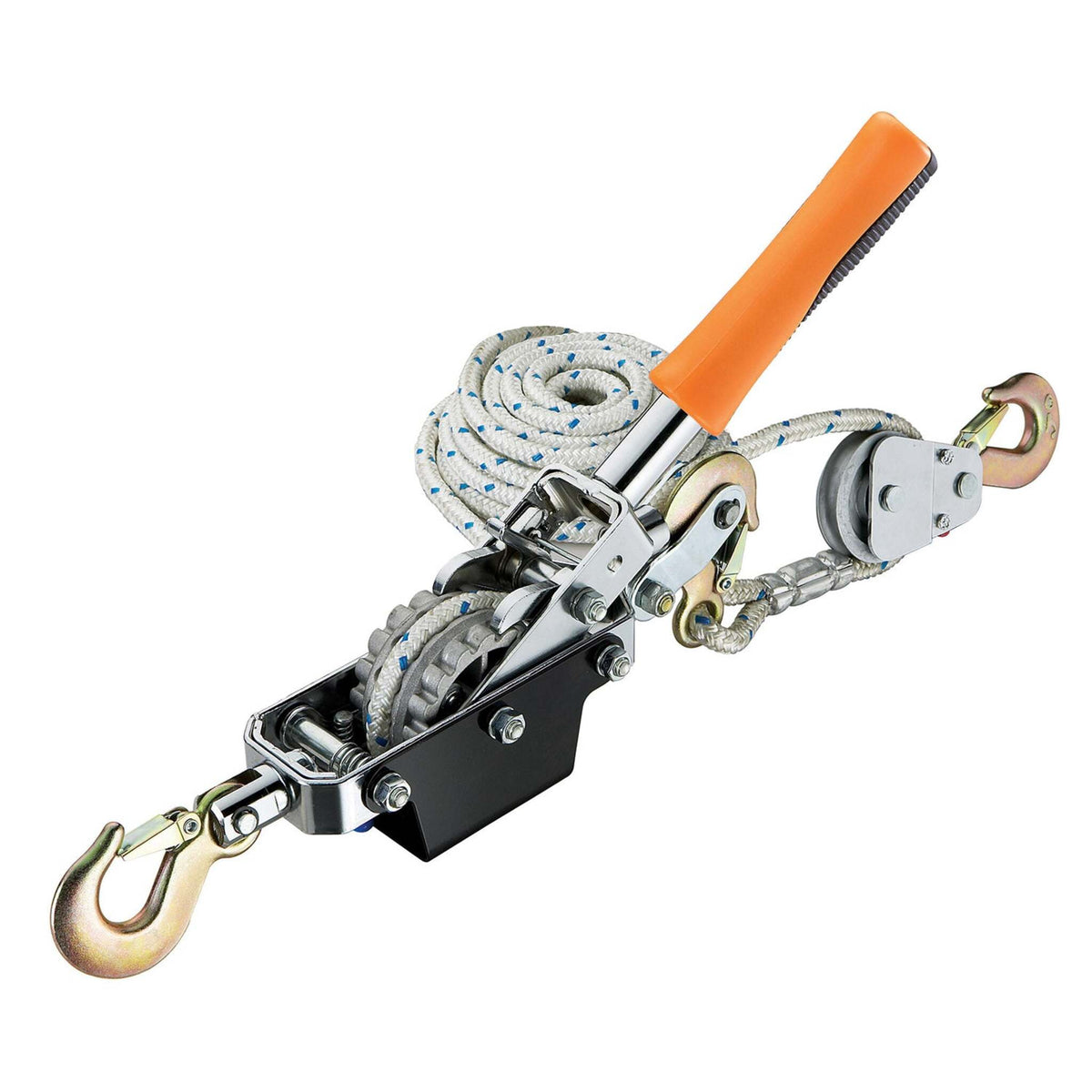

Description
1 Ton Rope Puller with Double Gear and 20 ft Polyester Rope
Wire cable come-alongs scratch finished surfaces and conduct electricity. This 1 ton rope puller solves both problems. The ratcheting rope puller uses 20 ft of non-conductive polyester rope that grips loads up to 2,000 lbs without marking paint, gel coat, or powder-coated finishes. Also called a rope come along or hand power puller, this polyester rope puller works where cable tools leave damage.
How the Double Gear System Works
A double gear rope puller trades handle speed for pulling force. This ratcheting rope puller locks the load between strokes with a 3 mm pawl, and one person generates full rated pull.
Three hooks (19 mm) give more rigging options than the standard two-hook layout on most rope come along models. The detachable bi-colour handle reduces storage bulk, and an anti-tangle design keeps the polyester rope from kinking as it feeds out.
Specifications
| Specification | Detail |
|---|---|
| Capacity | 1 ton (2,000 lbs) |
| Rope Diameter | 10.5 mm (~7/16") |
| Rope Length | 6 m (~20 ft) |
| Rope Material | Non-conductive polyester |
| Gear Type | Double gear |
| Hooks | 3 (19 mm x 3 mm) |
| Pawl Thickness | 3 mm |
| Handle | Bi-colour ergonomic, detachable |
| Net Weight | 13 kg (~28.6 lbs) |
| Gross Weight | 15 kg (~33 lbs) |
| Model | HPR-302-2 |
| Certifications | CE, GS; ISO 9001 |
| Not Suitable For | Overhead lifting |
Applications
Construction crews use this 1 ton rope puller to tension formwork, position equipment, and pull conduit runs. Landscapers rely on the hand power puller for tree felling assist and fence-line tensioning. Boat yard workers choose a polyester rope puller because it grips hulls without scratching gel coats. The non-conductive rope also keeps utility crews safer during pulls near energized lines.
For lighter-duty pulls, see the Vulcan Mini XT Ratchet Pullers.
Buy a Ratcheting Rope Puller Online from Cleanflow
Cleanflow Utility Supply Company stocks this 1 ton rope puller and ships across Canada and the USA, with free shipping on orders over $199. Returns accepted within 30 days at returns and exchanges. Email info@cleanflow.ca for questions or stock confirmation.
Frequently Asked Questions
What is a rope puller used for?
A rope puller tensions, pulls, and positions loads using polyester rope instead of wire cable. Common jobs include tree felling assist, fence-line tensioning, boat positioning, conduit pulling, and equipment relocation. A polyester rope puller is the better choice when surface damage from cable is a concern.
How does a ratcheting rope puller work?
The ratchet lever on a double gear rope puller advances the rope one stroke at a time. A 3 mm pawl locks the load between strokes, holding position under tension. Reversing the lever releases rope in controlled increments for gradual load letdown.
What is the difference between a rope puller and a cable puller?
The rope puller vs cable puller choice depends on your load and surface. A rope puller uses polyester that won't scratch painted or coated finishes and does not conduct electricity. A cable puller handles higher loads per diameter but leaves marks. See the Ratcheting Cable Pullers.
What is the best rope puller for landscaping and tree work?
A 1 ton rope puller with 20 ft of polyester rope covers most landscaping and tree felling jobs. The polyester line reaches farther than 6 to 12 ft cables on standard come-alongs and is gentler on bark with trunk wraps. The double gear system handles directed felling on smaller trees.
Rope puller vs come along, which is better?
A rope puller is a come-along that uses polyester rope instead of wire cable. The rope come along version reaches 20+ ft (vs 6 to 12 ft for cable) and won't damage surfaces. Cable come-alongs handle heavier loads in less space. Pick rope for finish work, cable for tonnage.
Similar Products
Featured collection


