

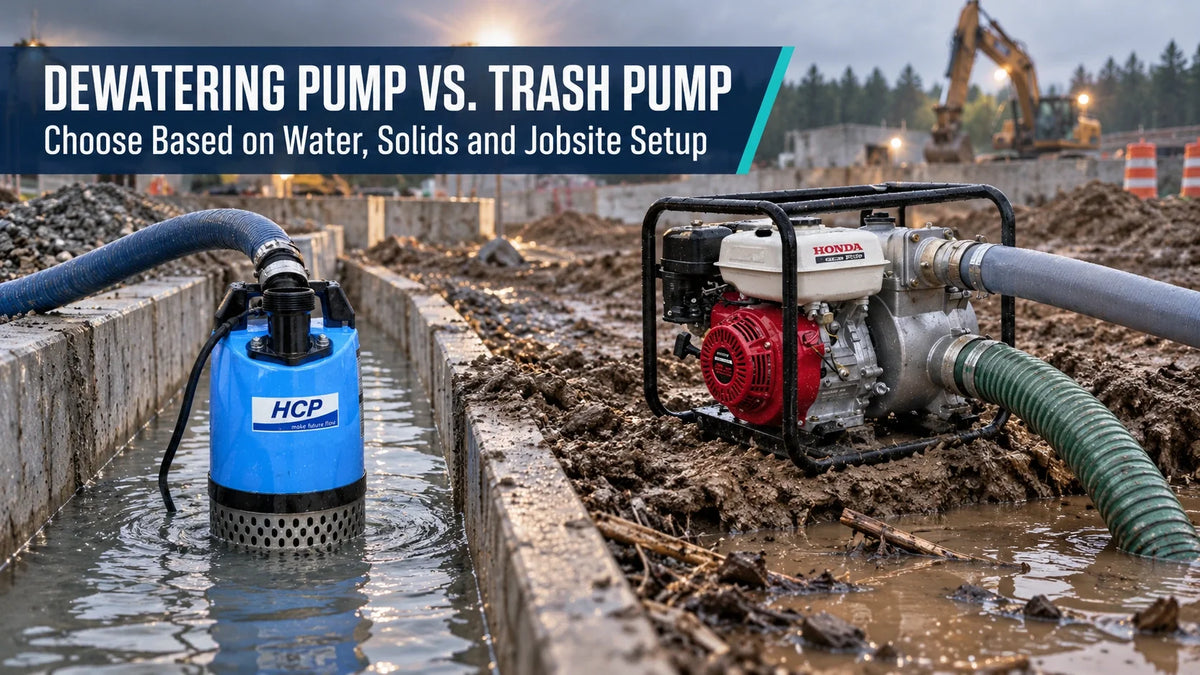
A dewatering pump removes unwanted water from a site. A trash pump is built to move water that contains larger solids or debris. Those categories can overlap: a trash pump can perform dewatering, and some trash pumps are submersible.
So, what is the difference between a dewatering pump and a trash pump in practice? Check the water, solids, abrasion risk, pump placement, and flow at the required head.
Dewatering Pump vs. Trash Pump at a Glance

The simple answer to what the difference is between a dewatering pump and a trash pump is purpose versus capability. Dewatering describes the work. Trash describes a pump with enough internal clearance to pass specified solids. This distinction should guide any trash pump vs. dewatering pump comparison.
Why the Two Categories Overlap
Some dewatering pumps move clear water, while others tolerate sediment. Many trash pumps are engine-driven surface units, but electric submersible models also exist.
The Multiquip ST2040T is a submersible trash pump used for dewatering. So a submersible dewatering pump vs. trash pump comparison must separate three questions:
- What is in the water?
- Will the pump operate in the water or above it?
- What flow is available at the required head?
What Is a Dewatering Pump?
A dewatering pump removes water from a place where it should not remain. Common locations include excavations, trenches, pits, basements, tunnels, tanks, and low areas on construction sites.
Many portable dewatering pumps are submersible. They sit in the water and push it through a discharge hose, with no suction hose to prime.
Choose one when the water is clear or lightly contaminated, the expected solids fit the published rating, and compact placement or low-level drainage matters. Common jobs include groundwater seepage, rainwater, and shallow water on slabs.
But do not assume that every dewatering pump can tolerate sand, gravel, or construction debris. Intake openings, impeller design, and wear materials differ by model.
What Is a Trash Pump?
A trash pump moves water containing solids that could clog or damage a tighter-clearance pump, such as leaves, small stones, or wood chips.
Trash pumps use wider internal passages and rugged wet-end components. Many surface models also provide cleanout access.
Surface trash pumps stay above the water and are often engine-driven. They use suction and discharge hoses, must stay within their suction-lift limit, and may require priming.
A submersible trash pump works differently. It sits in the water, so it does not use a suction hose or require suction priming. This is another reason trash pump vs dewatering pump cannot be reduced to "surface versus submersible."
Dewatering, Semi-Trash and Full-Trash Pumps

These labels are useful, but they do not create fixed solids limits. Two pumps with the same port size may have different impellers, internal clearances, and maximum solids ratings.
| Pump type | Typical water condition | What to verify |
|---|---|---|
| Dewatering pump | Clear water to light sediment | Maximum solids size, abrasion rating, and minimum drawdown level |
| Semi-trash pump | Water with small debris, leaves, or light silt | Published solids size and whether sand is allowed |
| Full-trash pump | Debris-filled water with larger solids | Maximum spherical solids size, cleanout access, and wear materials |
| Slurry or diaphragm pump | Thick mud or a high concentration of abrasive solids | Solids concentration, particle size, and fluid density |
Do not assign a pump from the label alone. Match its published limits to what is actually in the water.
Is the Half-Diameter Rule Reliable?
The "half-diameter rule" says a trash pump can pass a solid about half the diameter of its suction or discharge port. It is a rough shortcut, not an industry-wide sizing formula.
Some pumps fit the pattern. The 2-inch Multiquip ST2040T, for example, has a maximum solids size of 1 inch. But the 3-inch Honda WT30 is rated for 1 1/16-inch solids, not 1.5 inches. Port size alone does not tell you what can pass through the impeller and volute.
Use the manufacturer's maximum spherical solids rating as the limit. Then use an intake strainer or screen to keep larger material and long fibres out.
Do Internal Materials Matter?
Yes, especially when the water contains grit. Cast iron, high-chrome iron, hardened wear plates and silicon-carbide seals can improve resistance to impact or abrasion. But no one material belongs only to trash pumps. Some dewatering pumps also use silicon-carbide seals and abrasion-resistant parts, while some trash pumps use carbon-ceramic seals.
Check the casing, impeller, wear plate, and mechanical-seal specifications together. And remember that a pump may pass a grain of sand without clogging while still wearing faster when exposed to a steady load of grit.
When to Use a Trash Pump Instead of a Dewatering Pump
Start with a trash pump when clogging from visible debris is the main risk. Typical examples include:
- Stormwater containing leaves, twigs, or litter
- Excavation water with small stones or loose construction debris
- Ditches and containments where the intake may encounter mixed material
- Floodwater with debris that cannot be screened out reliably
Still, "trash pump" does not mean it can pass anything. Long fibres, oversized stones,, and dense solids can still cause a blockage.
A standard dewatering pump is usually the better starting point when the water is clear or lightly silty, the site is confined, quiet electric operation is preferred, or the job requires low-level drawdown. The model must still meet the required flow and head.
What Is the Best Pump for Muddy Water Construction?
The best pump for muddy water construction depends on what "muddy" means at that site.
- Light silt in thin water: A wear-resistant dewatering pump may work if the sediment remains within its published limits.
- Leaves, stones, or mixed debris: A trash pump is usually the safer starting point because clogging is the main risk.
- High sand or grit content: Look for abrasion-resistant components. Sand may pass through an opening yet still wear the impeller and casing.
- Thick mud or slurry: A standard dewatering or trash pump may not be suitable. Review a slurry or diaphragm pump designed for a higher solids concentration.
Do not judge water only by colour. A brown trench may contain fine clay, abrasive sand, stones, or a mix of all three.
How to Choose the Right One for Your Project
Ask these five questions to settle a submersible dewatering pump vs trash pump decision:
- What is in the water? Identify silt, sand, gravel, leaves, fibres, and other debris.
- What is the largest solid? Compare it with the pump's published maximum solid intake.
- Where will the pump sit? Use a submersible unit in the water or a surface pump with a proper suction setup.
- What flow is required at the actual head? Add vertical lift and hose friction to estimate total dynamic head, then check the pump curve. Do not choose from maximum GPM alone.
- What power is available? Consider voltage, phase, generator capacity, fuel, ventilation, and runtime.
Also check the discharge location. Water should not flood an access route, erode soil or return to the excavation.

Suction Lift Is Not the Same as Discharge Head
A surface pump must pull water through a suction hose. Many portable trash pumps publish a maximum suction lift near 25 feet at sea level, but altitude, water temperature, hose friction, and air leaks can reduce it. Keep the pump close to the water and the suction hose short.
Total dynamic head is the resistance on the discharge side plus the lift the system must overcome. Compare the required operating point with the pump curve. Do not assume every dewatering pump produces more pressure or every trash pump produces less.
Clean the Pump Before Sediment Hardens
Many surface trash pumps have a removable cleanout cover, while some submersible models have an easy-clean base. Shut down and isolate the power before opening anything.
After pumping mud, grit, or silt, follow the manual's cleaning steps. That often means flushing with clean water, draining the casing, and checking the impeller, volute, strainer, and hose. Do not leave wet sediment inside the pump to dry and harden.
Compare Pumps for Your Jobsite
The right dewatering pump vs trash pump choice starts with the water, not the product name. Note the solids present, required flow, vertical lift, hose length, discharge point, and available power before comparing models.
Explore Cleanflow's dewatering pumps and trash pumps. If the conditions are unclear, send us the job details so we can help narrow the options.
Frequently Asked Questions
Can you use a trash pump for clean water?
Yes. A trash pump can move clean water if its pump curve meets the required flow and head. But it may be heavier, larger, or less suitable for low-level drainage than a general dewatering pump. Choose it when its capacity, placement, and power source fit the job.
Will sand ruin a dewatering pump?
Not instantly, but repeated sand exposure can wear the impeller, casing, wear plate, and seals. A solids opening tells you what can pass, not how well the pump resists abrasion. For sandy water, check the wear materials and the manufacturer's approved fluid limits.
Can I use a trash pump for dewatering?
Yes. Use a trash pump for dewatering when visible debris makes clogging the main concern. Confirm the maximum solids size, abrasion risk, and flow at total dynamic head first. Thick slurry or stringy material may require another pump design.
Can a dewatering pump handle solids?
Some can. Solids capacity depends on the intake, impeller, internal clearances, and wear materials. Check the published maximum spherical solids size and allowed solids concentration. Do not assume that every pump sold for dewatering is limited to clean water.