

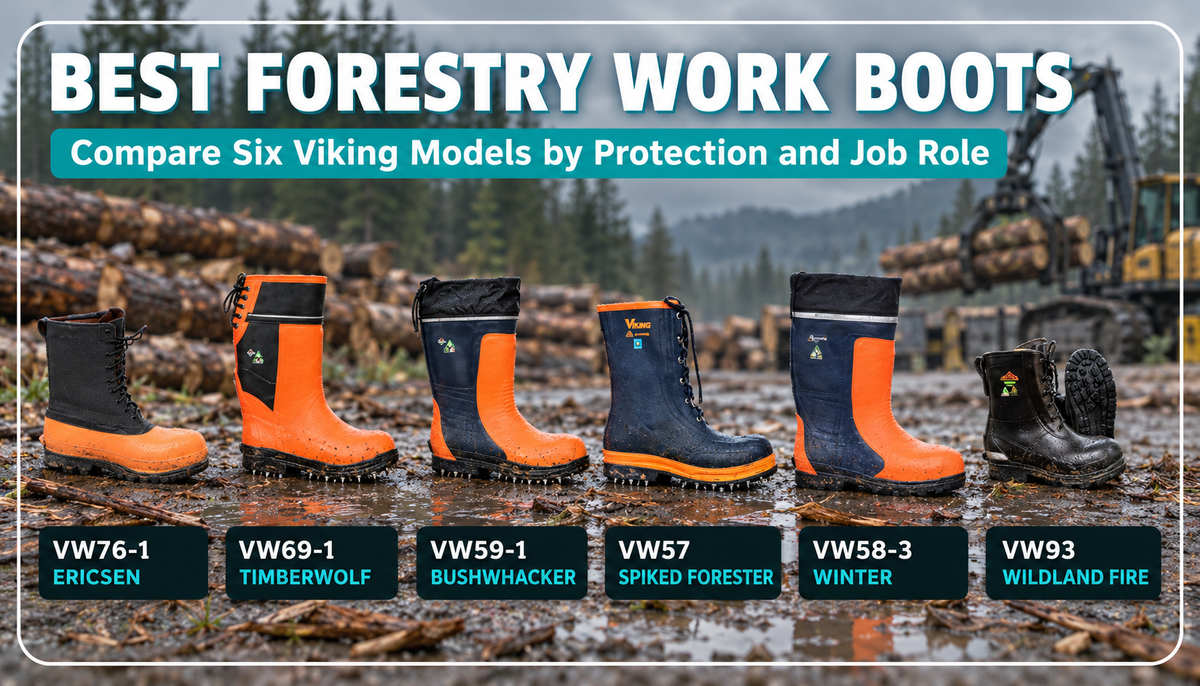
The best forestry work boots match the hazard, terrain, season, and job requirements. Chainsaw operators may need Class 3 cut protection. Loggers may require permanent caulks, while forestry technicians often need a waterproof lug sole. Cold-weather crews and wildland firefighters require different insulation and certifications.
Forestry footwear may be called logging boots, chainsaw boots, or caulk boots—also spelled "calk boots." These names are not interchangeable. Canadian buyers should check the safety markings and sole construction rather than relying on the product name alone.
Quick Answer: Which Viking Boot Fits the Job?
- VW76-1 Ericsen: general wet forestry work and mixed sites where a conventional lug sole is practical.
- VW69-1 Timberwolf: Class 3 chainsaw work requiring permanent caulks and a traditional logging design.
- VW59-1 Bushwhacker: Class 3 chainsaw work with permanent caulks, a snug fit, and an air-cushioned heel.
- VW57 Spiked Forester: permanent-caulk traction with a Grade 1 steel toe, without a stated chainsaw class.
- VW58-3 Winter Bushwhacker: Class 3 chainsaw work in extreme cold, with removable insulation rated to -70°C.
- VW93 Wildland Fire Boot: wildland fire and rescue work requiring NFPA 1977 certification.
What Should You Check Before Ordering?
1. Required Protection
Choose the protective category before comparing comfort. A steel toe protects against impact and compression; a puncture plate protects the sole. Neither replaces certified chainsaw protection, fire certification, electrical protection, or chemical resistance. Match the markings on the boot to the workplace hazard assessment and site requirements.
2. Chainsaw Protection Class
Chainsaw classes correspond to chain speed under standardized testing: Class 1 relates to 20 m/s, Class 2 to 24 m/s, and Class 3 to 28 m/s. The VW69-1, VW59-1, and VW58-3 list Class 3 protection. Match the class to the work requirement; protective footwear is not cut-proof.
3. Sole and Surface
Caulked soles use permanent spikes for wet logs, bark, and soft forest ground. Conventional lug soles are more versatile across mixed worksites. Listings for studded forestry boots may refer to permanent caulks or optional ice studs, so check the sole description. Ice studs do not turn a lug sole into a logging caulk boot.
4. Water, Fit and Mobility
Waterproof construction helps on saturated ground, while chemical- and oil-resistant compounds suit equipment areas. For winter work, distinguish a published insulation rating from a protective certification. Compare shaft height, liner volume, ankle support, and cushioning, and allow room for work socks without creating heel movement.
Model-by-Model Viking Boot Guide
VW76-1 Ericsen: For Wet Forestry and Mixed Sites

Choose the Viking VW76-1 Ericsen when waterproof construction and a versatile lug sole matter more than chainsaw protection. It combines a vulcanized nylon, rubber, and polyester upper with a Grade 1 steel toe and plate, CSA Omega electric-shock resistance to 18 kV, and a reinforced heel. The nitrile lug sole resists abrasion, chemicals, and oil and provides slip resistance.
Keep in mind: the standard VW76-1 has a conventional lug sole. The separate VW76S-1 comes with steel traction spikes. The VW76-1 is not a chainsaw boot, so choose another model when certified cut protection is required.
For a closer look at its construction and intended uses, read the Viking Ericsen boots review.
VW69-1 Timberwolf: For Traditional Caulked Logging Work

The Viking VW69-1 Timberwolf combines Class 3 chainsaw protection with a Grade 1 steel toe and plate and a permanently caulked NBR sole. Its rating corresponds to testing at speeds up to 28 m/s under EN ISO 17249:2013. The SBR-blended natural-rubber upper resists chemicals and oils, with reinforcement at the ankle and Achilles tendon.
Choose it for logging, harvesting, or ground-based arborist work that requires permanent spikes. Reflective material around the lace collar adds visibility. Confirm that caulks are suitable for every surface the worker must cross.
VW59-1 Bushwhacker: For a Snug Fit and Cushioned Heel

The Viking VW59-1 Bushwhacker also provides Class 3 chainsaw protection, a Grade 1 steel toe and plate, and an NBR caulked sole. Its snug-fit profile supports the heel and ankle, while an ergonomic insole and air-cushioned heel improve comfort during long shifts.
A nylon cuff helps keep debris out, and protective construction covers the metatarsal area. This model suits brush cutters, clearing-saw operators, scarifier operators, and conservation crews who need permanent spikes and a close fit.
VW57 Spiked Forester: For Permanent Caulk Traction

The Viking VW57 Spiked Forester is a traction-focused forestry boot with a Grade 1 steel toe and a permanently caulked SBR-blended natural-rubber sole. Its chemical-resistant rubber upper, polyester lining, lace flap, and reinforced heel and instep suit logging, arboriculture, timber rafting, and plant maintenance.
Keep in mind: the supplied specification does not state a chainsaw protection class or puncture plate. Choose the VW57 when its steel-toe protection and permanent caulks match the job; do not substitute it for a certified chainsaw boot.
VW58-3 Winter Bushwhacker: For Extreme-Cold Chainsaw Work

The Viking VW58-3 Winter Bushwhacker combines Class 3 chainsaw protection, a steel toe, and a removable foam liner with a published rating to -70°C (-100°F). Its chemical-resistant SBR-blended natural-rubber upper and high-impact NBR lug sole are designed for winter forestry and construction.
Unlike the permanently caulked VW59-1, the VW58-3 uses a lug sole that accepts optional ice studs. It also lists an air-cushioned heel plus Achilles, ankle, and metatarsal-area protection. Treat the temperature figure as a manufacturer product rating, not a guarantee of comfort for every worker or exposure.
VW93 Wildland Fire Boot: For Wildland Fire and Rescue

The Viking Firefighter VW93 Wildland Fire and Rescue Boot is certified to NFPA 1977-2022 for wildland and urban-interface firefighting. It pairs a CSA Z195-14 / ASTM F3413-24 Grade 1 steel toe and plate with CSA Omega 18 kV protection, 2.5 kV wet dielectric testing, and NFPA 1990 (2022) CBRN chemical resistance.
Its flame-retardant upper, lining, and laces are backed by a 300°C contact-melting-point specification and a 150°C direct-contact rating for 30 minutes. A felt lining, brass side zipper, reflective patch, reinforced backstay, and oil-resistant lug sole support fire and rescue use. It is not listed as a Class 3 chainsaw boot.
Head-to-Head: Which Boot Should You Choose?
VW69-1 Timberwolf vs VW59-1 Bushwhacker
Both provide Class 3 chainsaw protection, Grade 1 steel toes and plates, and caulked NBR soles. Choose the Timberwolf for a traditional logging design. Choose the Bushwhacker for its snug fit, air-cushioned heel, and debris-blocking cuff. Fit should decide between them once the protection and sole requirements are confirmed.
Permanent Caulks vs Lug Soles and Optional Ice Studs
Choose the VW69-1, VW59-1, or VW57 when permanent caulks are required on wet logs, bark, or soft forest terrain. Choose the VW76-1 for a conventional lug sole across mixed sites. Choose the VW58-3 for an insulated lug sole that accepts optional ice studs. The VW93 uses an oil-resistant lug sole for wildland fire and rescue terrain.
Chainsaw Protection vs Wildland Fire Certification
Select the VW69-1, VW59-1, or VW58-3 when the job requires their stated Class 3 chainsaw protection. Select the VW93 when NFPA 1977 wildland-fire certification and its listed electrical, heat, and CBRN protections match the assignment. The categories are not interchangeable.
VW59-1 vs VW58-3 Bushwhacker
Choose the VW59-1 for permanent caulks and a close-fitting cuff in non-winter forestry work. Choose the VW58-3 when Class 3 protection must be combined with a removable cold-weather liner and a lug sole that accepts optional ice studs. Do not treat its -70°C product rating as a personal comfort guarantee.
Crew Buying Checklist
Do not assign one model to the entire crew by default. Before ordering:
- Group workers by hazard, job role, and surface conditions.
- Confirm chainsaw, toe, plate, metatarsal, and electrical requirements.
- Check whether permanent caulks are suitable on every surface employees use.
- Fit-test boots with the socks worn during a normal shift.
- Confirm sizes, replacement needs and site rules before placing the order.
For overlapping roles, choose by the highest hazard, then compare fit, traction and comfort.
Choose Forestry Boots by Protection, Not Appearance
The right boot follows the hazard. Choose the VW76-1 for wet mixed sites; the VW69-1 or VW59-1 for Class 3 chainsaw work with permanent caulks; the VW57 for steel-toe protection with permanent caulks; the VW58-3 for Class 3 winter work; or the VW93 for certified wildland fire and rescue assignments.
Browse Cleanflow's Chainsaw and Forestry Boots collection for dedicated forestry and chainsaw styles. For footwear designed around other specialized work environments, browse the broader Specialty Work Boots collection.
Frequently Asked Questions
Are all forestry boots chainsaw boots?
No. A forestry boot may provide waterproofing, toe protection, fire certification, or traction without certified chainsaw protection. In this guide, the VW69-1, VW59-1, and VW58-3 list Class 3 chainsaw protection. The VW76-1, VW57, and VW93 serve different needs.
What does Class 3 chainsaw protection mean?
Class 3 corresponds to chainsaw-speed testing at 28 m/s. The workplace should determine the appropriate class because standardized testing does not make protective footwear cut-proof.
What is the difference between caulk boots and studded boots?
Caulk boots have permanent spikes for logs, bark, and soft forest ground. Ice-stud-compatible boots use optional studs for frozen surfaces. These sole systems have different purposes and should be identified accurately when ordering.
Which Viking forestry boot is best for wet conditions?
The VW76-1 is a practical general-purpose choice because it combines a waterproof vulcanized upper with a nitrile lug sole. If the wet-weather job also requires Class 3 chainsaw protection, compare the VW69-1 and VW59-1 with permanent caulks, or the insulated VW58-3 with a lug sole.