

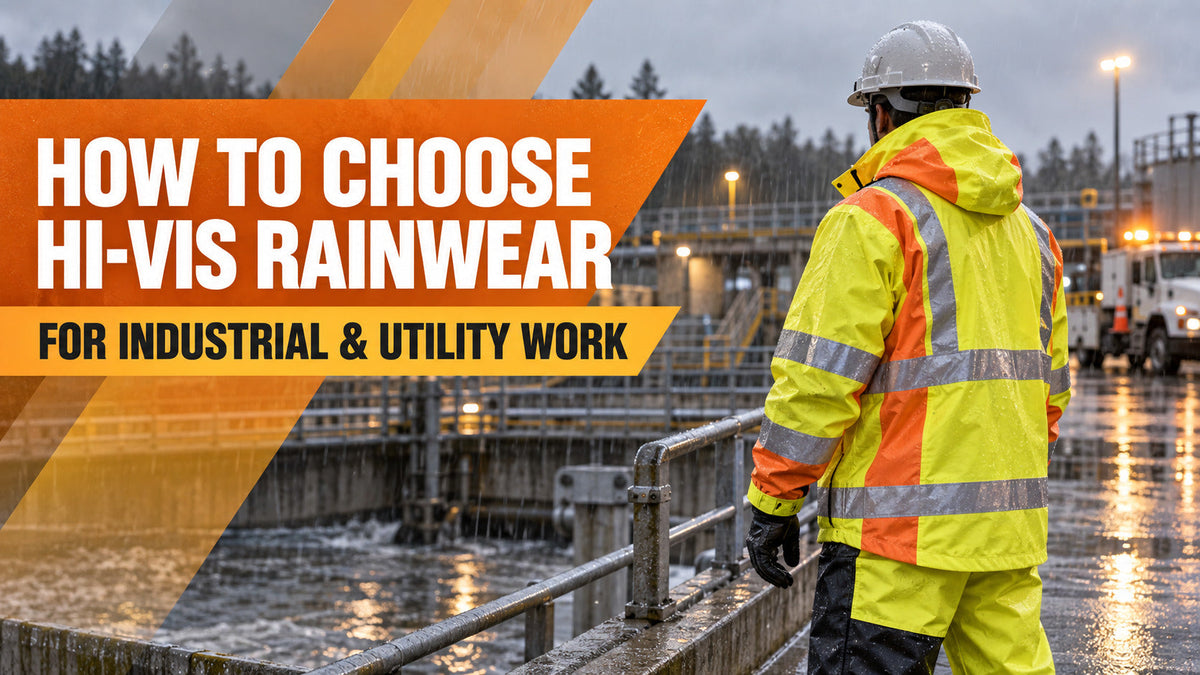
Rain makes workers harder to see, and ordinary outerwear can cover the high-visibility clothing underneath. Here is how to choose hi-vis rain gear for work: confirm the required CSA classification, then match the waterproof construction and coverage to the job.
If you already know those requirements, browse Cleanflow’s hi-vis rainwear by garment type and colour.
The Quick Answer
Choose hi-vis rainwear in this order:
- Confirm the CSA class, level and edition. Check the label and the rules for the site.
- Match the shell to the exposure. Heavy coatings suit spray and wipe-down. Lighter, breathable shells suit active work.
- Choose enough coverage. A jacket is easy to remove; bibs or a suit protect more of the body.
- Check additional hazards separately. Rain protection and high visibility do not provide flame, arc-flash, or chemical protection.
- Test the full setup. Layers and other PPE must not hide the striping or restrict movement.

Choose Rainwear Based on the Work
| Work setting | Start with | Why it fits |
|---|---|---|
| Roadside or public works | CSA-rated jacket and bibs or a rain suit | Keeps the upper and lower body visible near moving traffic |
| Utility field work | Breathable jacket with matching pants or bibs | Reduces heat buildup while climbing, walking and handling equipment |
| Wastewater plant or wet well area | Easy-clean jacket and bibs with verified splash compatibility | Adds coverage where spray can reach the waist and legs |
| Industrial yard | Durable jacket with sealed seams | Handles rain, abrasion and repeated movement around equipment |
| Occasional inspections | Lightweight, packable rainwear | Stores easily in a service vehicle and can be put on quickly |
This is only a starting point. Traffic speed, lighting, exposure time, mobile equipment and the visual background can change the required protection.
Hi-vis rainwear for utility workers must also suit the movement and secondary hazards of the actual task.
Hi-vis rainwear for industrial work must match the weather, activity level, splash exposure and other site hazards.
Check the Label on CSA Hi-Vis Rainwear
CSA class and level answer different questions. The class relates mainly to body coverage: Class 1 provides the least and Class 3 the most. The level identifies retroreflective performance.
Look for the standard edition, class, and level on the sewn-in label. Also check the colour. A product sold in several colours may not carry the same classification in every colour.
The CSA pattern is another buying cue: vertical bands over the shoulders, a horizontal torso band and a symmetrical “X” on the back. Class 3 adds bands around the arms and legs. The CCOHS high-visibility guide explains these elements and recommends a site-specific hazard assessment.
When a CSA Class 2 Rain Jacket May Be Appropriate
Class 2 is common for work near traffic or mobile equipment, but the job title alone does not set the class. Vehicle speed, distance from traffic, lighting, weather, and worker attention all matter.
Provincial rules can be more specific.
In British Columbia, workers exposed to vehicles or mobile equipment above 30 km/h must wear Class 2 or 3 apparel under the cited CSA edition. At 30 km/h or below, Class 1, 2, or 3 may be allowed. This WorkSafeBC requirement is a provincial example, not a Canada-wide rule.
Pick the Right Waterproof Construction
“High visibility” does not mean waterproof. And “water-resistant” usually means a garment can handle light rain for a limited time, not steady rain or pressurized spray. A waterproof reflective jacket must meet both claims separately.
PVC and Heavy Coated Rainwear
PVC-coated and similar non-breathable shells block water and usually wipe clean easily. They suit stationary work, washdown, and heavy spray, but can trap heat during active work.
PU-Coated Rainwear
Polyurethane coatings can provide waterproof protection in a lighter, more flexible shell. They suit utility and municipal crews that move throughout the shift. Also compare the face fabric and reinforcement.
Waterproof-Breathable Rainwear
A breathable membrane lets some water vapour escape while stopping liquid water. That can reduce clamminess during active work, although heavy layers can still trap heat.
If a product lists a hydrostatic-head rating in millimetres, that number describes resistance to water pressure under a specified test. A higher number generally means greater resistance, but it does not tell you about seam quality, durability or fit. Compare the complete garment, not one number.
For more coverage, see Cleanflow’s industrial rainwear and winter jacket guide for cold shifts.
Jacket, Bibs or Full Rain Suit?
A jacket is quick to remove for workers moving between a truck, building and outdoor site, but it leaves ordinary pants exposed.
Jacket-and-bib combinations cover the waist and stay in place while workers bend, climb or kneel. Check that the legs pass over work boots.
A two-piece rain suit keeps a complete set ready in a vehicle. Keep the jacket over the bib or pants so water sheds outside the waistband.
Treat FR and Arc Protection as Separate Requirements
FR hi-vis rainwear is needed only when the hazard assessment and workplace rules call for it. Utility, oil and gas, welding and hot work can add flame or arc hazards.
Do not choose by an “FR” product name alone. Confirm the exact standard, test method and rating on the label and technical data. A flame-resistance test is not proof that a garment carries the arc rating required for energized electrical work. The outer rain layer must match the hazard; an unsuitable shell over compliant clothing can undermine the system.
When flame resistance is required, compare garments in Cleanflow’s FR rainwear collection against the employer’s written PPE requirements.
Hi-Vis Rainwear Picks by Job
There is no single best hi-vis rain jacket for every crew. These options suit different jobs and hazards.
Tough Duck SJ35 for Active Utility and Road Work
The Tough Duck SJ35 rain jacket uses 300D ripstop polyester, a PU membrane, and taped seams. Its breathable construction, drop-back, and runoff-shaped sleeves help active crews stay covered without moving in a stiff shell. Yellow and orange meet CSA Z96-15 Class 2, Level 2; black meets Class 1, Level 2. Choose the colour by the required class, not appearance.

Pioneer 150D Rain Suit for Full-Body Roadside Coverage
The Pioneer 150D hi-vis rain suit includes a hooded jacket and bib pants in a storage pouch. The 150D Oxford polyester has a PU backing, while a full back vent and half-mesh lining improve airflow. It suits road and municipal crews that need a portable matching set. The product page identifies the jacket as CSA Z96-15 Class 2, Level 2.

Big K BK802 for Durable General Outdoor Work
The Big K BK802 rain jacket pairs waterproof 300D polyester with a mesh lining, hideaway hood and side zippers. It gives plant and field workers a durable outer layer that is easier to vent and remove. Yellow and orange are listed as CSA Z96-02 Class 2, Level 2; black is Class 1, Level 2. Because that is an older standard edition, confirm acceptance before ordering.

Viking 5200J for Heavy Industrial Splash Exposure
The Viking 5200J Miner 49er jacket uses neoprene with nylon and PU backing, plus heat-sealed and taped seams. It is built for wet, abrasive industrial conditions where durable waterproof construction and chemical-specific splash resistance matter more than low weight. The product is listed as CSA Z96-15 Class 1, so it may not satisfy roadside requirements. Verify the substance, concentration, and contact time before use.

Viking 3907FRJ for Jobs Requiring Listed Flame Resistance
The Viking 3907FRJ Journeyman jacket combines an FR-treated 300D ripstop shell with PU backing, vents, a storm flap and adjustable cuffs. Orange is listed as CSA Z96-15 Class 2, Level 2; black is Class 1, Level 2. Its product page lists ASTM D6413 and CAN/CGSB-4.2 No. 27.10 flame-resistance testing. Confirm those standards meet the job’s exact FR or electrical PPE requirements before selecting it.

Check Fit With the Rest of the PPE
Try rainwear over the heaviest work layers. The wearer should be able to reach, crouch and climb without exposed wrists or a lifted hem.
A harness, tool belt, backpack, glove gauntlet or tall boot must not hide required high-visibility material. The hood must work with the hard hat without blocking side vision.
For wet plant and utility work, pair rainwear with work boots chosen for the site’s slip, impact, puncture, electrical and chemical hazards. Cleanflow’s STC work boot guide compares several models.
How to Choose Hi-Vis Rain Gear for Work: Checklist
Before placing a crew order, confirm:
- The required CSA edition, class and level appear on the exact colour and size.
- The waterproof claim applies to the complete garment, including seams and closures.
- The material suits the work rate, expected rain and splash exposure.
- The jacket, bibs or suit covers the areas that actually get wet.
- Any FR, arc or chemical claim matches the written hazard assessment.
- The garment fits over seasonal layers and works with all other PPE.
- Workers can clean, inspect and dry it as directed by the manufacturer.
Replace rainwear when damaged seams, worn coatings, torn fabric or permanently contaminated reflective material reduce protection. Dirt and contamination can lower visibility even when the shell still keeps water out.
Stay Visible Without Giving Up Rain Protection
The right high-visibility rainwear starts with the required CSA classification, then adds the waterproof construction and coverage the job demands. Compare labels on the exact colour, verify any secondary protection and order enough room for the full PPE system.
Frequently Asked Questions
What class of hi-vis rain jacket do utility workers need in Canada?
There is no single class for every utility job. Use the site hazard assessment and applicable provincial, employer or project rules. Traffic speed, mobile equipment, lighting, weather and distance from vehicles all affect the choice.
Is a CSA Class 2 rain jacket always enough for roadside work?
No. Class 2 may be suitable in many situations, but high-speed traffic, night work or poor visibility may require Class 3 or a specific garment system. Confirm the rule for the site before ordering.
Is waterproof-breathable rainwear fully waterproof?
It can be waterproof when the membrane, seams and closures are properly designed and maintained. Breathable means the fabric can release some water vapour; it does not mean air passes freely or that sweat disappears.
Can FR clothing be worn under ordinary hi-vis rainwear?
Only when the complete layered system is permitted by the hazard assessment and employer program. Do not assume an ordinary shell is acceptable; verify the requirements for the exposed outer layer.