



Description
Coconut Shell Carbon Block Filter for Chlorine, Taste, and Odor Reduction in Drinking Water Systems
Product Overview
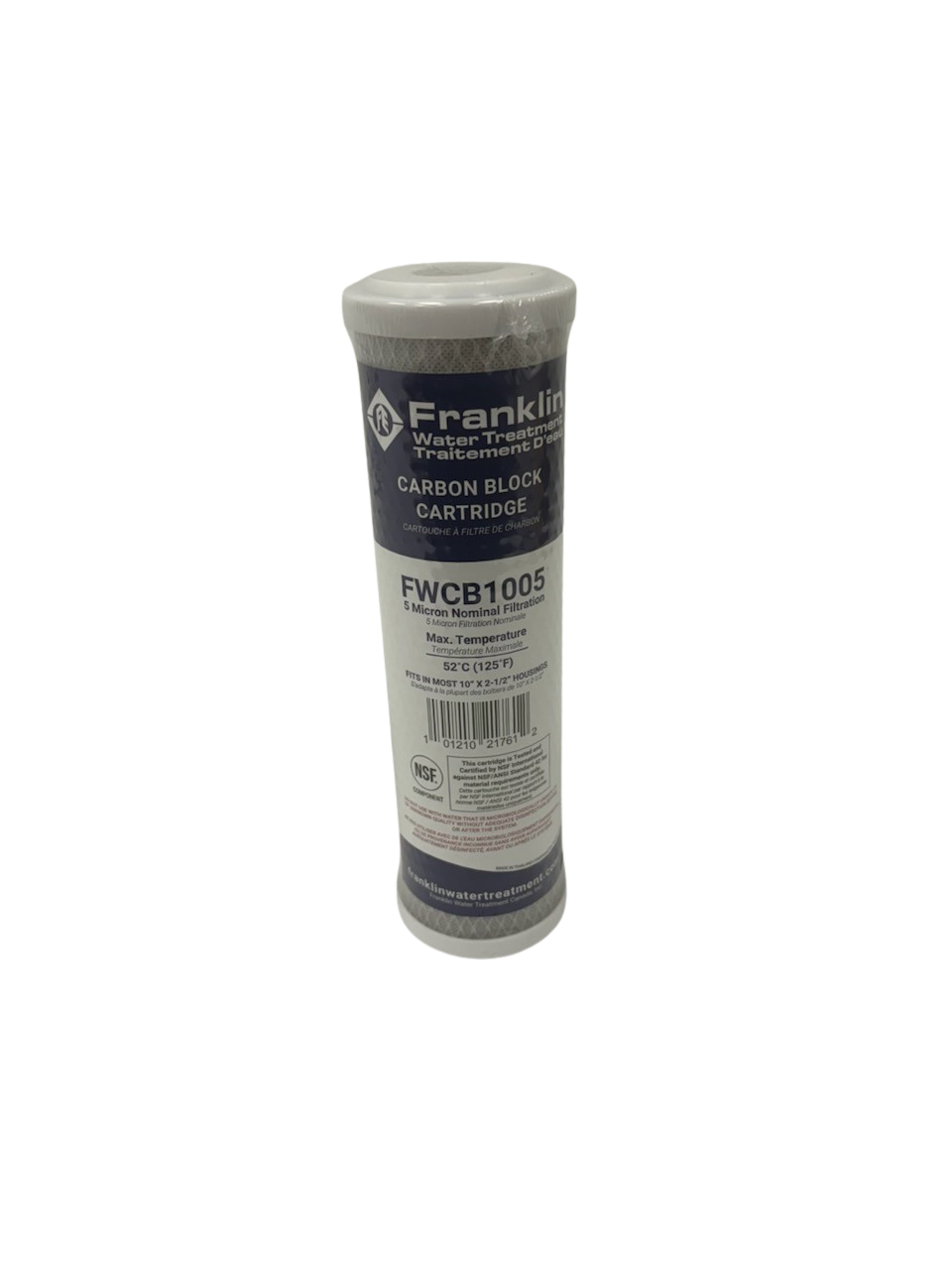
The Franklin FWCB is a carbon block filter cartridge manufactured from 100% coconut shell activated carbon. Carbon block filters reduce dissolved chlorine, taste, and odor through chemical adsorption, which is a different process from sediment filters that capture particles. Available in 5 micron (FWCB1005) and 0.5 micron (FWCB10P5). NSF 42 and NSF 61 certified for material safety requirements. Fits standard 2.5" x 10" filter housings.

Specifications
| Specification | Detail |
|---|---|
| Series | FWCB |
| Filter Type | Carbon block (adsorption filter) |
| Carbon Media | 100% coconut shell activated carbon |
| Micron Ratings | 0.5 and 5 |
| Reduces | Chlorine, taste, odor |
| Size | 2.5" x 10" |
| End Caps | Polypropylene |
| Inner/Outer Wrap | Polypropylene |
| Netting | Polypropylene |
| Gasket | Natural rubber |
| Operating Temperature | 4-50°C (40-120°F) |
| Max Operating Pressure | 10 Bar (150 psi) |
| Nominal ΔP for Replacement | 1.5 Bar (22 psi) |
| Certifications | NSF 42, NSF 61 (material requirements) |
| Housing Compatibility | Standard 2.5" x 10" filter housings |
Chlorine Reduction Capacity by Model
| Part # | Micron | Chlorine Capacity | Initial ΔP | Box Qty |
|---|---|---|---|---|
| FWCB1005 | 5 | >17,000 gal @ 1 GPM | 2 psid @ 1 GPM | 20 |
| FWCB10P5 | 0.5 | >20,000 gal @ 1 GPM | 3 psid @ 1 GPM | 20 |
Key Features
- 100% coconut shell activated carbon provides higher chlorine adsorption capacity and fewer carbon fines than coal-based carbon blocks. Coconut shell has more micropores per gram, which increases the surface area available for chemical adsorption.
- Carbon block construction compresses the carbon media into a solid form, which eliminates channeling. Water must pass through the full carbon matrix rather than finding paths of least resistance, as it can in loose granular carbon (GAC) filters.
- NSF 42 and NSF 61 certified by NSF International for material safety requirements. NSF 42 covers materials in contact with drinking water for chlorine, taste, and odor reduction systems. NSF 61 covers materials in contact with potable water system components.
- Low initial pressure drop (2 psid at 1 GPM for 5 micron, 3 psid for 0.5 micron) maintains consistent flow in point-of-use systems without requiring a booster pump.
- Polypropylene end caps, wrap, and netting with a natural rubber gasket.

0.5 Micron vs 5 Micron: Which to Choose
| FWCB1005 (5µ) | FWCB10P5 (0.5µ) | |
|---|---|---|
| Chlorine capacity | >17,000 gal @ 1 GPM | >20,000 gal @ 1 GPM |
| Initial pressure drop | 2 psid @ 1 GPM | 3 psid @ 1 GPM |
| Particle removal | Down to 5 micron | Down to 0.5 micron |
| Best for | General chlorine, taste, odor reduction with lower pressure drop | Fine particulate polishing, higher chlorine capacity, RO pre-filtration |
Choose 5 micron for general drinking water chlorine reduction where maintaining higher flow rates matters. Choose 0.5 micron when you need finer particulate removal, longer chlorine service life, or are feeding an RO membrane that benefits from tighter pre-filtration.
Applications
- Point-of-use (POU) drinking water systems
- Under-sink and countertop filter housings
- Pre-filtration and post-filtration for reverse osmosis systems
- Food and beverage processing
- Water purification systems
- Potable and process water treatment

Buy Carbon Block Filter Cartridges from Cleanflow
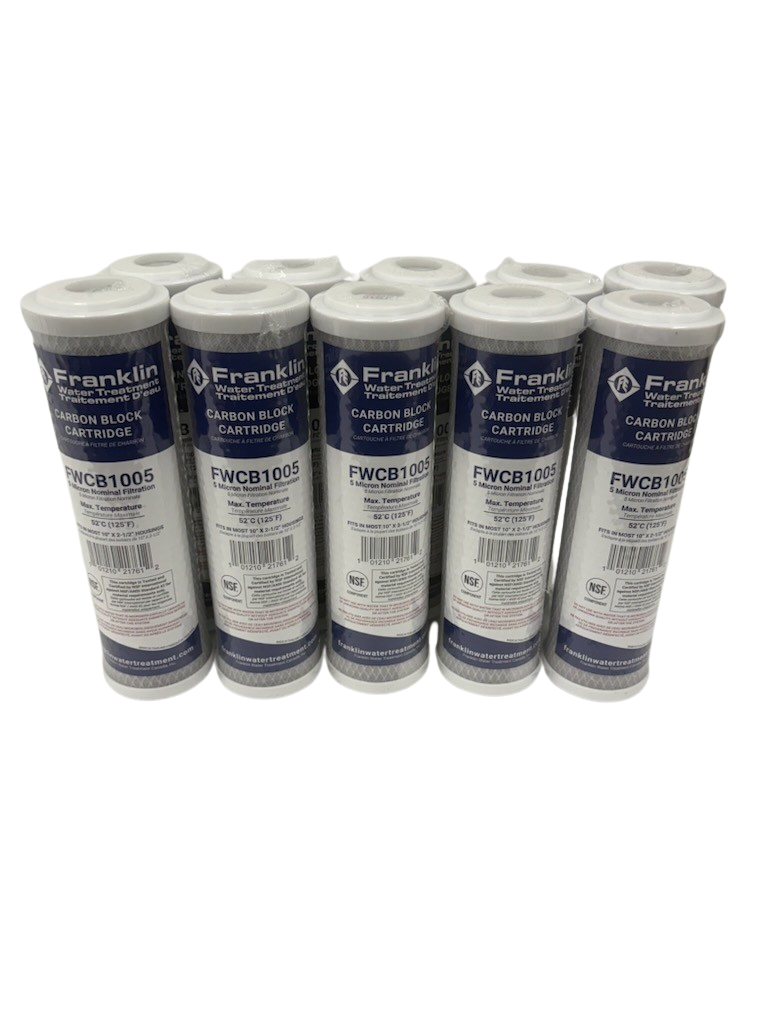
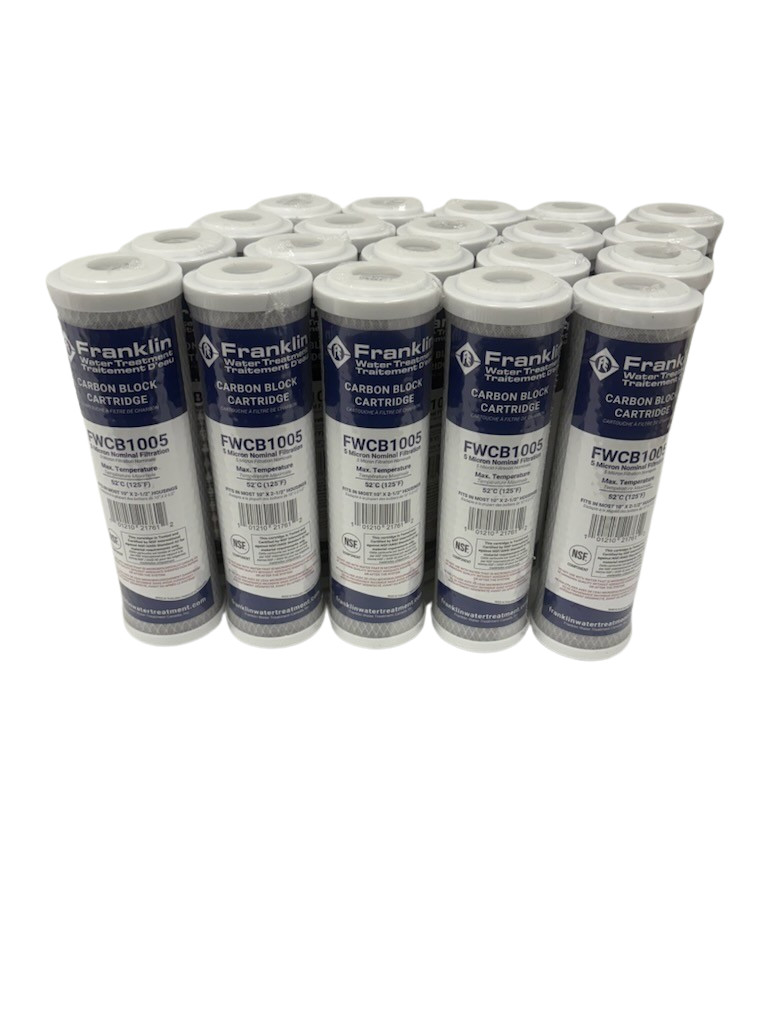
Cleanflow Utility Supply Company stocks the Franklin FWCB coconut shell carbon block filter cartridge in both 0.5 and 5 micron as part of the Standard Water Filters collection. Sold individually, in packs of 10, or packs of 20.
Need a longer cartridge? The FWCB 2.5" x 20" provides higher chlorine capacity for systems with more throughput. Need a Big Blue format? The FWCB 4.5" Big Blue carbon block handles higher flow rates for whole-house systems. Pair with a FWSW string wound or FWPS spun poly sediment pre-filter to protect the carbon block from premature loading.
Free shipping on orders over $199. 30-day return policy. Email info@cleanflow.ca for pack pricing.
Frequently Asked Questions
What is the difference between a carbon block filter and a GAC (granular activated carbon) filter?
A carbon block filter compresses activated carbon into a solid block. Water must pass through the entire carbon matrix, which provides consistent contact time and prevents channeling. A GAC filter uses loose carbon granules inside a cartridge shell. GAC has lower pressure drop and higher flow rates, but water can find paths of least resistance through the loose media, reducing contact time. Carbon block provides more reliable chlorine reduction at the rated capacity. Choose a carbon block for drinking water and RO pre-filtration. Choose GAC when higher flow rates matter more than maximum chlorine removal consistency.
How many gallons can a carbon block filter treat?
The FWCB1005 (5 micron) reduces chlorine for more than 17,000 gallons at 1 GPM. The FWCB10P5 (0.5 micron) reduces chlorine for more than 20,000 gallons at 1 GPM. These are manufacturer lab test values at 1.8-2.2 ppm chlorine input and 60 psi pressure. Actual capacity depends on your water's chlorine level, flow rate, and temperature.
Do carbon block filters remove bacteria?
No. Carbon block filters are not microbiological purifiers. They reduce dissolved chlorine, taste, and odor through chemical adsorption. Franklin recommends multiple disinfection barriers where raw water may contain pathogens.
Should I use a sediment pre-filter with a carbon block?
Yes. Sediment (sand, silt, rust) clogs carbon block filters and shortens their service life. Install a sediment pre-filter (string wound or spun poly) upstream of the carbon block to catch particulates before they reach the carbon media. This is standard practice in multi-stage systems and RO pre-filtration trains.
What is the recommended filter sequence for a complete drinking water system?
Stage 1: a sediment pre-filter (FWSW string wound or FWPS spun poly) removes sand, silt, and rust.
Stage 2: this FWCB carbon block reduces chlorine, taste, and odor.
Stage 3 (optional): an RO membrane removes dissolved solids, and a second carbon block polishes the water after the membrane.
Each stage protects the next, and replacing the less expensive upstream cartridges on schedule extends the life of the more expensive downstream filters.
Manuals & Documentation
How-To Articles
Similar Products
Featured collection


