

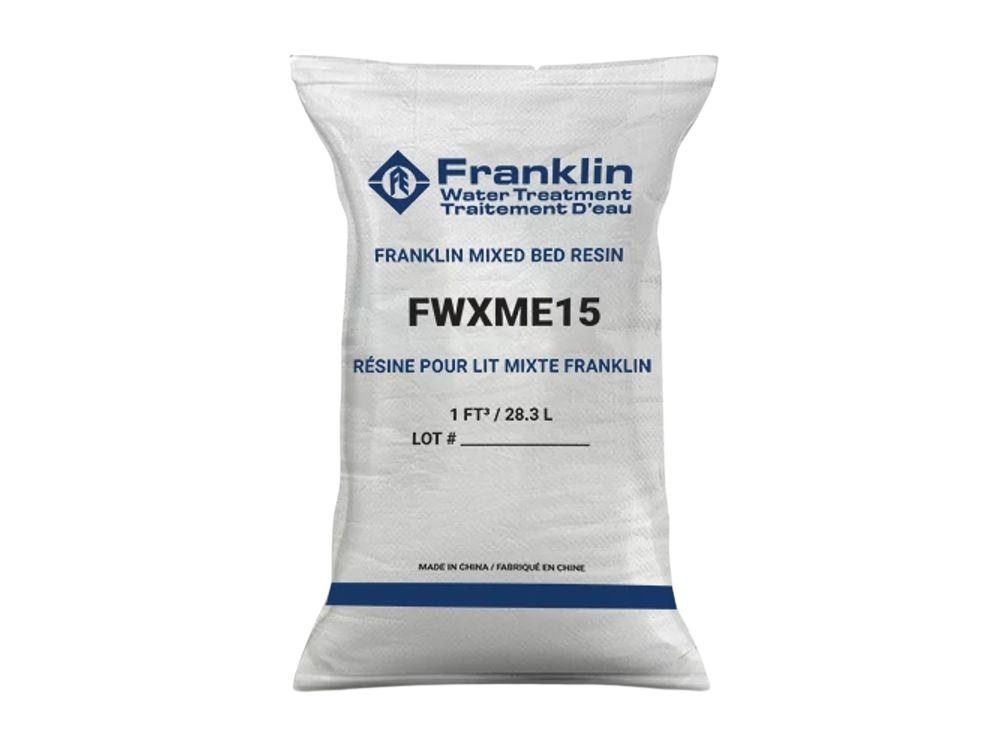

Description
Pre-Mixed Deionization Resin for Ultrapure Water Polishing
Franklin FWXME15 is a pre-mixed ion exchange resin combining strong acid cation (H+) and Type I strong base anion (OH⁻) resins in a single media bed. It is a mixed bed DI resin used to produce deionized water for laboratory, dental and industrial applications.
FWXME15 uses a gel polystyrene matrix crosslinked with divinylbenzene (DVB). It is a mixed bed deionization resin pre-mixed at a 40% cation to 60% anion ratio, eliminating the need for separate resin loading or blending.
As a high purity mixed bed resin, FWXME15 can reduce residual ionic content to levels suitable for ultrapure water production when installed as a polishing stage after reverse osmosis or primary demineralization. The resin is generally replaced when exhausted rather than regenerated in the field.
Best Suited For
- Laboratory water purification for analytical instruments
- Dental and medical equipment requiring deionized water
- Polishing stage after reverse osmosis or primary demineralization
- Camera lens cleaning, metal cleaning and precision surface preparation
- Beverage production using deionized process water
- Replacing exhausted mixed bed deionization resin in existing DI systems
Key Features of Franklin FWXME15 Mixed Bed DI Resin
- Pre-mixed 40% cation / 60% anion ratio
- Gel polystyrene matrix crosslinked with DVB
- Sulfonic acid (cation) and Type I quaternary ammonium (anion) functional groups
- Shipped in H+ / OH⁻ ionic form, ready to load
- No separate blending or ratio adjustment required
- Maximum operating temperature of 60°C (140°F)
- Particle size range of 0.40 to 1.25 mm (≥95%)
- Total exchange capacity ≥1.9 eq/L (cation) and ≥1.0 eq/L (anion)
Technical Specifications
| Property | Value |
|---|---|
| Application | Deionized water production, polishing after RO or primary demineralization |
| Resin Type | Mixed bed (cation + anion) |
| Polymer Matrix | Gel polystyrene crosslinked with DVB |
| Appearance | Amber spherical beads |
| Functional Groups | Sulfonic Acid / Quaternary Ammonium, Type I |
| Ionic Form as Shipped | H+ / OH⁻ |
| Resin Ratio | 40% cation / 60% anion |
| Total Exchange Capacity (Cation) | ≥1.9 eq/L |
| Total Exchange Capacity (Anion) | ≥1.0 eq/L |
| Moisture Retention | 55 to 60% |
| Particle Size Range | 0.40 to 1.25 mm (≥95%) |
| Uniformity Coefficient | <1.7 |
| Whole Uncracked Beads After Attrition | ≥95% |
| Shipping Weight | 0.69 to 0.75 g/mL |
| Minimum Bed Depth | >600 mm |
| Maximum Pressure Loss | 25 PSI |
| Service Flow Rate | 8 to 40 BV/h |
| Max Operating Temperature | 60°C (140°F) |
| pH Range | 2 to 12 |
How FWXME15 Works as a Polishing Stage
Mixed bed DI resin combines cation and anion exchange resins in a single vessel. When water passes through the bed, the H+ form cation resin removes positively charged ions while the OH⁻ form anion resin removes negatively charged ions. The exchanged H+ and OH⁻ ions combine to form water, reducing total dissolved solids in a single pass.
FWXME15 uses a 40% cation to 60% anion ratio. This proportion is standard for mixed bed deionization resin in polishing applications where the feed water has already been partially treated. A mixed bed ion exchange resin in this configuration can produce water with resistivity approaching 18.2 MΩ·cm under controlled conditions.
When evaluating mixed bed resin vs separate bed deionization, the key difference is configuration. In separate bed systems, cation and anion resins are loaded into individual vessels and the water passes through each in sequence. A pre-mixed ion exchange resin like FWXME15 combines both resins in one vessel. Separate beds allow independent regeneration and optimization, while mixed bed systems require less equipment and can produce higher purity water in fewer stages.
Actual output quality depends on the feed-water chemistry, flow rate, resin volume, bed depth and system design.
Selecting the Correct Resin
Choose FWXME15 when the treatment system requires a deionization resin for ultrapure water production in a polishing or single-stage configuration. Before ordering, confirm:
- Feed-water analysis (TDS, pH, contaminants present)
- Whether pretreatment is installed (RO, primary demineralization)
- Target deionized water quality (resistivity)
- Required resin volume
- Service flow rate
- Vessel size and minimum bed depth
- Whether the resin will be replaced or regenerated when exhausted
For systems requiring individual cation and anion resins in a multi-bed configuration, Franklin offers Franklin FWXCMP1 for cation exchange and Franklin FWXA213 for anion exchange.
Order Franklin FWXME15 from Cleanflow
Buy Franklin FWXME15 mixed bed DI resin online for shipment across Canada and the United States. Review the technical specification sheet before selecting the resin volume for your system.
For help confirming whether FWXME15 fits your application, contact Cleanflow Utility Supply Company with your feed-water analysis, vessel size, flow rate and treatment objective.
For other resin types and treatment applications, browse the Franklin Water Treatment collection.
Frequently Asked Questions
What is mixed bed DI resin used for?
Mixed bed DI resin is used to produce deionized water by removing both cations and anions in a single vessel. It is commonly used as a polishing stage after reverse osmosis or primary demineralization in laboratory, dental, medical and industrial water systems.
What is the difference between mixed bed resin and separate bed deionization?
Mixed bed resin combines cation and anion resins in one vessel, producing higher purity water in a single pass. Separate bed deionization uses individual vessels for each resin type, allowing independent regeneration but requiring more equipment. Mixed bed systems are typically used for polishing after primary treatment.
Can mixed bed resin produce ultrapure water?
Mixed bed resin can produce water with very low ionic content when used as a polishing stage after pretreatment. Under controlled conditions with low-TDS feed water, a mixed bed ion exchange resin may achieve resistivity approaching 18.2 MΩ·cm. Actual results depend on feed-water quality and system design.
What is the cation to anion ratio in mixed bed resin?
The standard cation to anion ratio for polishing-grade mixed bed resin is 40% cation to 60% anion by volume. This ratio provides balanced exchange capacity for both positively and negatively charged ions. FWXME15 ships pre-mixed at this ratio.
What is the best DI resin for laboratory water purification?
A deionization resin for ultrapure water production in laboratory systems is typically a high purity mixed bed resin installed as a polishing stage after reverse osmosis. Franklin FWXME15 is a pre-mixed mixed bed DI resin with a 40/60 cation-to-anion ratio used in laboratory and analytical water purification systems.
Manuals & Documentation
Similar Products
Featured collection


