

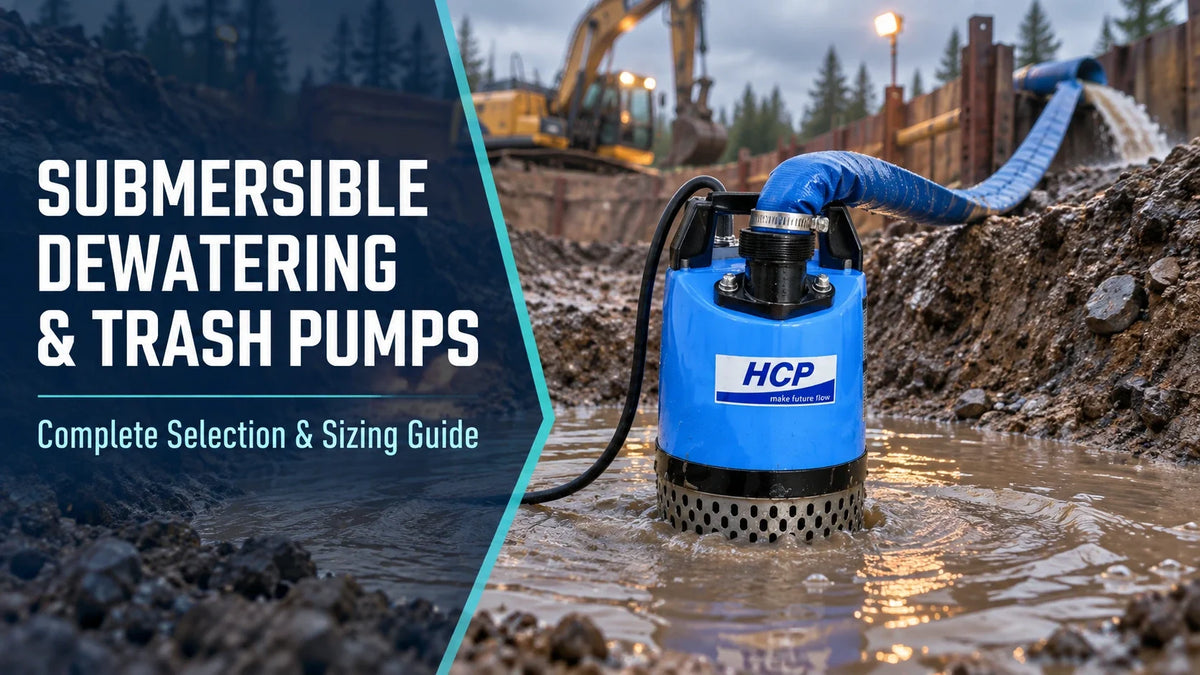
A pump can show a high GPM on the product page and still move much less water on site. Lift, hose length, fittings, and debris all reduce the flow you get in real conditions.
So start with the job, not the horsepower. Check the water, required flow, and total dynamic head (TDH). Then use the pump curve to confirm that the pump can meet both flow and head simultaneously.
You can compare Cleanflow's submersible dewatering pumps and submersible trash pumps as you work through this guide.
Use a standard dewatering pump for clear or lightly dirty water. Use a submersible trash pump for water with larger debris that fits the model's solids-passage rating. Slurry, sewage, fibrous waste, and chemicals need pumps made for those materials.
Dewatering Pump or Trash Pump? Start With the Water
Dewatering is the process of removing unwanted water. Trash describes the pump's ability to pass debris. And submersible means the pump operates in the water. That is why a pump can be both submersible and a trash pump.
A standard dewatering pump usually has a strainer and smaller internal passages. It works well for rainwater, groundwater, and limited silt. A trash pump has larger passages for debris such as leaves, small stones, and jobsite waste.
| Water or site condition | Start with | Verify before buying |
|---|---|---|
| Clear rainwater or groundwater | Standard submersible dewatering pump | Required flow, TDH, minimum water level, and hose size |
| Water with mud, silt or limited sand | Dewatering pump designed for dirty water | Strainer, impeller, wear materials and allowed solids |
| Water with leaves, stones or jobsite debris | Submersible trash pump | Published solids passage, concentration and cleanout access |
| Very shallow residual water | Puddle-sucker or low-level pump | Minimum pickup depth and flat-surface setup |
| Raw sewage or fibrous waste | Sewage, non-clog or grinder pump | Passage geometry, controls and approved application |
| Thick or highly abrasive mixture | Slurry pump | Solids concentration, particle hardness, materials and motor loading |
Seven Steps for Choosing a Submersible Dewatering Pump
1. Identify the liquid and everything in it
Plan for the worst water the pump will face, not the cleaner water at the start. An excavation often gets muddier as the level drops and sediment moves toward the intake.
- Water type, temperature and measured or expected pH.
- Salt, chlorides, cleaning chemicals or process contaminants.
- Compatibility of the casing, impeller, shaft, seals and O-rings with the liquid.
- Largest particle and the amount of solids.
- Whether the solids are soft, sharp, fibrous, or abrasive.
- Any rags, roots, or sticks that could wrap around the impeller.
A solids-passage rating tells you the largest particle the pump is built to pass. It does not mean the pump can handle any amount of sand, grit, or slurry. Fine abrasive material can still cause fast wear.
2. Determine how much water must be moved
Required flow depends on the volume already there, new water entering the area and how fast the level must drop. It is not the maximum GPM printed on the pump.
Basic flow estimate: Required flow = volume to remove divided by available pumping time, plus ongoing inflow.
For example, removing 3,000 gallons in one hour takes 50 GPM. If another 15 GPM is entering the pit, the pump must deliver more than 65 GPM at the site's actual head to lower the level on time.
Allow for changing rainfall, a partly blocked inlet, and other site risks. If flooding could affect excavation stability, have the pumping plan reviewed for that site.
3. Calculate total dynamic head
TDH is the total resistance the pump must overcome. It includes vertical lift, friction in the hose and fittings, and any pressure needed at the outlet.
Simplified open-discharge formula: TDH = vertical lift + hose and fitting friction + required outlet pressure. For a free, open discharge, the last part is usually zero.
Measure the height from the water surface to the discharge point. Then add friction from the full hose run, valves, elbows and couplings. A long or undersized hose can create high TDH even when the vertical lift is low.

4. Check the duty point on the pump curve
A pump curve shows the flow a model can deliver at different head levels. Flow falls as head rises. Maximum GPM and maximum head are opposite ends of the curve, so a pump cannot provide both at once.
Find your required flow and TDH on the manufacturer's curve. The point where they meet is the duty point. It must sit inside the pump's allowed operating range. Two pumps with the same horsepower or outlet size can have very different curves.
5. Match the discharge hose to the required flow
The hose is part of the pump system. A smaller or longer hose creates more friction and usually lowers the delivered flow. Include the real hose length, inside diameter, couplings, elbows, and check valves in the TDH calculation.
Use the manufacturer's curve with a hose-friction chart. Cleanflow carries hose and fittings, and dewatering pump packages can help complete the setup, but the selected hose still needs to match the required flow and TDH.
6. Confirm voltage, phase, amperage, and controls
The pump also has to match the available site power. Check the voltage, phase, running current, starting current, plug, starter, and overload protection.
Do not size a generator from horsepower or running watts alone. The generator must also handle motor starting demand. Long or undersized cables can cause voltage drop, so follow the pump and generator manufacturers' electrical guidance.
For automatic operation, choose compatible float switches and accessories. A tethered float also needs enough room to move without catching on the pit wall, hose, or cable.
7. Check installation and operating limits
Read the manual for the exact model. Submersible does not mean the pump can run in any position, at any depth, or without water.
- Minimum water level and allowed submergence.
- Duty rating, liquid temperature and allowed pH.
- Approved operating position and any dry-run limit.
- Lifting method and inspection schedule.
Never lift the pump by its power cable. Use the approved handle, chain or rope.
Which Cleanflow Pump Fits the Job?

These examples help narrow the options. The listed figures are maximum ratings, so confirm the required duty point on the model's pump curve before buying.
Portable 120V dewatering for clear or lightly dirty water
The HCP GD-400 is a compact 2-inch, 120V option for construction drainage and stormwater. It is rated for up to 64 GPM and 1/4-inch solids. Its discharge can face up or sideways to fit the hose layout.
The 120V HCP GD-750 is rated for up to 80 GPM when more capacity is needed. Actual flow for both models depends on the job's TDH.
Other HCP Dewatering Models by Job Type
HCP's dewatering range also covers muddy water, higher head, larger discharge lines, and liquids that can attack standard pump materials. Use this table as a starting point, then confirm the duty point and liquid limits for the exact model.
| Water or site condition | HCP starting option | Main distinction |
|---|---|---|
| Clear or lightly dirty water | GD-400 or GD-750 | Compact 120V pumps rated up to 64 or 80 GPM. |
| Muddy or silty water | AN-21A | 2-inch vortex pump; up to 88 GPM, 53 ft of head and 1/4-inch solids. |
| Deep pits or long discharge runs | AN-22 | 2 HP; up to 132 GPM, 80.4 ft of head and 3/8-inch solids. |
| High-volume, lower-head drainage | AN-31 | 3-inch outlet; up to 135 GPM, 40 ft of head and 1/4-inch solids. |
| Low-pH water or seawater | 50SA2.4A or 50SA2.8A | Stainless hydraulic parts, Viton seals and a published pH range of 2–10. |
Stainless Steel Pumps for Low-pH Water and Seawater
Choose a stainless steel submersible dewatering pump when pH, salts or chemicals can attack a standard jobsite pump. HCP's SA hydraulic body uses SUS316 stainless steel. Its impeller and drainage cover use SCS14 cast stainless steel, while Viton O-rings protect critical joints.
The 1/2 HP 50SA2.4A is rated up to 79 GPM and 36.1 feet of head. The 1 HP 50SA2.8A is rated up to 90 GPM and 50.9 feet. Both have 2-inch discharges, pass 3/8-inch solids and carry a published pH range of 2–10 at 0–40°C.
These models can be a starting point for low-pH water or seawater. They are not universal chemical-resistant pumps. Confirm the exact liquid, concentration and temperature against every wetted material and seal. Then use the pump curve to verify flow at the site's TDH.
Debris-laden water
The Multiquip ST2040T submersible trash pump is rated for up to 79 GPM, 40 feet of head and 1-inch solids. Those maximums do not happen at the same point. Check the curve for the flow available at your TDH.
For a deeper model review, read the Multiquip ST2040T trash-pump guide. If the job needs a different flow, voltage or solid capacity, compare the HCP submersible trash pump range.
Very shallow water on a hard surface
For water left on a flat floor or slab, the Multiquip ST2038P puddle-sucker pump is built for low-level removal and is rated for up to 60 GPM. Choosing this style when removing shallow water matters more than passing large debris.
When a Dewatering or Trash Pump Is the Wrong Choice
A trash pump is not the answer for every dirty liquid. Start with another pump type in these cases:
| Condition | Better starting category | Reason |
|---|---|---|
| Raw sewage or fibrous material | Sewage, non-clog or grinder pump | Rags and fibres can wrap or bridge inside a general dewatering pump |
| Settled solids or high-concentration abrasive slurry | Purpose-built slurry pump | A large passage alone does not provide wear resistance or keep solids suspended |
| Chemically aggressive liquid | Chemically compatible pump | Seals, elastomers and metals must match the liquid |
| No suitable site power | Engine-driven pump or approved generator | The power source must match the pump |
| Deep excavation drawdown | Engineered wellpoint or deep-well system | A sump pump may not control groundwater or soil movement |
Canadian Jobsite and Cold-Weather Considerations
Use electrical equipment approved for the location. Keep connections away from water and damage, and follow provincial, municipal and jobsite rules. Ground-fault protection may be required. Ask a qualified electrician if the supply, generator or temporary wiring is uncertain.
Do not enter the water or handle wet electrical equipment when a shock risk may be present. Shut off and verify the power before checking the pump, cable or intake.
Water-taking and discharge rules vary across Canada. The job may need provincial approval, a municipal discharge permit, water testing or sediment treatment. Check the local rules before pumping starts.
In freezing weather, drain the pump, hose and fittings as the manufacturer directs. Protect cables from ice, sharp edges and traffic. Do not apply heat or de-icing chemicals unless the manufacturer allows it.
What to Know Before Asking for a Pump Recommendation
Bring these details to the supplier:
- Water type, temperature and largest solids.
- Total volume, incoming flow and required pumping time.
- Vertical lift, hose diameter, length, and fittings.
- Available voltage, phase, and generator details.
- Manual or automatic operation and expected run time.
- Discharge location and any permit or treatment rules.
For small drainage jobs, you can also compare utility dewatering pumps and the available pump accessories.

Choose the Complete Dewatering System
Start with the water, required flow, and TDH. Then check the pump curve, solids limit, hose, power supply, and operating limits.
Compare Cleanflow's submersible dewatering pumps and dewatering pump packages, or send the Cleanflow team the job details above for help choosing the right setup.
Frequently Asked Questions
What is the difference between a submersible dewatering pump and a trash pump?
A submersible dewatering pump runs in the water and usually handles clear or lightly dirty water. A trash pump has larger internal passages for debris. Some trash pumps are submersible, while others are engine-driven surface pumps.
What size submersible dewatering pump do I need?
Choose a pump that delivers the required flow at the calculated TDH and can handle the water and solids. Confirm the duty point on the manufacturer's curve. Horsepower, outlet size or maximum GPM alone cannot tell you the right size.
Can a dewatering pump handle muddy or sandy water?
Yes, but only when the model is made for those conditions. Check its solids limit, impeller, and wear materials. Fine sand may pass through the pump and still wear the impeller, casing, and seals faster.
Can a submersible pump run dry?
Only if the manufacturer allows it, and only for the stated time. Many submersible pumps use the surrounding water for cooling or seal protection. Use a float switch or dry-run protection when the water may fall below the safe level.