

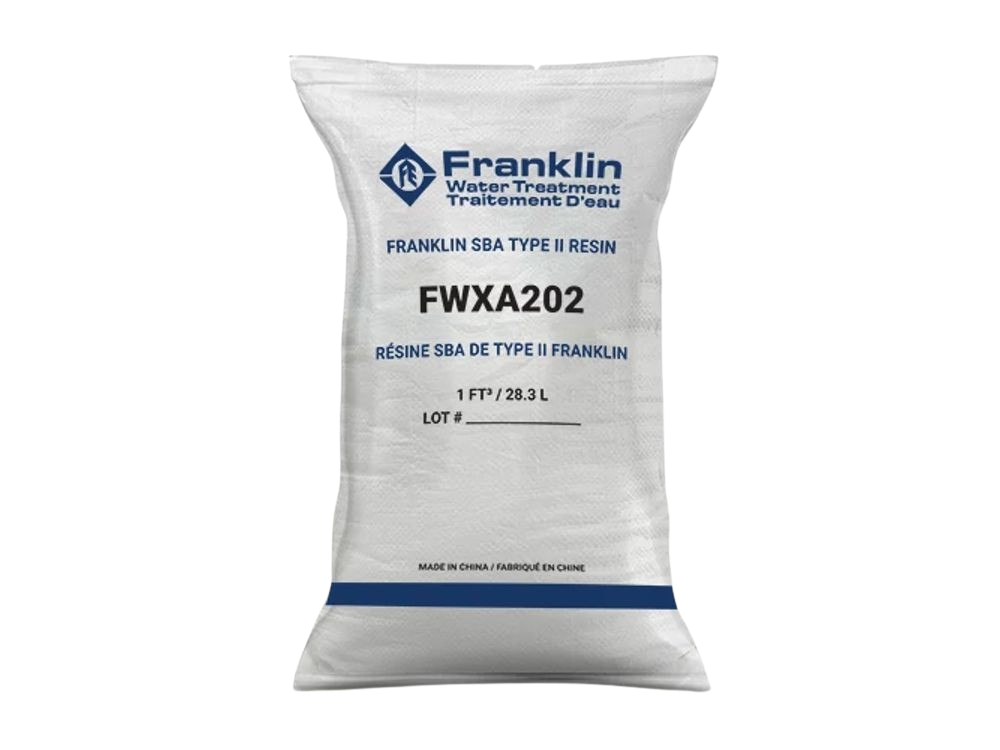

Description
Type II Gel Anion Resin for Dealkalization, Nitrate Removal and Demineralization
Overview
Every regeneration cycle costs caustic. Type I resins grip anions tighter and need more NaOH to release them. The Franklin FWXA202 is a Type II gel strong base anion exchange resin with a dimethylethanolamine (DMEA) functional group that regenerates more completely per pound of caustic. Lower chemical cost per cycle on dealkalization, nitrate removal, and demineralization systems.
Specifications
| Property | Value |
|---|---|
| Application | Water demineralization, dealkalization, nitrates removal |
| Polymer Matrix Structure | Gel polystyrene crosslinked with divinylbenzene (DVB) |
| Appearance | Pale yellow transparent, spherical beads |
| Functional Group | Quaternary amine, Type II (Dimethylethanolamine) |
| Ionic Form as Shipped | Cl⁻ or OH⁻ (when ordered as FWXA202) |
| Suggested Operating Conditions | |
| Max Operating Temperature (Cl⁻ form) | 85°C (185°F) |
| Max Operating Temperature (OH⁻ form) | 35°C (95°F) |
| pH Range | 0 to 10 |
| Service Flow Rate | 5 to 40 BV/h |
| Regenerant (Cl⁻ form) | 2 to 10% NaCl |
| Regenerant (OH⁻ form) | 2 to 6% NaOH |
| Physical and Chemical Properties | |
| Total Exchange Capacity (eq/L) | ≥1.4 |
| Moisture Retention (%) | 34 to 46 |
| Particle Size Range | 0.315 to 1.25 mm (≥95%) |
| Whole Uncracked Beads After Attrition (%) | ≥96 |
| Bulk Density (g/mL) | 0.68 to 0.76 |
| Specific Gravity (g/mL) | 1.09 to 1.16 |
| Effective Size (mm) | 0.4 to 0.6 |
| Homogeneous Coefficient | <1.7 |
| Reversible Swelling, Cl⁻ to OH⁻ (%) | <20 |
| Free Moisture (%) | <2 |
Type I vs Type II: Which Anion Resin Fits Your System?
The difference between Type I and Type II strong base anion resin comes down to the functional group on the polymer backbone. Type I uses trimethylamine, which grips anions more tightly and strips silica more effectively. Type II uses dimethylethanolamine (DMEA), which lets go of anions more easily during regeneration, meaning less caustic per cycle and higher operating capacity per service run. The FWXA213 (Type I macroporous) is the better fit when silica specs are tight or organic fouling demands a macroporous structure.
Choose FWXA202 (Type II) when:
- Regeneration chemical cost is a primary operating concern
- Application is dealkalization, nitrate removal, or general demineralization
- Silica and CO₂ combined are under 25% of total anion load
- Treated water must be free of amine odor (potable water, food processing)
Choose FWXA213 (Type I) when:
- Low silica leakage is required (high-pressure boiler makeup, electronics)
- Feed water carries heavy tannin or organic loading
- Condensate polishing with tight silica and TOC limits
- Maximum total organic carbon removal from treated water is the priority
Key Features
- Type II DMEA functional group for higher regeneration efficiency. DMEA releases captured anions more readily than the trimethylamine group in Type I resins, resulting in 20 to 40% less caustic per regeneration cycle. That difference compounds into real chemical savings over the life of the bed.
- 85°C max operating temperature in chloride form. Handles industrial dealkalization and processes water systems where feed temperatures run hot. Hydroxide form limit is 35°C, standard for Type II SBA resins in demineralization service.
- Ships in Cl⁻ or OH⁻ ionic form. Chloride form for dealkalization and nitrate removal. Hydroxide form for full demineralization paired with a hydrogen-cycle cation resin. One resin, two service modes, ordered to match the application.
- No taste or odor. Type I resins can release a fishy trimethylamine smell that needs extra rinse cycles. The FWXA202 uses DMEA, which produces milder byproducts. Suitable for potable water and food or beverage systems where amine odor is unacceptable.
- ≥96% whole uncracked beads after attrition testing. The gel polystyrene matrix holds up through repeated backwash and regeneration cycles, reducing fines and preventing bed channeling.
Applications
- Dealkalization for boiler feedwater and steam generation systems (Cl⁻ form)
- Nitrate removal from well water and municipal supplies (Cl⁻ form)
- Full water demineralization paired with cation exchange resin (OH⁻ form)
- Mixed bed deionization systems
- Potable water treatment where amine odor is unacceptable
- Food and beverage process water preparation
Buy Franklin FWXA202 Anion Resin Online from Cleanflow
Cleanflow Utility Supply Company is an authorized Franklin Water Treatment distributor shipping the FWXA202 Type II strong base anion resin across Canada and the United States. Orders over $199 qualify for free shipping, and all purchases are backed by a 30-day return policy. Browse the full Franklin Water Treatment lineup at Cleanflow for cation resins, anion resins, and specialty media.
For a complete demineralization train, pair the FWXA202 in hydroxide form with the FWXC008 strong acid cation resin in hydrogen form. The cation bed strips calcium, magnesium, and other cations while the FWXA202 anion bed removes sulfates, chlorides, nitrates, and carbonates for boiler makeup, process supply, and lab-grade water.
Frequently Asked Questions
What is the difference between Type I and Type II strong base anion resin?
Type I uses trimethylamine and removes silica better. Type II uses DMEA, regenerates with less caustic, and delivers higher operating capacity per cycle. Choose Type II (FWXA202) for dealkalization and nitrate removal. Choose Type I (FWXA213) when silica limits are tight. See the comparison above for a full breakdown.
Is Type II anion resin effective for nitrate removal?
Yes. In chloride form, the FWXA202 exchanges chloride for nitrate, sulfate, and bicarbonate in the feed water. Works well when the system also needs alkalinity reduction alongside nitrate removal. If sulfate far exceeds nitrate in your water analysis, a nitrate-selective resin may be a better fit.
How much caustic does Type II anion resin save compared to Type I?
Typically 20 to 40% less NaOH per cycle compared to Type I on the same water. DMEA releases anions at lower caustic dosages, so each regeneration goes further. Over hundreds of cycles per year, the savings add up. Tradeoff is higher silica leakage, acceptable for dealkalization and general demineralization.
What is the best resin for dealkalization?
A Type II strong base anion resin in chloride form is the industry standard for salt-splitting dealkalization. It exchanges chloride for bicarbonate, carbonate, and sulfate, reducing alkalinity without acid. The FWXA202 is built for this service and regenerates with 2 to 10% sodium chloride, simpler and safer than acid-based methods.
Should I order anion resin in chloride form or hydroxide form?
Chloride form for dealkalization and nitrate or sulfate removal (regenerates with NaCl). Hydroxide forms for full demineralization where the anion bed follows a hydrogen-cycle cation bed (regenerates with NaOH). The FWXA202 ships in either form. Not sure which you need? Check what your existing bed regenerates with.
Manuals & Documentation
Similar Products
Featured collection


