

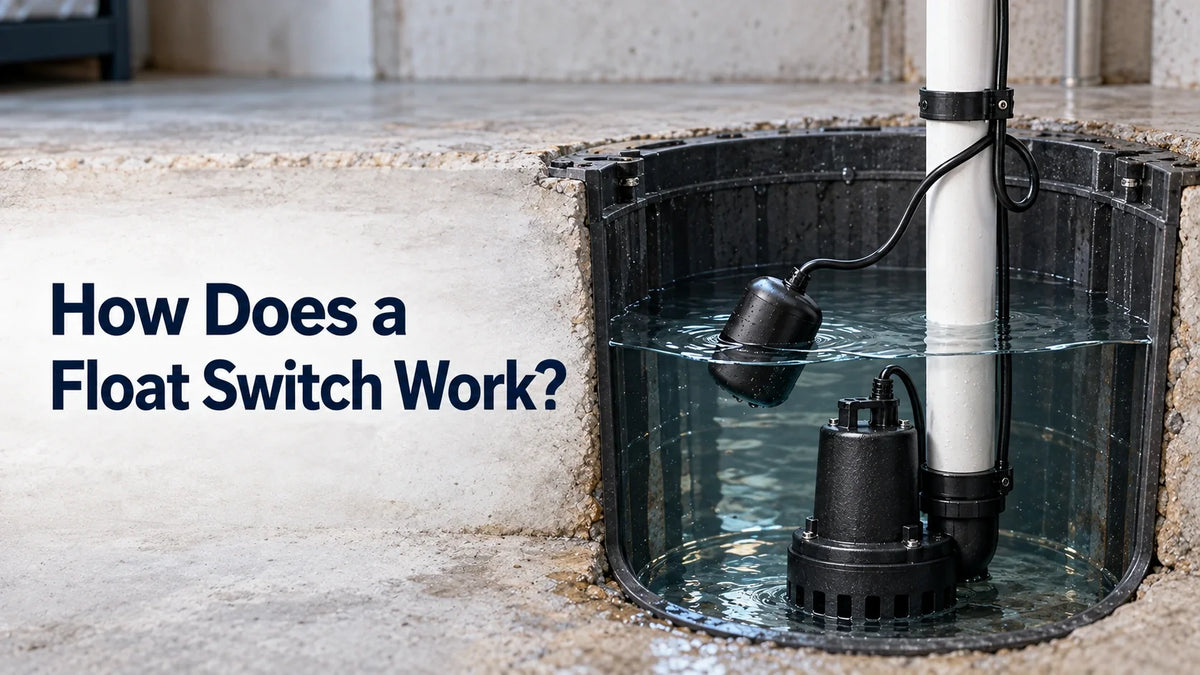
A float switch uses a rising or falling liquid level to turn a pump on or off. In a sump pit, water lifts the float until the switch starts the pump. As the pump empties the pit, the float drops and the switch stops it. The float moves with the water; an electrical contact inside the switch responds to that movement.
Depending on its rating, the switch can power a pump directly or signal a control panel.
How Does a Float Switch Turn a Sump Pump On And Off?
Here is one complete cycle for a pump that empties a pit. This is called pump-down operation.
- Water is low. The float is down, and the pump is off.
- Water reaches the ON level. The float rises. Its mechanism changes the electrical contacts, starting a properly matched pump or signaling a control panel to start it.
- The pump removes water. The float follows the falling water. The pump keeps running until the float reaches its lower switching position.
- Water reaches the OFF level. The contacts change again, and the pump stops. It starts another cycle when the pit refills.
The distance between the ON and OFF levels is the pumping range or differential. If the levels are too close for the pit and incoming water, the pump may start and stop too often. This is called short cycling. The pump must also stop before the water drops below its required operating level.
One float can provide both switching positions. Other systems use separate floats with a relay or controller. Check your arrangement before adjusting the levels.
What Is Inside a Float Switch?
A mechanical float switch has a buoyant float, electrical contacts, and a mechanism that connects the float's movement to those contacts. Liquid lifts the float. Depending on the design, the housing may tilt, the float may move a lift rod, or a magnet may pass a sealed reed contact.
Different Types of Float Switches
The clearest difference between common pump switch designs is how the float moves. A tethered float swings; a vertical float moves along a rod or stem.
How does a tethered float switch work?
A cable anchors the float to a pipe or bracket and leaves it room to swing. As the water rises, the housing tilts. In a pump-down setup, the switch starts the pump at the upper position and stops it after the float drops to the lower position. In SJE's PumpMaster design, a steel ball rolls inside the housing to change the contacts. Other tethered switches can use different mechanisms.
On some models, changing the free cable length changes the distance between the ON and OFF levels. The SJE PumpMaster Plus has an adjustable pumping range of 7 to 36 inches. That range is specific to this model. Leave enough space for the float to swing without touching the pump, pipe, or pit wall.
How does a vertical float switch work?
A vertical float moves up and down a rod or stem as the water level changes. In a mechanical design, it moves a lift rod that operates the contacts. In a magnetic design, a magnet in the float passes a sealed reed switch inside the stem. These are different mechanisms, so check the model when choosing a replacement.
The SJE VerticalMaster 3 Plus is a mechanically activated, pump-down example. It mounts to a discharge pipe with a bracket. Rising water lifts its float and starts the pump; falling water lowers it to the OFF point. Its straight movement suits a tight sump pit, provided the float can travel freely past nearby equipment and debris.

How does a horizontal float switch work?
A horizontal float switch mounts through the side of a tank. Its float extends into the liquid on a hinged arm and pivots as the level rises or falls. At a set position, that movement changes an electrical contact. This design needs a suitable side-wall mounting point and enough room inside the tank for the arm to move. Check the model's mounting position, liquid compatibility, and electrical rating before selecting one.

Which Design Fits Your Tank or Pit?
Start with the space available for the float to move.
| Design | Movement | Practical fit |
|---|---|---|
| Tethered float | Swings around the point where its cable is fixed. | A pit with enough open space for the float to swing freely. |
| Vertical float | Travels up and down on a rod or stem. | A narrower pit where a swinging float could hit a wall or pipe. |
| Horizontal float | Pivots on an arm from the tank wall. | A tank with a suitable side mount and clear space for the arm. |
How Does an Electronic Float Switch Work?
Some products sold as electronic float switches have no moving float. A sensor detects the liquid level, and a controller operates the pump.
Electronic level controls can use different methods. Conductive probes detect contact with a suitable liquid. Capacitive sensors detect changes in electrical properties near a probe. A pressure sensor measures the pressure of the liquid above it and sends a level signal to a compatible panel. Each method has different liquid and controller requirements.
Some controllers stop the pump at a lower sensor; others use a timed run. Before replacing a mechanical float, check both what starts the pump and what stops it.
Can a Float Switch Fill a Tank Instead of Emptying One?
Yes. A pump-up switch starts the pump when the liquid falls to a low level and stops it when the tank is full. A pump-down switch does the opposite job: it starts when liquid rises and empties the basin.
Normally open (NO) and normally closed (NC) describe the contacts in a defined position. For SJE's tethered floats, NO is open when the float hangs down; NC is closed. An SPDT switch offers two contact paths. Check the model's diagram for its pump-up or pump-down behavior.
Cleanflow's 2-wire versus 3-wire float switch guide covers the wiring terms.
How Does a Float Switch Connect to a Pump?
A switch can control pump power or send a signal to another device. Common connections include:
- Piggyback plug: The switch plugs into the correct outlet, and the compatible pump plugs into the switch. A pump-rated switch then controls power to the pump.
- Direct wiring: A properly rated pump switch is wired into the pump circuit according to its instructions. A qualified person should handle electrical installation and service.
- Control panel: The float sends a signal to a panel. A relay or contactor in the system can then start the pump, or the panel can activate an alarm.
The plug or wire count does not tell you how much electrical load the switch can handle. Check voltage, horsepower, running current, and starting current. A switch made for a panel signal may not carry a motor load. A motor-rated switch may not work reliably with a very small panel signal.
Why Might a Float Switch Stop Working?
First, check whether the float can move. A tethered float can catch on a wall, pipe, or cable. Debris can block a vertical float. Water entering the pit can push against a poorly placed float, and ON and OFF points that are too close can cause frequent starts.
A damaged cable, wrong switch type, or electrical mismatch can also cause trouble. If the pump does not start, keeps running, or cycles rapidly, check float movement against the model's instructions. Disconnect power before handling the equipment. Have a qualified person check electrical faults.
Where Are Float Switches Used?
They can empty sumps and sewage pits, refill storage tanks, or trigger high and low water alarms. Several floats can send separate start, stop, and alarm signals to a panel. Each switch must be rated for the liquid it touches and the electrical job it performs.
Is a Float Switch The Same As a Float Valve?
No. A float switch changes an electrical contact or signal. A float valve uses a float to open or close the flow of liquid mechanically. It does not, by itself, send an electrical signal to a pump.
Choosing The Right Float Switch
Decide whether the pump needs to empty a basin or fill a tank. Then check the room available for the float, the required ON and OFF levels, the liquid, and whether the switch will run the pump directly or connect to a panel. A switch designed for water may not float properly in a liquid with a different density or tolerate every chemical. Match its electrical ratings to the pump and keep the OFF level within the pump's operating requirements.
Once those details are clear, browse Cleanflow's float switches and accessories for an appropriate design.