

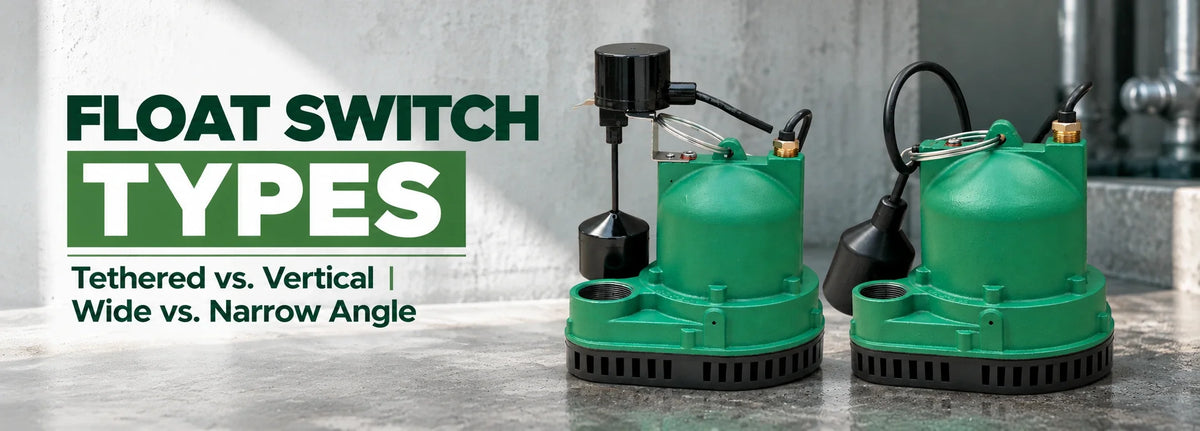
A float switch can be in working order and still fail to control a pump if it cannot move freely. A tethered float needs space to swing. A vertical float needs a clear path along its guide. That physical fit is the first difference to check.
For a narrow or crowded sump pit, a vertical float is often the better fit. A tethered float suits a basin with enough open space for its full swing, especially when the pump needs a wider difference between its start and stop levels. Neither choice is complete until you check what the switch does electrically.
The terms wide angle and narrow angle answer a different question. They describe how a tilting float responds as it rises and falls. A narrow-angle float may still be tethered, and its electrical contacts may only be intended to signal a control panel or alarm.
Tethered vs. Vertical Float Switches
| Feature | Tethered | Vertical |
|---|---|---|
| How it moves | Hangs from an anchored cable and tips as the liquid level changes | Rises and falls along a rod or guide |
| Space it needs | A clear arc around the float | Less side clearance, with an unobstructed path along the guide |
| Start and stop levels | Often adjustable through the free tether length | Can be adjustable, usually across a shorter range; check the specific design |
| What can interfere | Pit wall, pump, discharge pipe, other cords, or debris | Debris or another obstruction along the float's travel |

How Does a Tethered Float Work?
The cable is secured to a pipe, bracket, or weight. The portion between that anchor point and the float is the tether. As the liquid rises, the float lifts and tips around the anchor. Its internal switch changes state at a certain position. It changes back as the liquid falls.
On an adjustable pump switch, a longer free tether generally increases the difference between the water levels where the pump starts and stops. It also makes the float sweep through more space. The total cable length on a product listing tells you how far the switch can reach; it is not the free tether length that sets the on/off range. The PumpMaster Plus illustrates this: its pumping range is adjustable from 7 to 36 inches, depending on tether setting.
Check the float at both ends of its movement. It must be able to rise, tip, and return without catching on the pump body, pit wall, discharge pipe, power cord, or a backup pump.
How does a vertical float work?
A vertical float moves up and down on a guide instead of swinging across the pit. This can solve a clearance problem when a tethered float would touch the wall or nearby equipment. The guide and float still need room to move through their full travel.
Vertical switches often provide a shorter distance between pump start and stop levels, but that distance is not fixed across all designs. Some allow adjustment. Confirm the available range and the resulting water levels for the switch being installed. The VerticalMaster 3 Plus is a pipe-mounted example with an adjustable pumping range of 2 to 6.5 inches.
No basin diameter makes every tethered float suitable or every vertical float necessary. An otherwise wide pit may be crowded by a backup pump and piping. A narrower pit may accommodate a particular switch arrangement. Use the dimensions and clearance requirements for the complete setup.
Wide Angle vs. Narrow Angle: What Changes?
Angle describes how far a tilting float must move before its contacts change state. It does not describe a vertical float moving along a rod, and it does not tell you whether a switch can carry a pump motor's electrical load.
A wide-angle float requires a larger change in position. When designed for direct pump control, it can provide separation between the water levels where one float turns the pump on and off. The actual pumping range depends on the switch and how its tether is set.
A narrow-angle float changes state with a smaller tilt around the horizontal position. It is commonly used to signal that water has reached a particular point, such as a pump start level, low-water stop level, or high-water alarm level. These floats are often connected to a control panel rather than directly to a pump motor. The SignalMaster is a narrow-angle control float for a panel or alarm, not a direct motor switch.
Both wide- and narrow-angle floats can hang from cables. A narrow-angle float still needs room to move. Some wide-angle floats are control switches, too. Read the switch's electrical rating and intended use instead of treating its angle as proof that it can run a pump.

Pump Switch vs. Control Switch
A pump switch directly opens and closes the circuit supplying a compatible pump. It must be rated for the pump's voltage, horsepower, running current, and starting current. The starting load matters because a motor can draw more current when it first turns on.
A control switch sends a signal to a panel, relay, or alarm. The control equipment handles the pump circuit separately. A control float's contact rating alone does not establish that it can switch a motor directly.
This distinction also explains why a narrow-angle float does not automatically cause short cycling. A panel can use one control float at an upper start level and another at a lower stop level. The distance between those two positions sets the operating range, while the panel maintains the pump's run between them.
Piggyback and hardwired describe connections, not float mechanisms. In a piggyback arrangement, the pump plugs into the switch plug; a hardwired switch connects through the appropriate circuit or panel. Pump-down and pump-up describe whether the pump empties or fills a container. For a closer look at those electrical arrangements, see two-wire versus three-wire float switches.
Why Do Some Pumps Short Cycle?
Pumping range is the vertical difference between the pump's ON and OFF water levels. The amount of water between those levels depends on the basin's width as well as the range. That is why the same switch setting can produce different cycling patterns in two pits.
For an empty cylindrical basin, a six-inch change in level represents about 2.9 US gallons in a 12-inch-diameter pit. In an 18-inch-diameter pit, it represents about 6.6 US gallons. A real installation has less usable volume where the pump and piping occupy space. These figures illustrate volume, not a promised run time or number of starts per hour.
A wider operating range can reduce frequent starts if there is enough safe depth. The pump must stop at an acceptable water level and start before the pit reaches its alarm or overflow level. Extending a tether until it catches on the wall creates another problem. Water returning through the discharge line because of a missing or faulty check valve can also make a pump start repeatedly, even when the float range is suitable.
How to Choose the Right Float Switch
- Check its path of movement. Look beyond the pit diameter. Account for the pump, discharge pipe, cords, debris, and any backup equipment. Make sure the float can complete its movement in both directions.
- Mark the safe ON and OFF levels. Check the pump's required stopping level and the highest acceptable starting level. The switch must operate within that space.
- Identify the electrical job. Is the float supplying power to the motor, or signaling a panel or alarm? For direct pump control, match the voltage and motor ratings, including running and starting current.
- Match the rest of the system. Check whether the existing switch is separate or built into the pump. Confirm pump-down or pump-up operation, plug or hardwired connection, and suitability for the liquid and temperature. A switch intended for sump or sewage water is not automatically suitable for drinking water.
A tethered switch is suitable only if it moves freely at a tether setting that gives acceptable ON and OFF levels. A vertical switch saves side clearance, but its operating range must still suit the basin and pump.

Sump Pumps for Narrow and Open Pits
If you are replacing the whole pump, these two 3/10 HP models show how the float design affects where the pump can fit:
- For a narrow pit: The Hydromatic VA1-10 has a vertical float and a listed minimum basin diameter of 12 inches. Its guided travel uses less side space, but the float still needs a clear path beside the pump and piping.

For a pit with room to swing: The Hydromatic WA1-10 has a wide-angle tethered float and a listed minimum basin diameter of 18 inches. Check the full sweep of the float and the resulting start and stop levels before choosing it.

Those minimum diameters apply to these models, not to every vertical or tethered switch. The pump must also meet the installation's flow and head requirements. For a closer look at how the two models differ, read the VA1-10 vs. WA1-10 comparison.
You can compare other complete units in the sump pumps collection. If the pump itself is sound and you need a separate switch, browse float switches and accessories with the clearance, electrical rating, and connection checks above in mind.
Frequently Asked Questions
Which is better, a tethered or vertical float switch?
A vertical switch fits a crowded pit more easily. A tethered switch is useful when it has room to swing, and the pump needs a wider start-to-stop range.
What is the difference between wide-angle and narrow-angle float switches?
A wide-angle float needs more tilt to change state. A narrow-angle float responds to a smaller tilt and is often used as a level signal for a control panel or alarm.
Can you adjust a vertical float switch?
Some models allow you to change their ON and OFF range; others have fixed settings. Check the specific switch's adjustment instructions.
Can you replace a float switch without replacing the pump?
Often, yes, if the switch is a separate, replaceable part and the pump still works. Check the pump's design and match the replacement switch to its electrical requirements.